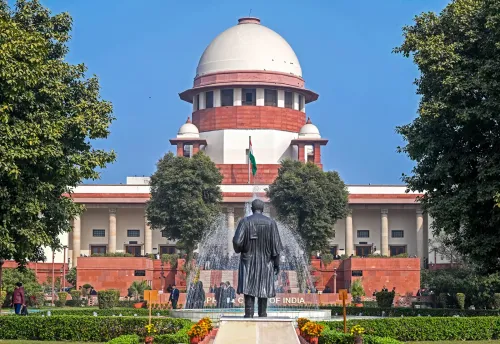
Supreme Court uses Article 142 to acquit POCSO convict after victim marries him
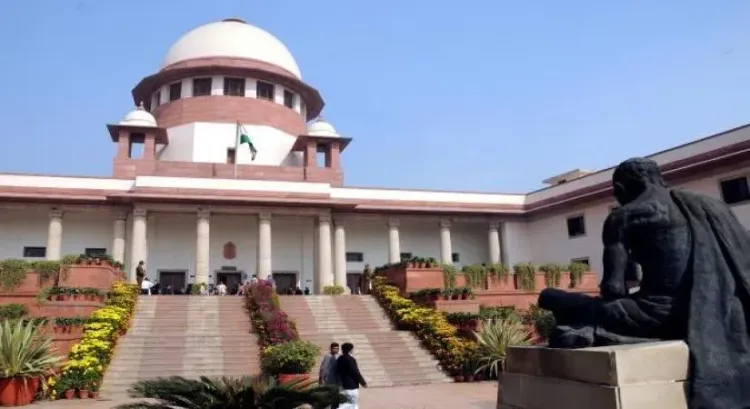
Synopsis
The Supreme Court has used its rare Article 142 powers to acquit a man convicted under POCSO — after the victim married him in December 2024 and sought closure. The bench stressed twice that the order sets no precedent, but the ruling reignites a charged debate about whether post-conviction marriages can or should influence child sexual offence cases.
Key Takeaways
The Supreme Court invoked Article 142 of the Constitution to set aside the POCSO conviction of Maruthupandi , a Tamil Nadu resident.
A Fast Track Mahila Court in Dharmapuri had convicted him in April 2019 , sentencing him to 10 years' imprisonment under the POCSO Act.
The victim married Maruthupandi on 5 December 2024 after both attained majority, and confirmed receiving ₹10 lakh in settlement.
The bench of Justice J.K.
Maheshwari and Justice Atul S.
Chandurkar explicitly stated the order will not serve as a precedent .
The Tamil Nadu government raised no objection to the acquittal, also requesting it not be treated as a precedent.
Child rights advocates warn the ruling could be misused despite the court's non-precedent caution.
The Supreme Court of India has invoked its extraordinary powers under Article 142 of the Constitution to set aside the conviction of a Tamil Nadu man sentenced under the Protection of Children from Sexual Offences (POCSO) Act, after taking note of subsequent developments — including his marriage to the victim following both parties attaining majority and a mutual settlement between them. The order was passed on 8 June by a bench of Justice J.K. Maheshwari and Justice Atul S. Chandurkar.
Background of the Case
The case originated from a complaint filed by the victim alleging that the accused, Maruthupandi, a resident of Tamil Nadu, had repeatedly engaged in sexual intercourse with her on a promise of marriage while she was a minor. A Fast Track Mahila Court in Dharmapuri convicted Maruthupandi in April 2019 under Section 5(1) read with Section 6 of the POCSO Act, sentencing him to 10 years' imprisonment along with a fine.
During the pendency of his appeal before the Madras High Court, the victim sought permission to place additional evidence on record, stating that she and the accused had resolved their differences and wished to live together. The Madras High Court rejected this plea, following which Maruthupandi approached the Supreme Court.
Key Developments Before the Apex Court
The Supreme Court directed that the victim's statement be recorded before a magistrate under Section 164 of the Code of Criminal Procedure. In her statement recorded in December 2022, the victim confirmed that the accused had sexual relations with her when she was a minor and that she had filed the complaint after he refused to marry her.
However, in a subsequent statement recorded in February 2025, she disclosed that after a failed marriage with another person, she had married Maruthupandi on 5 December 2024 and was living with him. The accused also paid ₹10 lakh to the victim towards securing her future and family life, which she confirmed receiving in full.
What the Court Said
The bench, led by Justice Maheshwari, recorded the victim's statement confirming receipt of ₹10,00,000 and her wish to end the litigation. The court noted: 'She has specifically admitted that she has received the amount of Rs 10,00,000/- and she wishes to put a quietus to this litigation. It is specifically stated by her that in case the conviction of the appellant is set aside, she has no objection.'
The Tamil Nadu government also informed the apex court that it had no objection to setting aside the conviction, given the peculiar factual circumstances, while requesting the order not be treated as a precedent.
Exercising its plenary powers under Article 142, the bench stated: 'Therefore, at this stage, without entering into the merits of the case, in the peculiar facts, as narrated above, we deem it appropriate to exercise our plenary power under Article 142 of the Constitution for setting aside the judgment of conviction and sentence of the appellant.'
Acquittal and Its Limits
The Supreme Court allowed Maruthupandi's appeal and acquitted him, directing that he and the victim be 'left free to live their life peacefully in society as spouses.' Since his sentence had already been suspended by the Madras High Court in 2019, the court said he need not surrender and discharged his bail bonds.
Critically, the bench issued an explicit caution: 'We make it clear that the present order has been passed in the peculiar facts of the case, therefore, it will not be treated as a precedent for any other purpose.' The court repeated this non-precedent clarification twice in its order, signalling awareness of the legal sensitivity surrounding POCSO matters.
Legal Significance and Concerns
The use of Article 142 in POCSO cases remains legally contentious. Critics and child rights advocates argue that allowing post-facto marriages to influence POCSO convictions — even in one-off rulings — risks creating a perverse incentive that could be exploited in future cases, regardless of the court's non-precedent caveat. Notably, this is not the first time the Supreme Court has faced pressure to balance the rigid protections of the POCSO Act against changed ground realities between parties after they attain adulthood.
The judgment underscores the tension between the letter of child protection law and the equitable jurisdiction the Constitution vests in the apex court — a tension that is unlikely to be resolved by a single non-precedent order.
Point of View
But 'exceptional' is precisely what makes it exploitable: every future accused whose victim is pressured into marriage will cite these 'peculiar facts.' The POCSO Act was designed to be prosecution-proof against post-offence settlements for good reason — child sexual abuse does not become retroactively consensual because the parties later marry. The deeper question the court sidestepped is whether ₹10 lakh and a subsequent marriage genuinely reflect the victim's free will, or whether they are the product of the same power asymmetry that enabled the original offence. A non-precedent order that acquits is still an acquittal on the record — and that signal will travel further than the bench intended.
NationPress
24 Oct 2026
Frequently Asked Questions
Why did the Supreme Court acquit a POCSO convict in this case?
The Supreme Court acquitted Maruthupandi by invoking Article 142 of the Constitution, citing the victim's subsequent marriage to him on 5 December 2024 after both attained majority, her receipt of ₹10 lakh in settlement, and her stated wish to end the litigation. The court stressed the ruling was based on the peculiar facts of this case alone.
What is Article 142 of the Constitution and why was it used here?
Article 142 grants the Supreme Court plenary powers to pass any order necessary to ensure 'complete justice' in a case before it. The court used this provision because the changed ground reality — including the victim's marriage to the convict and her desire to close the case — fell outside the normal appellate framework.
Does this Supreme Court order set a precedent for other POCSO cases?
No. The bench explicitly clarified twice that the order 'will not be treated as a precedent for any other purpose.' However, legal experts and child rights advocates have cautioned that the ruling could still be cited in future cases despite this caveat.
What was the original conviction and sentence in this case?
A Fast Track Mahila Court in Dharmapuri, Tamil Nadu convicted Maruthupandi in April 2019 under Section 5(1) read with Section 6 of the POCSO Act and sentenced him to 10 years' imprisonment along with a fine. The Madras High Court had suspended his sentence in 2019 pending appeal.
What did the victim say before the Supreme Court?
In a statement recorded in February 2025, the victim disclosed she had married Maruthupandi on 5 December 2024 after a failed earlier marriage, confirmed receiving ₹10 lakh from him, and stated she wished to end the litigation and had no objection to his conviction being set aside.