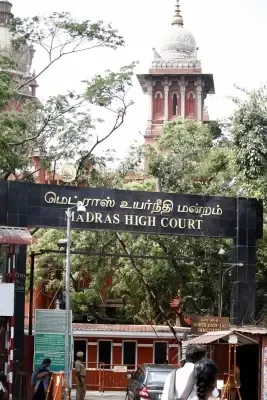
Madras HC orders 2-month trial deadline for sexual offence cases in Tamil Nadu
Synopsis
The Madras High Court has issued a sweeping directive to all Tamil Nadu courts to wrap up sexual offence trials within two months — and POCSO cases within one year — backed by a mandatory monitoring mechanism and judicial training mandate. It is a direct rebuke to a system where delays have routinely denied justice to survivors, especially children.
Key Takeaways
The Madras High Court has directed all Tamil Nadu courts to complete sexual offence trials within two months of charge sheet filing, per Section 346(1) of the BNSS .
Adjournments are permissible only in truly exceptional circumstances, which must be recorded in writing .
A 2024 circular to special POCSO courts has been ordered to be reissued, mandating child victim evidence within 30 days and trial completion within one year .
Every POCSO case must be heard exclusively by a Special Court constituted under Section 28 of the POCSO Act .
The High Court's monitoring committee will obtain periodic compliance reports from every district on trial progress and delays.
The Tamil Nadu State Judicial Academy has been directed to conduct regular training for POCSO court judges on child-sensitive procedures.
The Madras High Court has directed all courts across Tamil Nadu handling sexual offence cases to complete trials within two months, warning that adjournments must not be granted unless truly exceptional circumstances exist — and those reasons must be recorded in writing. The order, issued on 29 July, reinforces statutory timelines that courts have frequently failed to meet.
Key Directions Issued
A division bench comprising Chief Justice Sushrut Arvind Dharmadhikari and Justice G. Arul Murugan issued the directives while reiterating timelines prescribed under the Bharatiya Nagarik Suraksha Sanhita (BNSS) and the Protection of Children from Sexual Offences (POCSO) Act. The bench specifically invoked Section 346(1) of the BNSS, which mandates trial completion within two months of the filing of a police charge sheet.
The Registrar General of the Madras High Court has been directed to circulate fresh instructions to all district and sessions courts in the state, reminding them of this mandatory statutory requirement.
Special Focus on POCSO Cases
The bench also ordered the reissue of a 2024 circular addressed to all special POCSO courts, directing presiding officers to record the evidence of child victims within 30 days of taking cognisance and to complete trials within one year, as mandated under Section 35(2) of the POCSO Act. The court stressed that every POCSO case must be heard only by a duly constituted Special Court under Section 28 of the POCSO Act — a requirement that, notably, has not always been uniformly followed across the state.
The Tamil Nadu government and the High Court Registrar General were jointly directed to ensure compliance with this requirement going forward.
Monitoring and Compliance Mechanism
To enforce these directions, the High Court has tasked its committee constituted for monitoring Juvenile Justice Act and POCSO cases with closely supervising trial progress in every district. The committee must obtain periodic compliance reports detailing the date of cognisance, the current stage of each trial, and specific reasons for any delay beyond the prescribed statutory period.
This comes amid longstanding concerns that survivors of sexual offences — particularly children — face prolonged legal proceedings that compound trauma and erode the prospect of justice.
Judicial Training Mandated
The Tamil Nadu State Judicial Academy has been directed to organise periodic training programmes for judges presiding over POCSO courts. Sessions will cover child-friendly procedures, the prompt taking of cognisance of electronically filed charge sheets, mandatory evidence recording within 30 days, and the obligation to conclude trials within one year. Presiding officers of these courts will also receive regular training in child-sensitive judicial procedures.
With a structured monitoring committee, mandatory training, and fresh circulars now in the pipeline, the effectiveness of these directions will hinge on how consistently the state's district courts translate them into practice.
Point of View
Including the 2024 one now being reissued. Reissuing a circular that did not fully work the first time, without structural changes to caseloads or judicial vacancies, risks producing the same outcome. The court would do well to also direct a public pendency audit.
NationPress
14 Sept 2026
Frequently Asked Questions
What has the Madras High Court ordered regarding sexual offence trials?
The Madras High Court has directed all courts in Tamil Nadu to complete sexual offence trials within two months of the filing of a police charge sheet, as mandated under Section 346(1) of the BNSS. Adjournments can be granted only in truly exceptional circumstances, which must be recorded in writing.
What are the specific directions for POCSO cases?
For POCSO cases, courts have been directed to record the evidence of child victims within 30 days of taking cognisance and to complete trials within one year under Section 35(2) of the POCSO Act. Every such case must be heard by a Special Court constituted under Section 28 of the POCSO Act.
How will compliance with these directions be monitored?
The High Court's existing committee for monitoring Juvenile Justice Act and POCSO cases will supervise trial progress across all districts. It will obtain periodic compliance reports covering the date of cognisance, the current trial stage, and specific reasons for any delay beyond the statutory period.
What training has been mandated for POCSO court judges?
The Tamil Nadu State Judicial Academy has been directed to organise periodic training programmes covering child-friendly procedures, prompt cognisance of electronically filed charge sheets, mandatory 30-day evidence recording, and the one-year trial completion obligation under the POCSO Act.
Why did the Madras High Court issue these directions?
The court stressed that strict adherence to statutory timelines is essential to ensure timely justice for survivors of sexual offences, particularly children. The directions come amid longstanding concerns over prolonged trials that compound trauma and delay accountability.