Oil price surge at $107-$108: Why India is bufferred but not immune

Synopsis
Brent crude has surged to $107–$108, but India's record $785.7 billion in forex reserves and a low 0.8% CAD mean the country is buffered — for now. The real danger lies in a sustained spike above $100, which analysts warn could blow out the current account deficit to 2.2% of GDP and force a brutal choice between inflation and fiscal discipline.
Key Takeaways
Brent crude is trading at $107–$108 per barrel amid rising West Asia tensions, but analysts say this is not yet a macro crisis for India.
India's forex reserves hit a record $785.7 billion for the week ended 4 September , after a $44.9 billion addition, per RBI data.
India imported 88.6% of its crude oil requirement in April–January FY26 , leaving it vulnerable to sustained price increases.
A $10-per-barrel oil rise can add 49 basis points to headline inflation or 43 basis points to the fiscal deficit if the government absorbs the shock.
A sustained $100-per-barrel average could widen India's FY27 CAD to 1.9%–2.2% of GDP , up from a projected 0.7%–0.8% .
Upstream producers ONGC and Oil India stand to gain; airlines , logistics , cement , and consumer companies face margin compression.
The surge in crude oil prices driven by escalating West Asia tensions is a legitimate concern for India, but the scale of its economic damage will hinge on whether the price spike proves brief or prolonged — and, critically, whether it disrupts physical oil supply routes, market analysts said on Monday, 14 September 2026. With Brent crude trading at $107–$108 per barrel, experts say the situation does not yet constitute a macro crisis, given India's current economic buffers.
India's Buffers: Low Inflation, Record Forex Reserves
India enters this period of oil-price stress from a relatively stable macroeconomic position. The country's current account deficit (CAD) stood at a manageable 0.8% of GDP in the first half of FY26, and headline inflation remains comparatively subdued. More significantly, India's foreign-exchange reserves reached a record $785.7 billion for the week ended 4 September, after adding $44.9 billion, according to the latest data from the Reserve Bank of India (RBI). These buffers collectively give policymakers meaningful room to absorb near-term shocks.
The Tipping Point: What Sustained High Oil Prices Would Mean
'Yet, if oil remains above $100 for several months, or shipping through West Asia is disrupted, the growth-inflation trade-off would significantly worsen,' said Dr. Manoranjan Sharma, Chief Economist at Infomerics Ratings.
India imported 88.6% of its crude oil requirement during April–January FY26, leaving the economy acutely exposed to a surging dollar-denominated oil bill. Research from the RBI estimates that a $10-per-barrel rise in oil prices can add roughly 49 basis points to headline inflation. Alternatively, if the government opts to absorb the shock rather than pass it on, the fiscal deficit could widen by 43 basis points.
The Policy Dilemma: Pass-Through or Absorption?
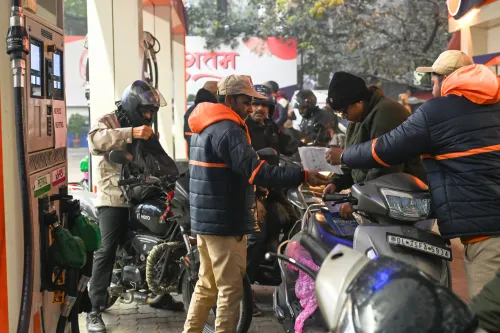
This dynamic creates a difficult policy trade-off for New Delhi. Passing on the price increase to consumers — through higher petrol, diesel, and LPG prices — pushes up transport, food, and manufactured-goods costs, ultimately squeezing household real incomes and dampening consumption demand. On the other hand, absorbing the shock through excise duty cuts or fuel subsidies temporarily shields inflation but strains fiscal arithmetic and puts pressure on oil marketing companies (OMCs).
According to analysts, an average crude price of $100 per barrel could widen India's FY27 CAD to between 1.9% and 2.2% of GDP, sharply up from a projected 0.7%–0.8%. This would mark a significant deterioration in the external balance within a single fiscal year.
Sector-Level Impact: Winners and Losers
Higher crude prices compress margins across a wide swathe of industries, including airlines, paints, chemicals, logistics, cement, consumer goods companies, and downstream oil marketers — particularly where retail prices remain administratively controlled.
Selective upstream producers, however, stand to benefit. ONGC and Oil India would gain from higher realisations on their crude output. Refiners may also benefit, but only if product cracks and pricing freedom are sufficient to offset elevated feedstock costs. Notably, analysts point to renewable energy, electric mobility, and domestic gas themes as sectors that could attract longer-term investor interest as the geopolitical premium on oil persists.
What to Watch
The trajectory of West Asia tensions and any disruption to key shipping lanes — particularly the Strait of Hormuz — will be the decisive variable. If the oil price spike proves transient, India's existing buffers should contain the damage. If it is sustained above $100 per barrel for multiple quarters, the government will face increasingly hard choices between growth, inflation, and fiscal consolidation.
Point of View
But they are not infinite shock absorbers. The more revealing question is one that analysts are skating around: at what oil price does the government blink and pass costs to consumers? Every month of suppressed retail fuel prices is a subsidy the government is quietly running. If Brent holds above $100 into the second half of FY27, the RBI's monetary policy calculus becomes deeply complicated — cutting rates to support growth while inflation re-accelerates is not a comfortable position. The renewable energy and EV pivot being flagged as a silver lining is structurally correct but operationally years away from mattering at scale. India's 88.6% import dependence is a structural vulnerability, not a cyclical one, and no amount of forex reserves changes that fundamental exposure.
NationPress
14 Sept 2026
Frequently Asked Questions
Is the crude oil price surge a macro crisis for India?
Not yet, according to market analysts. With Brent crude at $107–$108 per barrel, India's low headline inflation, a CAD of 0.8% of GDP in H1 FY26, and record forex reserves of $785.7 billion provide meaningful near-term buffers. However, a sustained spell above $100 per barrel could materially worsen the growth-inflation trade-off.
How much crude oil does India import, and why does it matter?
India imported 88.6% of its crude oil requirement during April–January FY26, making it heavily dependent on global oil markets. This high import dependence means any sustained price rise directly inflates India's dollar oil bill, widens the current account deficit, and pressures the rupee.
What happens to India's inflation if oil prices stay elevated?
RBI research estimates that a $10-per-barrel rise in oil prices adds roughly 49 basis points to headline inflation if costs are passed on to consumers. If the government absorbs the shock instead — through excise cuts or subsidies — the fiscal deficit could widen by 43 basis points.
Which Indian sectors are most affected by higher crude prices?
Airlines, paints, chemicals, logistics, cement, consumer goods companies, and downstream oil marketing companies face the most margin pressure when crude prices rise and retail prices are controlled. Upstream producers like ONGC and Oil India, by contrast, benefit from higher realisations.
What would sustained $100-per-barrel oil mean for India's current account deficit?
An average crude price of $100 per barrel could widen India's FY27 current account deficit to 1.9%–2.2% of GDP, according to analysts, compared with a projected 0.7%–0.8%. That would be a sharp deterioration in India's external balance within a single fiscal year.