India Maintains Tax Buffer to Prevent Fuel Price Surge Even at $110 per Barrel

Synopsis
A recent analysis reveals that India can effectively manage crude oil price fluctuations with existing tax buffers, potentially staving off fuel price hikes until prices hit $110 per barrel. This report highlights the significant impact on consumers and the energy sector as crude prices rise.
Key Takeaways
India has a tax buffer to manage fuel prices.
The excise duty can be reduced to maintain prices until $110/bbl.
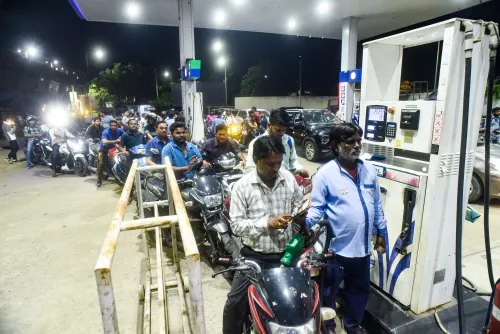
Beyond this point, consumers will likely face price hikes.
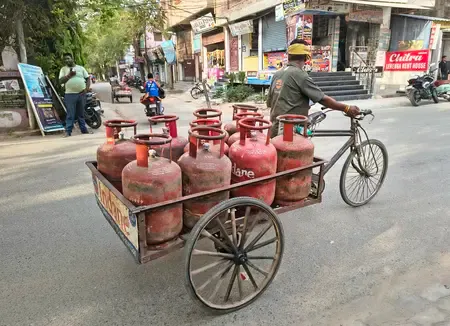
Annual LPG under-recovery is estimated at Rs 328 billion.
GAIL is favored among gas stocks due to lower risk from LNG disruptions.
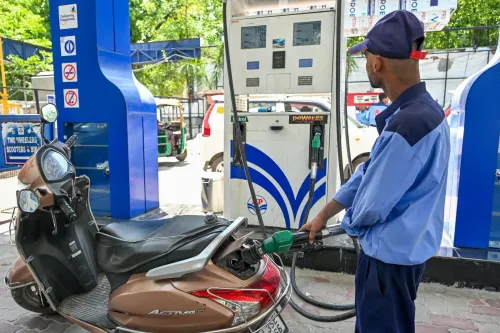
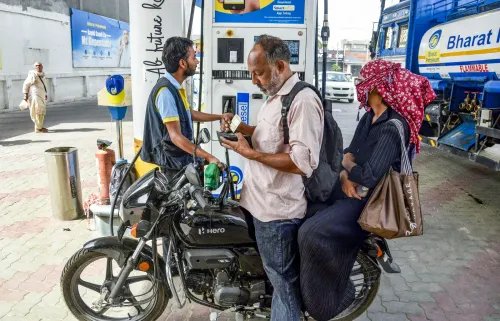
New Delhi, March 15 (NationPress) India possesses a significant tax buffer to mitigate the impact of crude oil price fluctuations. According to a recent report, the excise duties of Rs 19.9 per litre on petrol and Rs 15.8 per litre on diesel can be reduced to maintain retail prices until crude oil reaches approximately $110 per barrel. Elara Capital's report indicates that excise cuts could fully shield retail gasoline and diesel prices until this threshold, beyond which consumers would face unavoidable price hikes.
The analysis suggests that India is capable of withstanding a crude oil shock of $40–45 through tax adjustments. However, once crude prices exceed $110/bbl, the financial responsibility would transition from the government to consumers. For each $10 increase in crude prices, the profit margins for oil marketing companies on diesel and gasoline would decrease by Rs 6.3 per litre, and losses related to LPG would escalate by Rs 10.2 per kg.
This situation implies an annual LPG under-recovery of about Rs 328 billion, as reported. Furthermore, the gross refining margins for oil marketing companies could potentially rise by around $5/bbl with every $10/bbl crude price increase, but this would not completely offset their losses in marketing and LPG.
At the current Brent price of $100/bbl, earnings could plummet drastically, by 90-190%, without retail price adjustments, tax reductions, or increased LPG subsidies. Among oil marketing companies, IOCL stands in a relatively stronger position due to its larger refining share, yet it remains susceptible if crude prices remain elevated while retail prices do not change.
The ongoing US-Iran conflict has altered how the Indian Oil & Gas sector responds to crude price changes. The report highlights that the sensitivity analysis at Brent crude oil prices of $100, $125, and $150 reveals a potential ‘EBITDA swing range’ from a collapse of over 400% for oil marketing companies to a 10-15x expansion for standalone refiners.
Moreover, two-thirds of India’s LNG imports transit through the Hormuz Strait, introducing further supply risks for natural gas. The report recommends that GAIL is in a more advantageous position among gas stocks, suggesting it is a relatively safer investment in the current scenario, as only about 16% of its marketing volumes are tied to Hormuz-linked LNG, significantly lower than many competitors, thus minimizing direct supply disruption risks.
aar/na
Point of View
The current analysis underscores the importance of India's fiscal strategies in the oil sector. While the government has tools to manage consumer prices amidst global fluctuations, the long-term implications of sustained high crude prices may necessitate a reevaluation of energy policies.
NationPress
29 Sept 2026
Frequently Asked Questions
What is the current excise duty on gasoline and diesel in India?
The excise duty on gasoline is Rs 19.9 per litre and Rs 15.8 per litre on diesel.
How much crude price increase can India absorb through taxes?
India can absorb a crude price shock of $40–45 through tax adjustments before consumers face price hikes.
What happens if crude prices exceed $110 per barrel?
If crude prices surpass $110 per barrel, inevitable price hikes for diesel and gasoline will shift the financial burden from the government to consumers.
How does the US-Iran conflict affect India's oil sector?
The US-Iran conflict has changed India's response to crude price changes, with significant implications for oil marketing companies and refiners.
Which gas stock is recommended in the current market?
GAIL is considered to be better positioned among gas stocks, offering a relatively defensive investment due to lower dependence on Hormuz-linked LNG.