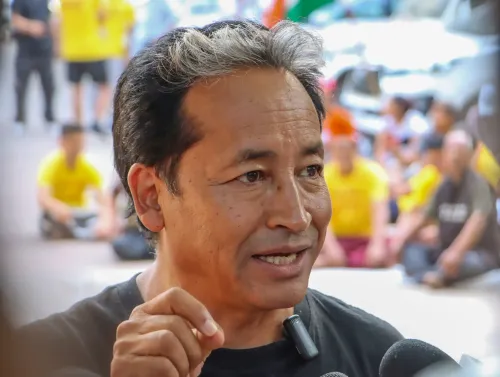
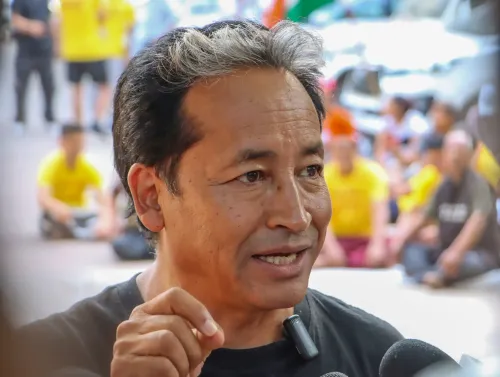
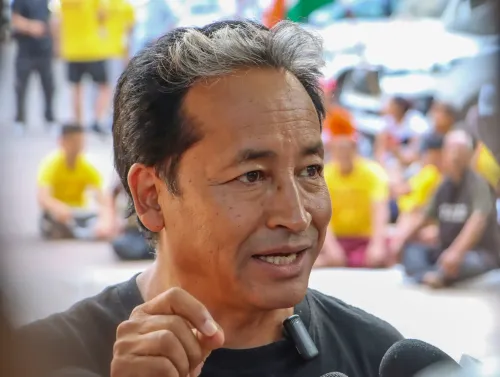
Why Did the SC Postpone Sonam Wangchuk's Detention Challenge?

Synopsis
The Supreme Court has deferred a critical hearing on the detention of climate activist Sonam Wangchuk, raising questions about the legality of his confinement under the National Security Act. This case touches on fundamental rights and the implications of governmental authority in matters of public dissent.
Key Takeaways
Supreme Court defers hearing on Wangchuk's detention.
His wife claims the detention is illegal .
Concerns raised over fundamental rights violations.
Ladakh administration defends the detention citing national security .
The case highlights ongoing tensions between activism and government authority.
New Delhi, Jan 7 (NationPress) The Supreme Court has postponed the hearing regarding a plea submitted by Gitanjali J. Angmo, the spouse of imprisoned Ladakh climate activist Sonam Wangchuk, contesting his detention under the National Security Act (NSA) to January 8.
Angmo's habeas corpus petition, which characterizes Wangchuk's confinement as "illegal" and an "arbitrary exercise infringing upon his fundamental rights," was presented to a Bench comprising Justices Aravind Kumar and P.B. Varale.
During the short hearing, the Justice Aravind Kumar-led Bench acknowledged the petitioner's desire to present a video during the session.
When asked if the other party had been notified, senior advocate Kapil Sibal, representing the petitioner, confirmed that prior notice had been provided.
However, Solicitor General Tushar Mehta, the second-highest legal officer in the country, indicated that he may not attend due to involvement in another ongoing case.
The bench approved the arrangement and scheduled the matter for discussion on Thursday.
Previously, the Supreme Court had allowed Angmo to modify her petition and instructed the Centre, the UT administration, and prison officials to submit additional responses.
"The petitioner is allowed to amend the petition and submit an updated copy within a week. The amended counter must be filed within the following 10 days, with any rejoinder due a week later. The matter is set for November 24," stated the apex court order issued on October 29.
In her revised petition, Angmo asserts that the detention order was issued mechanically, without proper consideration, and that essential procedural safeguards of the NSA were neglected.
She further claims that the authorities acted hastily and failed to provide sufficient grounds for detention in a timely and meaningful way, preventing Wangchuk from making a competent representation.
In its affidavit, the Ladakh administration contends that Wangchuk's detention was justified due to his alleged role in provoking unrest in Leh. They also stated that the grounds for detention were communicated within the legally required timeframe and that the detention advisory board later upheld the decision.
The District Magistrate of Leh noted that the detention order was issued on September 26 after he was "satisfied and continues to be satisfied regarding the detention of the detainee," based on actions deemed "prejudicial to the security of the State, maintenance of public order, and essential community services."
Wangchuk, a well-known environmentalist and education reform advocate, was detained in September and subsequently transferred to Jodhpur Central Jail in Rajasthan.
Point of View
The ongoing legal battle surrounding Sonam Wangchuk's detention highlights the delicate balance between national security and individual rights. The judiciary's role in ensuring that fundamental freedoms are protected is critical in a democratic society. As the case unfolds, it is essential to monitor how the courts interpret the laws governing security and personal liberties.
NationPress
1 Oct 2026
Frequently Asked Questions
What is the National Security Act (NSA)?
The National Security Act (NSA) is a law in India that allows for detention without trial for individuals deemed a threat to national security.
Who is Sonam Wangchuk?
Sonam Wangchuk is a prominent climate activist and education reformer from Ladakh, known for his work in sustainable development and environmental education.
Why is Sonam Wangchuk detained?
He was detained under the NSA, with allegations of inciting unrest in Leh, which the authorities claim poses a threat to public order.
What does a habeas corpus petition entail?
A habeas corpus petition is a legal action through which a person can seek relief from unlawful detention.
What are the implications of this case for activists in India?
The case raises significant concerns regarding the protection of civil liberties and the treatment of dissenting voices in a democratic society.