Will the Supreme Court Uphold the Petition Against Sonam Wangchuk's Detention?
Synopsis
The Supreme Court's continued hearing on Sonam Wangchuk's detention raises crucial questions about legality and human rights. The case draws attention to the balance between national security and individual freedoms, making it a significant legal battle in India. Will justice prevail for the activist, or will the government's stance hold firm?
Key Takeaways
The Supreme Court is reviewing the legality of Sonam Wangchuk's detention.
Concerns about his health have been raised during the hearings.
Wangchuk's wife argues that the detention is an infringement on fundamental rights.
The government defends the detention under the National Security Act.
Legal implications of the case could affect future preventive detentions.
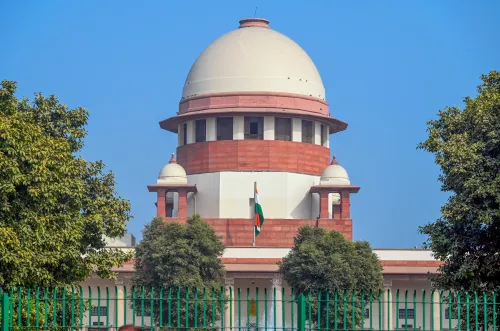
New Delhi, Feb 5 (NationPress) The Supreme Court is set to continue its deliberation on the government's stance regarding the petition challenging the detention of Ladakh-based social activist Sonam Wangchuk under the National Security Act (NSA).
Earlier on Wednesday, the apex court urged the Centre to reconsider the ongoing preventive detention of Wangchuk under the NSA.
A bench comprising Justices Aravind Kumar and P.B. Varale was reviewing a habeas corpus petition submitted by Wangchuk's wife, Dr. Gitanjali Angmo, who described his detention as "illegal" and an "arbitrary exercise infringing upon his fundamental rights".
During the proceedings, Justice Aravind Kumar noted that Wangchuk had been in custody since September 26, 2025, and the medical reports presented indicated that his health was "certainly not very good".
It was proposed to Additional Solicitor General (ASG) K.M. Nataraj that the government should "reconsider" the decision regarding Wangchuk's detention.
In response, ASG Nataraj assured the Supreme Court that he would seek guidance from the relevant authorities.
Defending the detention, he maintained that the NSA is a specialized law designed for preventive purposes.
"The NSA aims to prevent individuals from engaging in activities detrimental to public order or state security. Preventive detention is not a form of punishment. It is based on the discretion of the detaining authority," he expressed, adding that the District Magistrate had issued the order after thoroughly evaluating the evidence presented.
ASG Nataraj argued that Wangchuk's speech on September 24, 2025, was provocative and incited violent protests in Leh, leading to four fatalities and injuries to 161 individuals. He further claimed that while Wangchuk contested the original detention order, he did not challenge the subsequent orders.
However, the Justice Aravind Kumar-led bench suggested that if the basis of the detention order is found to be legally flawed, including a lack of consideration, the subsequent approvals may not be justifiable.
The Supreme Court noted that if the detention order is annulled, all subsequent actions would become void. In a prior session, the bench acknowledged Wangchuk's health issues and directed that a specialist from a government hospital assess him, with the medical report to be submitted in a sealed envelope.
Point of View
It's essential to emphasize that the proceedings surrounding Sonam Wangchuk's detention under the National Security Act reflect the delicate balance between safeguarding national security and upholding individual rights. The Supreme Court's ongoing examination is crucial in ensuring that justice and legal integrity prevail in such sensitive matters.
NationPress
15 Oct 2026
Frequently Asked Questions
What is the reason for Sonam Wangchuk's detention?
Sonam Wangchuk is detained under the National Security Act for allegedly inciting violence with his provocative speeches.
Who filed the habeas corpus petition?
The habeas corpus petition was filed by Wangchuk's wife, Dr. Gitanjali Angmo, claiming the detention is illegal.
What health concerns have been raised about Sonam Wangchuk?
Reports presented during the hearing indicate that Wangchuk's health is not in good condition.
What did the Supreme Court suggest regarding the detention?
The Supreme Court suggested that the government reconsider the continued detention of Wangchuk.
What implications could this case have?
The case could have significant implications for the balance between national security and individual freedoms in India.