Sonia Gandhi slams Modi govt over student protests, exam paper leaks
Synopsis
Sonia Gandhi's column in The Hindu goes well beyond condemning police action — it frames the student protest movement as a constitutional reckoning for the Modi government, linking NTA failures, public education underfunding, and a pattern of suppressing dissent into a single indictment. The article signals that Congress intends to make the education crisis a sustained political front, not just a news cycle.
Key Takeaways
Sonia Gandhi published a column in The Hindu on 24 July criticising the Central government over its handling of student protests linked to examination paper leaks.
She alleged that Delhi Police and CAPFs used lathicharges and tear gas against demonstrators during the 20 July protests in New Delhi .
Gandhi questioned the accountability of the National Testing Agency (NTA) and alleged that parliamentary committee recommendations on reforms had not been implemented.
She argued that declining public investment in education and repeated paper leaks had eroded student trust in competitive examinations.
The Congress leader framed standing with protesting students as a 'moral, political, and constitutional duty.'
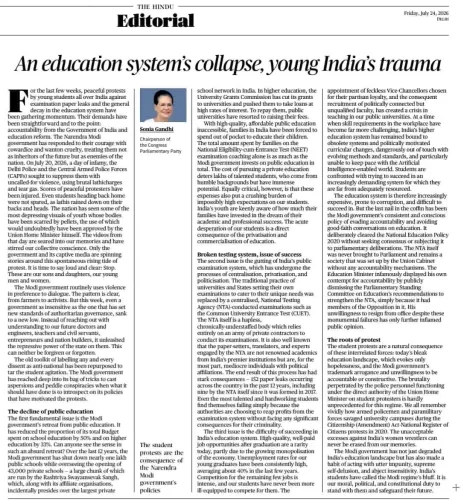
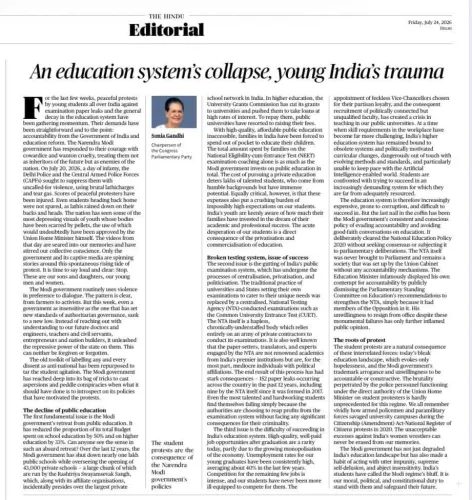
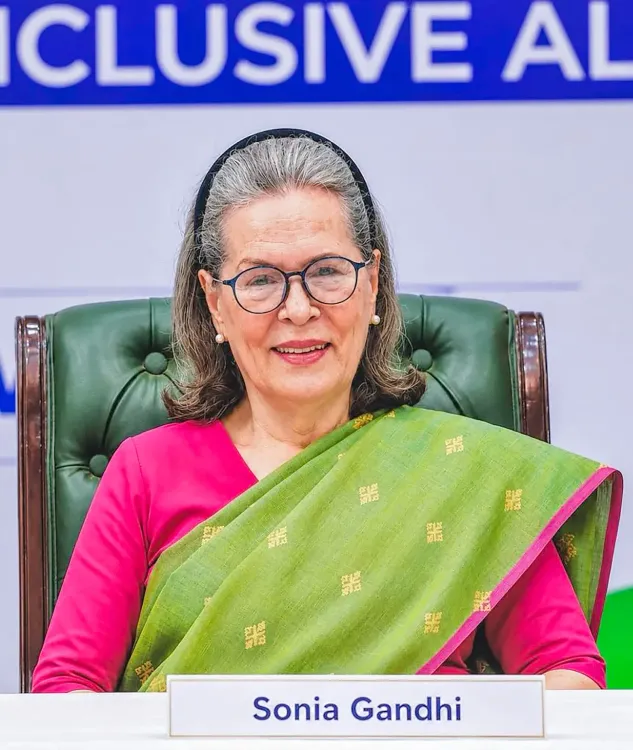
Congress Parliamentary Party (CPP) Chairperson Sonia Gandhi on Friday, 24 July launched a sharp attack on the Central government over its handling of student protests linked to examination paper leaks, alleging that India's education system was in the grip of a deep, structural crisis. Her criticism came through a column published in The Hindu, which the Indian National Congress (INC) shared on its official social media handle.
What Sonia Gandhi Said
In her article titled 'An Education System's Collapse, Young India's Trauma', Gandhi argued that student agitations demanding accountability and examination reforms had gathered momentum across the country. She alleged that the government's response to peaceful dissent had been disproportionate, writing: 'The Narendra Modi government has responded to their courage with cowardice and wanton cruelty, treating them not as inheritors of the future but as enemies of the nation.'
Referring specifically to the 20 July demonstrations in New Delhi, she alleged that security forces resorted to force against protestors. 'The Delhi Police and the Central Armed Police Forces (CAPFs) sought to suppress them with uncalled-for violence, using brutal lathicharges and tear gas,' she wrote.
Allegations Against the NTA and Examination System
Gandhi trained her fire on the National Testing Agency (NTA), questioning its accountability and alleging that reforms recommended by parliamentary committees had not been adequately implemented. She contended that centralisation, privatisation, and politicisation had eroded the integrity of the testing architecture, and that repeated paper leaks had severely damaged students' trust in competitive examinations.
She also raised concerns about declining public investment in education and growing dependence on private institutions, arguing that these trends had compounded the pressure on students and their families — particularly those from economically weaker backgrounds.
Broader Pattern of Dissent, According to Gandhi
The Congress leader drew a wider pattern, alleging that the government's use of force against protestors was not an isolated incident. 'The Modi government routinely uses violence in preference to dialogue. The pattern is clear, from farmers to activists,' she wrote — a reference to earlier episodes of civil unrest, including the 2020-21 farmers' protests.
She also pointed to unemployment, intense competition, and limited opportunities as factors compounding student stress, arguing that young people were being asked to succeed in an increasingly demanding system without adequate institutional support.
The Constitutional Argument
Concluding her column, Gandhi framed solidarity with protesting students as a matter of democratic obligation. 'India's students have called the Modi regime's bluff. It is our moral, political, and constitutional duty to stand with them and safeguard their future,' she wrote.
The Congress separately stated that the government 'has not just degraded India's education landscape but has also made a habit of acting with utter impunity, supreme self-delusion, and abject insensitivity.'
Political Context
This comes amid a continuing national debate over examination paper leaks, student demonstrations, and the government's announcement of stricter legal measures against irregularities in competitive examinations. The controversy around the NTA and alleged irregularities in high-stakes tests such as NEET had already drawn parliamentary scrutiny before Gandhi's article added fresh political weight to the opposition's position. How the ruling Bharatiya Janata Party (BJP) responds to this latest salvo — and whether it offers any new accountability measures — will shape the next phase of this debate.
Point of View
Not just a commentary — by publishing in The Hindu and amplifying it on party channels, Congress is staking a clear claim on the student protest movement ahead of a politically sensitive period. The NTA controversy has genuine public traction, but the opposition's challenge is to sustain it beyond the news cycle. What the article does not address is any concrete alternative policy framework for examination reform, which leaves the critique sharp on diagnosis but thin on prescription. The government, meanwhile, has yet to offer a credible accountability mechanism for the NTA — and that silence is the real vulnerability this article is designed to exploit.
NationPress
22 Oct 2026
Frequently Asked Questions
What did Sonia Gandhi write about the student protests?
Sonia Gandhi, in a column in The Hindu titled 'An Education System's Collapse, Young India's Trauma', alleged that the Modi government responded to student protests over exam paper leaks with 'cowardice and wanton cruelty.' She called for dialogue with students and described solidarity with them as a moral, political, and constitutional duty.
What allegations did Gandhi make against Delhi Police?
Gandhi alleged that Delhi Police and the Central Armed Police Forces (CAPFs) used lathicharges and tear gas against student demonstrators during the 20 July protests in New Delhi. She described the action as 'uncalled-for violence' against peaceful protestors demanding accountability.
What did Sonia Gandhi say about the National Testing Agency (NTA)?
Gandhi questioned the NTA's accountability and alleged that reforms recommended by parliamentary committees had not been adequately addressed. She argued that centralisation, privatisation, and politicisation of the examination system had led to repeated paper leaks that damaged students' trust.
Why are students protesting over examination paper leaks?
Students across India have been protesting over alleged irregularities in competitive examinations, including paper leaks that they say undermine the fairness of high-stakes tests. Their demands centre on accountability, structural reforms to the examination system, and action against those responsible for the leaks.
What is the broader political context of Gandhi's article?
The article comes amid a sustained national debate over NTA failures, student demonstrations, and the government's announcement of stricter legal measures against examination irregularities. Congress is using the issue to mount a political challenge to the BJP, framing the education crisis as a symptom of broader governance failures under the Modi government.