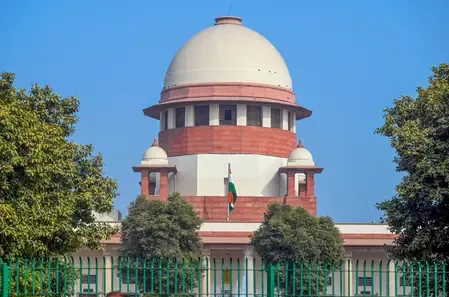
Supreme Court's Nine-Judge Panel to Review Sabarimala Case Today
Synopsis
The Supreme Court's nine-judge Constitution Bench, under CJI Surya Kant, will hear the pivotal Sabarimala review case today, addressing key constitutional questions on gender equality and religious freedom. This landmark hearing could reshape access rights in places of worship across India.
Key Takeaways
Supreme Court to review pivotal Sabarimala case.
Constitution Bench led by CJI Surya Kant.
Significant questions on gender equality and religious freedom .
Related issues include women's access to mosques and fire temples.
Hearings scheduled over multiple days.
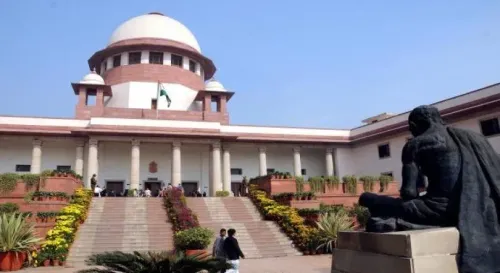
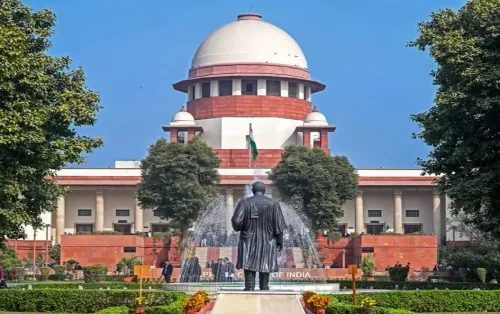
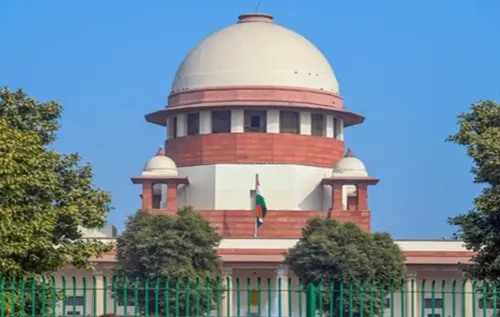
New Delhi, April 7 (NationPress) A Constitution Bench comprising nine judges, led by Chief Justice of India (CJI) Surya Kant, is scheduled to deliberate on the long-awaited Sabarimala review case today. This case includes a series of petitions that raise crucial constitutional issues regarding religious freedom and gender equality.
The Supreme Court's official website has released the cause list, indicating that the Constitution Bench, which also includes Justices B.V. Nagarathna, M.M. Sundresh, Ahsanuddin Amanullah, Aravind Kumar, A.G. Masih, Prasanna B. Varale, R. Mahadevan, and Joymalya Bagchi, will address the reference stemming from review petitions against the landmark decision made in September 2018. This ruling allowed women of all ages to enter the Lord Ayyappa temple at Sabarimala.
The proceedings before the nine-judge Bench are set to start at 10:30 a.m. in the Chief Justice’s court and will be organized over several days according to a predetermined schedule established by the apex court. The Supreme Court is expected to not only reassess the accuracy of its 2018 ruling but also to explore broader constitutional issues concerning the scope and implications of Article 25 of the Constitution, particularly the rights of women in accessing places of worship across different religions.
In addition to the Sabarimala case, the Constitution Bench will also examine related matters, including the entry of Muslim women into mosques and dargahs, the rights of Parsi women to access fire temples following interfaith marriages, the legitimacy of excommunication practices, and the legality of female genital mutilation within the Dawoodi Bohra community.
Previously, the CJI Surya Kant-led Bench had established a comprehensive schedule and confirmed that the maintainability of the reference has been conclusively decided, identifying seven significant legal questions for consideration.
According to the timetable, arguments from parties advocating for the review petitions are slated to be heard from April 7 to April 9, with counterarguments from opponents of the review taking place from April 14 to April 16.
If necessary, rejoinder submissions will be addressed on April 21, with the final arguments from the amicus curiae expected to wrap up on April 22.
The apex court has mandated that all parties submit their written arguments in advance and emphasized adherence to strict timelines, noting the critical importance of Constitution Bench matters.
Leading up to the hearings, written submissions from the Travancore Devaswom Board have urged the Supreme Court to adopt a “community-centric” interpretation of religion, contending that courts should refrain from revising faith-based practices and questioning the ongoing applicability of the “essential religious practices” doctrine.
In the meantime, Solicitor General Tushar Mehta has informed the court that the Union government backs the review petitions. The Centre has argued that the matter falls squarely within the realm of religious faith and denominational autonomy, which is beyond the purview of judicial review.
“Examining whether a practice is rational, acceptable to judicial sensibilities, or aligned with transformative constitutional doctrines does not constitute constitutional review,” the Centre stated, adding that judges are neither trained nor institutionally prepared to interpret religious texts or resolve theological disputes.
Point of View
Highlighting the need for a delicate balance between tradition and constitutional rights.
NationPress
20 Sept 2026
Frequently Asked Questions
What is the Sabarimala review case about?
The Sabarimala review case involves petitions questioning the Supreme Court's 2018 ruling that allowed women of all ages to enter the Lord Ayyappa temple, raising significant issues related to religious freedom and gender equality.
Who is leading the Supreme Court Bench?
The nine-judge Constitution Bench is led by Chief Justice of India, Surya Kant.
What other issues will the Constitution Bench address?
In addition to the Sabarimala case, the Bench will consider related matters such as the rights of Muslim women in mosques, Parsi women's access to fire temples, and the legality of certain traditional practices.
When will the hearings take place?
The hearings are scheduled from April 7 to April 9 for supporters of the review petitions, with opposing arguments set for April 14 to April 16.
What is the significance of this review?
This review is significant as it may redefine women's rights in accessing places of worship, shaping the future of religious freedom and gender equality in India.