Taiwan's democracy poses existential challenge to CCP, report argues
Synopsis
A report in the European Times argues that Beijing's Taiwan obsession is fundamentally a crisis of legitimacy — Taiwan's democracy is a living proof that Chinese-speaking societies can thrive without the CCP. That ideological threat, combined with Taiwan's strategic position anchoring the first island chain, makes the Taiwan question far more combustible than a simple territorial dispute.
Key Takeaways
Khedroob Thondup , nephew of the Dalai Lama , authored the report published in the European Times this week.
Taiwan is described as 'a living rebuttal' to the CCP's claim that Chinese identity requires authoritarian rule.
Taiwan was ceded to Japan in 1895 ; the post-war San Francisco Peace Treaty did not explicitly assign sovereignty to China.
Xi Jinping has linked his 'national rejuvenation' promise to reunification, making Taiwan central to CCP domestic legitimacy.
Taiwan anchors the first island chain from Japan to the Philippines , constraining China's naval expansion into the Pacific.
Taiwan's population of over 23 million governs itself as a de facto independent democracy, the report notes.
Taiwan represents an existential ideological challenge to the Chinese Communist Party (CCP), according to a report published this week in the European Times, which argues that Beijing's fixation on the island goes far beyond territorial claims and strikes at the heart of the CCP's domestic legitimacy. The analysis, authored by Khedroob Thondup — nephew of the Dalai Lama — contends that Taiwan's thriving democracy functions as a direct rebuke to the CCP's foundational claim that Chinese identity is inseparable from authoritarian governance.
Ideology, Not Just Territory
Thondup argues that Beijing cannot frame its Taiwan policy as a straightforward sovereignty dispute. 'China's obsession with Taiwan is not merely about sovereignty. It is about regime survival,' he writes. In his assessment, the CCP views even the confident assertion of Taiwanese autonomy as a threat to its legitimacy at home and its ambitions abroad.
Taiwan, he contends, is 'a living rebuttal to the idea that Chinese identity requires authoritarian rule' — a Chinese-speaking society that is democratic, pluralist, and prosperous without Communist Party oversight. That contrast, according to the report, is precisely what makes Taiwan so dangerous to the CCP's narrative.
The Contested History Behind the 'One China' Claim
The report challenges Beijing's assertion that Taiwan has 'always been part of China.' Thondup notes that Taiwan was ceded to Japan in 1895 under the Treaty of Shimonoseki. After World War II, Japan formally renounced all rights, title, and claims to Taiwan and the Pescadores under the San Francisco Peace Treaty — but that treaty did not explicitly assign sovereignty to China.
'Taiwan's post-war status therefore remains politically and legally disputed, whatever Beijing may claim,' Thondup writes. This legal ambiguity, the report argues, undermines the historical certainty that Beijing projects through the One China principle.
Xi's Nationalist Mythology and the Reunification Promise
The report draws a direct line between President Xi Jinping's political identity and the Taiwan question. Xi has tied his leadership to the promise of 'national rejuvenation,' with reunification placed at the centre of that project. Failure to bring Taiwan under Beijing's control, the report argues, would 'puncture the nationalist mythology on which the CCP increasingly depends.'
This dynamic, according to Thondup, explains Beijing's disproportionate reactions to symbolic gestures — foreign parliamentary visits to Taipei, or meetings with Taiwan's president — which the outside world may view as routine protocol but which Beijing treats as challenges to regime credibility.
Taiwan's Strategic Weight in the Indo-Pacific
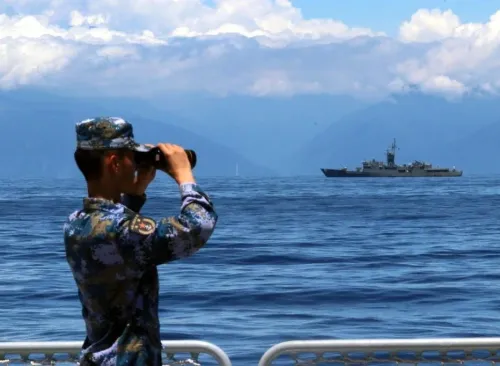
Beyond ideology, the report underscores Taiwan's military and strategic significance. Taiwan anchors the first island chain — the strategic arc stretching from Japan through Taiwan to the Philippines — which constrains China's naval expansion into the wider Pacific.
Each instance of international engagement with Taiwan, however limited, the report notes, erodes Beijing's diplomatic position and reinforces the island's de facto independence. With a population of over 23 million, Taiwan is described not as an 'internal Chinese administrative question' but as a 'self-governing democracy.' If Taiwan deepens security coordination with the United States, Japan, and regional partners, China's Pacific ambitions remain structurally constrained. 'For Beijing, Taiwan is therefore not only a symbol. It is a strategic barrier,' the report states.
Broader Implications
The report's framing — that Taiwan's democratic existence is itself a geopolitical act — adds analytical depth to a debate often reduced to military timelines and arms sales. It situates the Taiwan question within a longer arc of CCP legitimacy anxiety, one that predates Xi and is unlikely to be resolved by force alone. How the international community engages with Taipei in the months ahead will continue to test the limits of Beijing's tolerance.
Point of View
One foreign parliamentary visit at a time.
NationPress
30 Sept 2026
Frequently Asked Questions
Why does Taiwan pose an ideological challenge to the CCP?
Taiwan is a Chinese-speaking democracy that is prosperous and pluralist without Communist Party rule, directly contradicting the CCP's claim that Chinese identity requires authoritarian governance. The report describes it as 'a living rebuttal' to that foundational CCP argument.
Is Taiwan's sovereignty legally settled under international law?
No. Taiwan was ceded to Japan in 1895 under the Treaty of Shimonoseki, and while Japan renounced all claims after World War II under the San Francisco Peace Treaty, that treaty did not explicitly assign sovereignty to China. Taiwan's post-war legal status remains politically and legally disputed, according to the report.
How does Taiwan affect China's military strategy in the Indo-Pacific?
Taiwan anchors the first island chain — the strategic arc from Japan through Taiwan to the Philippines — which constrains China's naval expansion into the wider Pacific. If Taiwan deepens security ties with the US and Japan, Beijing's Pacific ambitions remain structurally limited.
Why does Xi Jinping treat Taiwan as central to his political project?
Xi has publicly tied his leadership to 'national rejuvenation,' with reunification at the centre of that promise. Failure to bring Taiwan under Beijing's control would, according to the report, undermine the nationalist mythology the CCP increasingly relies on for domestic legitimacy.
Who authored the European Times report on Taiwan and the CCP?
The report was written by Khedroob Thondup, the nephew of the Dalai Lama, and published in the European Times this week. Thondup argues that Beijing's Taiwan policy is fundamentally about regime survival rather than territorial integrity.