Tiruchi ranks 12th nationally in Swachh Vayu Sarvekshan 2026, leads Tamil Nadu
Synopsis
Tiruchi has outranked Chennai and Madurai to lead Tamil Nadu in the Swachh Vayu Sarvekshan 2026, finishing 12th nationally with 183 points — but that masks a slide from 9th last year. A 40% drop in PM10 levels since 2017-18 shows the gains are real; holding them against national competition is the harder task ahead.
Key Takeaways
Tiruchi ranked 12th nationally in the Swachh Vayu Sarvekshan 2026 (million-plus cities category), scoring 183 out of 200 .
The city topped Tamil Nadu, ahead of Chennai (35th, 147.7 points ) and Madurai (39th, 132.1 points ).
Nationally, Lucknow led the category with 198 points , followed by Indore ( 197 ) and Jabalpur ( 195 ).
Tiruchi's rank slipped from 9th in the previous year's survey to 12th this year.
PM10 levels in Tiruchi fell from 88 in 2017-18 to 53 in 2025-26 , a roughly 40% reduction.
Thoothukudi secured 35th place in the sub- 300,000 population category with a score of 142.2 .
Tiruchi has claimed Tamil Nadu's top spot in the Swachh Vayu Sarvekshan 2026, finishing 12th nationally among cities with populations exceeding one million — outpacing both Chennai and Madurai in the Union Ministry of Environment, Forest and Climate Change's annual clean-air rankings released on 9 September 2025. The city earned 183 out of 200 points, underscoring years of sustained civic intervention in air-quality management.
National Rankings at a Glance
At the national level, Lucknow led the million-plus category with 198 points, followed closely by Indore at 197 and Jabalpur at 195. Among Tamil Nadu's cities assessed in the same category, Tiruchi's performance stood well above its peers. Chennai placed 35th with 147.7 points, while Madurai trailed at 39th with 132.1 points.
Separately, Thoothukudi featured in the sub-300,000 population category, securing 35th position with a score of 142.2.
A Dip from Last Year's Peak
Notably, Tiruchi's current 12th-place finish represents a step down from the 9th rank it recorded in the previous year's assessment — a reminder that clean-air progress is competitive and incremental gains can be eroded. The city's challenge now is not just to sustain its lead within Tamil Nadu but to reclaim lost ground on the national table.
The survey, conducted by the Central Pollution Control Board (CPCB), covered 131 cities enrolled under the National Clean Air Programme (NCAP). Cities were evaluated on parameters including reductions in PM10 particulate matter, road-dust control measures, solid waste management, expansion of air-quality monitoring infrastructure, public awareness campaigns, and the institutional capacity of local bodies to implement clean-air plans.
What Drove Tiruchi's Performance
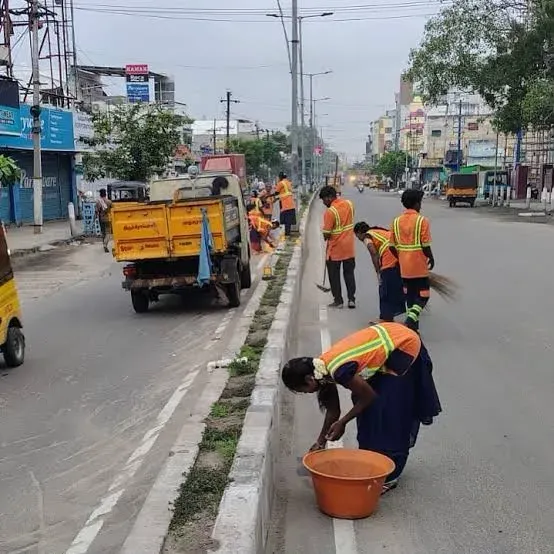
Officials attributed the city's strong showing to a series of targeted civic interventions rolled out over recent years. Improved waste segregation at source, more consistent door-to-door garbage collection, and greater deployment of mechanised road-sweeping equipment were cited as key contributors. The city administration also tightened enforcement against open waste burning — a significant source of harmful particulate emissions in urban areas.
Expansion of green cover and deeper community engagement in environmental programmes further bolstered Tiruchi's clean-air drive, according to officials.
PM10 Levels Tell the Longer Story
The most telling indicator of Tiruchi's air-quality trajectory is its PM10 trend over nearly a decade. Levels dropped from 88 micrograms per cubic metre in 2017-18 to 53 micrograms per cubic metre in 2025-26 — a reduction of roughly 40% over the period, according to city officials. This sustained decline reflects the cumulative impact of consistent policy enforcement rather than any single intervention.
This comes amid broader national efforts under NCAP to cut particulate pollution in India's most polluted urban centres by a targeted percentage by 2026. Tiruchi's trajectory positions it as a relative success story within that framework, even as absolute PM10 levels still leave room for improvement against global benchmarks.
With its national ranking slipping one place from last year, maintaining momentum — and recovering lost ground — will define Tiruchi's clean-air agenda in the year ahead.
Point of View
But the slide from 9th last year should not be glossed over — clean-air rankings are a moving target, and competitors are catching up. The PM10 decline from 88 to 53 over eight years is substantive, yet at 53 micrograms per cubic metre the city still sits well above the WHO guideline of 15. What Tiruchi's story really illustrates is the gap between 'best in Tamil Nadu' and 'genuinely clean air' — a distinction that civic communication tends to blur. The harder question is whether NCAP's incentive structure is pushing cities toward survey optimisation or toward durable emissions reduction.
NationPress
24 Oct 2026
Frequently Asked Questions
What is the Swachh Vayu Sarvekshan 2026?
The Swachh Vayu Sarvekshan is an annual clean-air survey conducted by the Central Pollution Control Board across 131 cities enrolled under the National Clean Air Programme. It ranks cities on parameters including PM10 reduction, road-dust control, waste management, air-quality monitoring, and public awareness.
How did Tiruchi perform in the Swachh Vayu Sarvekshan 2026?
Tiruchi ranked 12th nationally in the million-plus population category, scoring 183 out of 200 points. It was the best-performing city from Tamil Nadu, ahead of Chennai (35th) and Madurai (39th).
Which city topped the Swachh Vayu Sarvekshan 2026 nationally?
Lucknow topped the million-plus cities category with 198 points, followed by Indore with 197 points and Jabalpur with 195 points.
How has Tiruchi's air quality changed over the years?
PM10 levels in Tiruchi fell from 88 micrograms per cubic metre in 2017-18 to 53 in 2025-26, reflecting a roughly 40% reduction over eight years. Officials credit sustained interventions including mechanised road sweeping, waste segregation, and enforcement against open burning.
Did Tiruchi improve or decline compared to last year's survey?
Tiruchi's national rank declined from 9th in the previous year's Swachh Vayu Sarvekshan to 12th in 2026, even as its absolute score of 183 out of 200 remained strong. The slip indicates that other cities in the category improved at a faster pace.