Trump: US leads China in AI race, calls it bigger than the internet
Synopsis
Trump told CNBC that AI dwarfs the internet in long-term significance and that the US leads China 'substantially' — then disclosed he demanded a 10% equity stake in Intel as part of a recovery deal and claimed it generated $60–70 billion in eight months. The interview reveals a strategy built on deregulation, self-built power plants for AI firms, and aggressive chip reshoring — with Arizona as the centrepiece.
Key Takeaways
President Donald Trump said in a CNBC interview on 3 July that AI is 'bigger than the internet' and a top US strategic priority.
Trump claimed the US leads China 'substantially' in AI, without citing independent benchmarks.
His administration has allowed AI companies to build their own power generation facilities, citing a need to double current US electricity capacity for the AI sector.
Trump predicted the US would capture 40 to 60 per cent of global semiconductor manufacturing before he leaves office, with factories being built in Arizona .
He disclosed seeking a 10 per cent equity stake in Intel as part of a government-assisted recovery, claiming it generated roughly $60–$70 billion in eight months.
On regulation, Trump said AI needs 'some guard rails, but you want to do as little as possible.'
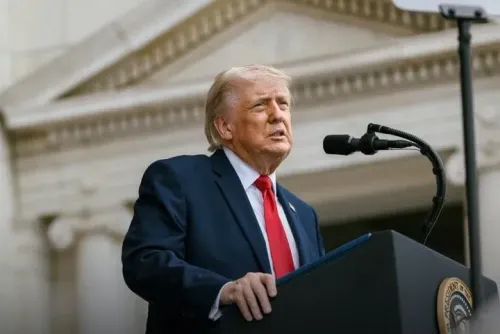
US President Donald Trump on 3 July declared that the United States must maintain its lead over China in artificial intelligence development, describing AI as a technology of greater long-term consequence than the internet itself. Speaking in an interview with CNBC, Trump framed American dominance in AI as a top strategic priority for his administration.
Trump's Assessment of the AI Race
Trump was unequivocal about the stakes of the competition. 'AI is bigger than the internet,' he said. 'I've never seen anything. The internet was a big deal. I think this is much bigger than the internet.' He argued that whichever nation leads in AI development will gain a decisive and lasting global advantage, adding: 'I really think whoever's number one is going to really win the race. And right now, we're substantially number one.'
The President also claimed a clear current lead over rivals. 'We're leading substantially in AI over China and everybody else,' he said, though he did not cite independent benchmarks to support the assertion.
Energy Demand and the Power Generation Policy
Trump acknowledged that the rapid expansion of the US AI industry would require a dramatic increase in electricity supply, estimating the sector alone would need double the country's current generation capacity. To address this, his administration has allowed AI and data-centre companies to build their own dedicated power generation facilities. 'I let the plants, as they build these billions and billions of dollars of plants, I let them build their own electric generating plants,' he said. He argued the policy was critical to preserving the country's technological edge, claiming: 'If I didn't come up with that concept, we wouldn't have... we would be in last place.'
Regulation: Guard Rails, Not Guardrails
On oversight, Trump struck a deliberately light-touch position. 'You need some guard rails, but you want to do as little as possible,' he said. He indicated his administration would act swiftly against specific security threats rather than impose broad regulatory frameworks. 'When we think there's a bad player out there, there's a little danger, we stop the player quickly and effectively,' he added. The remarks signal that the administration is unlikely to pursue sweeping AI legislation in the near term, a position that contrasts with the more structured regulatory approaches being developed in the European Union.
Semiconductor Manufacturing and the Intel Stake
Trump linked AI leadership directly to domestic semiconductor production, noting that major chipmakers are investing in new fabrication facilities in the United States. 'They're building chip factories in Arizona,' he said. He predicted the US would reclaim a substantial share of global chip output — between 40 and 60 per cent — before the end of his term, a significant reversal from recent decades in which manufacturing shifted heavily to Asia. 'Taiwan literally took 100 per cent of the business, almost,' he said.
Trump also disclosed that his administration had sought an equity stake in Intel as part of efforts to support the company's recovery. 'I said, I can solve your problem, but I want 10 per cent of the company,' he revealed, adding that the approach had reportedly generated approximately $60 to $70 billion in value over eight months, according to his account.
The Broader US-China AI Competition
Artificial intelligence has become one of the most contested arenas in US-China strategic rivalry, with both governments committing vast resources to advanced computing, semiconductor supply chains, and AI applications across defence, industry, and public services. Analysts and policymakers increasingly view AI leadership as a determinant of future economic growth, military capability, and geopolitical influence. Trump's remarks reflect a bipartisan consensus in Washington that ceding ground in AI to China would carry significant long-term costs — even as the two countries remain economically intertwined. How the administration balances deregulation with security screening will be closely watched in the months ahead.
Point of View
But the claim that the US leads China 'substantially' rests on no cited evidence — and the gap is more contested than the confidence suggests. The decision to let AI companies build private power plants solves a real bottleneck but creates a regulatory vacuum around grid stability and environmental accountability. The Intel equity-stake disclosure is the most consequential detail in the interview and has received the least scrutiny: a sitting president negotiating a government equity position in a publicly listed chipmaker raises questions about market distortion that neither the administration nor mainstream coverage has adequately addressed. Light-touch AI regulation may accelerate US deployment, but it also concentrates risk — and when something goes wrong, the absence of a framework becomes the story.
NationPress
26 Oct 2026
Frequently Asked Questions
What did Trump say about AI and China in his CNBC interview?
Trump said the US leads China 'substantially' in artificial intelligence and that maintaining that lead is a top strategic priority. He described AI as more consequential in the long run than the internet, warning that the nation that comes first in AI will gain a decisive global advantage.
Why does Trump say the US needs to double its electricity supply?
Trump said the expanding AI industry alone would require double the country's current electricity generation capacity. To address this, his administration has permitted AI and data-centre companies to construct their own dedicated power generation facilities rather than rely solely on existing grids.
What is Trump's position on AI regulation?
Trump favours minimal regulation, saying AI needs 'some guard rails, but you want to do as little as possible.' He said his administration would act quickly against specific security threats rather than impose broad regulatory frameworks.
What did Trump say about semiconductor manufacturing?
Trump said major chipmakers are building factories in Arizona and predicted the US would reclaim between 40 and 60 per cent of global semiconductor manufacturing before the end of his term, reversing decades of production shifting to Taiwan and South Korea.
What did Trump reveal about Intel?
Trump disclosed that his administration sought a 10 per cent equity stake in Intel as part of efforts to help the company recover. He claimed the arrangement generated approximately $60 to $70 billion in value over eight months, though he did not provide a detailed breakdown of that figure.