Tulu Language Mission 2026–2035 proposal submitted to PM Modi for Eighth Schedule push

Synopsis
A Karnataka state planning commissioner has submitted a sweeping ₹450 crore blueprint to PM Modi for a decade-long Tulu Language Mission — one that seeks constitutional recognition in the Eighth Schedule, classical language status, and a unique 'Dual-Graphic Harmony Model' preserving the ancient Tulu-Tigalari script, just days after Karnataka granted Tulu its second additional official language status.
Key Takeaways
Mohanadass Hegde of the Karnataka State Policy and Planning Commission submitted the proposal to PM Modi on 1 October 2026 .
The proposal seeks inclusion of Tulu in the Eighth Schedule of the Constitution and examination of classical language status .
Census 2011 data cited in the submission counts 18,46,849 native Tulu speakers.
An indicative financial outlay of ₹450 crore is proposed for a Detailed Project Report for a 10-year national mission .
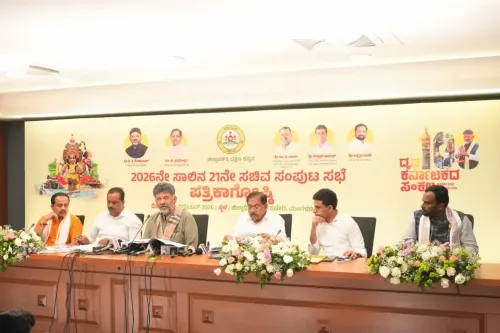
The Karnataka Cabinet on 18 September granted Tulu status as the state's second additional official language in Dakshina Kannada and Udupi districts, with an annual budget of ₹82 lakh .
The submission requests the PMO to direct the Ministries of Home Affairs , Culture and Education to initiate inter-ministerial examination.
A formal proposal for a Tulu Language National Recognition & Development Mission 2026–2035 was submitted on Thursday, 1 October 2026 to Prime Minister Narendra Modi, requesting an inter-ministerial review of measures for the constitutional recognition, preservation, digitisation, education and promotion of the Tulu language and its cultural heritage. The submission, originating from Bengaluru, marks the most structured push yet for Tulu's formal national standing.
Who submitted the proposal and what it seeks
The proposal was submitted by S. Mohanadass Hegde, Member of the Karnataka State Policy and Planning Commission. At its core, it seeks consideration of Tulu's inclusion in the Eighth Schedule of the Constitution — a long-standing demand — alongside a national framework for research and preservation of its literary, historical and cultural heritage. The document also requests an examination of Tulu's eligibility for classical language status.
Citing Census 2011 data, the proposal notes 18,46,849 native Tulu speakers across India and abroad, arguing that the language meets the threshold for constitutional acknowledgement. It calls for systematic research into Tulu's linguistic history, manuscripts, epigraphy, oral traditions and the Tulu-Tigalari script.
The 'Dual-Graphic Harmony Model' and historical research
One of the more distinctive elements of the submission is a proposed 'Dual-Graphic Harmony Model': Kannada would continue as the medium for contemporary governance and public education, while Tulu-Tigalari would be deployed for manuscript conservation, epigraphy and scholarly research. This framing is designed to avoid a direct linguistic or administrative competition with Kannada.
The proposal also calls for a dedicated research project into Tulu Nadu's history — including the Alupa dynasty, Barkur and the historical links between the Tuluva dynasty and the Vijayanagara Empire. Notably, it explicitly recommends that established historical evidence be distinguished from contested claims and cultural traditions, a methodological safeguard rarely specified in such petitions.
Financial outlay and policy tracks
The submission outlines three policy tracks: constitutional recognition, classical language eligibility, and a 10-year national mission blueprint. It proposes an indicative financial envelope of ₹450 crore for a Detailed Project Report (DPR), with suggested convergence with existing Central schemes on language technology, manuscript conservation, epigraphy and education.
A three-stage process is recommended — beginning with referral to the Ministries of Home Affairs, Culture and Education, followed by an expert working group to verify linguistic, inscriptional and manuscript evidence, and culminating in substantive consideration of the constitutional and classical language proposals alongside DPR appraisal.
Karnataka's recent move and the broader context
The proposal comes shortly after the Karnataka Cabinet, at its 18 September meeting in Mangaluru, decided to accord Tulu the status of the state's second additional official language for administrative purposes in Dakshina Kannada and Udupi districts. The state government has also announced an annual allocation of ₹82 lakh for translation, training and related implementation measures.
The Union government has previously acknowledged receiving proposals for Tulu's Eighth Schedule inclusion but has stated that there are currently no fixed constitutional criteria for adding languages to the Schedule — a position that advocates argue leaves the door open for a legislative push. The submission now requests the Prime Minister's Office to issue appropriate directions to the concerned ministries to initiate the inter-ministerial examination.
Point of View
Which means this is fundamentally a political decision, not a technical one. With Karnataka having just granted Tulu official language status in two districts, the political groundwork is being laid — but converting state momentum into a constitutional amendment will require Centre buy-in that has historically been cautious on language recognition, given the precedent each addition sets for dozens of other claimant languages.
NationPress
1 Oct 2026
Frequently Asked Questions
What is the Tulu Language National Recognition & Development Mission 2026–2035?
It is a proposed 10-year national mission submitted to PM Modi on 1 October 2026, seeking constitutional recognition of Tulu in the Eighth Schedule, classical language status, and a ₹450 crore framework for research, preservation, digitisation and education of the Tulu language and its cultural heritage.
How many people speak Tulu in India?
According to Census 2011 data cited in the proposal, there are 18,46,849 native Tulu speakers in India, with the language also present among diaspora communities abroad. Tulu is primarily spoken in Dakshina Kannada and Udupi districts of Karnataka, and in parts of northern Kerala.
What did Karnataka's Cabinet decide about Tulu in September 2026?
The Karnataka Cabinet, at its 18 September 2026 meeting in Mangaluru, decided to grant Tulu the status of the state's second additional official language for administrative purposes in Dakshina Kannada and Udupi districts. The state has allocated ₹82 lakh annually for translation, training and implementation.
What is the 'Dual-Graphic Harmony Model' proposed for Tulu?
The model proposes that Kannada continue as the medium for governance and public education, while the Tulu-Tigalari script is used specifically for manuscript conservation, epigraphy and scholarly research. It is designed to avoid direct competition with Kannada in administrative and educational domains.
Has the Union government previously considered Tulu for the Eighth Schedule?
The Union government has previously acknowledged receiving proposals for Tulu's inclusion in the Eighth Schedule but has stated that no fixed constitutional criteria exist for adding languages to it. The current proposal requests the PMO to direct the Ministries of Home Affairs, Culture and Education to begin a formal inter-ministerial examination.