Urban sector budget outlay up 10-fold since 2014, says NITI Aayog's Rajiv Gauba

Synopsis
India's urban sector budget has expanded 10-fold since 2014 and over ₹3.7 lakh crore has been poured into metro and bus infrastructure — yet NITI Aayog's Rajiv Gauba warns that money alone won't fix cities. Without empowered mayors, devolved functions, and reformed land-use rules, he argues, India's urban potential remains trapped in state-capital bureaucracy.
Key Takeaways
India's urban sector budgetary outlay has grown 10-fold since 2014 , according to NITI Aayog member Rajiv Gauba .
Approximately ₹3.7 lakh crore has been invested in metro rail and bus systems.
The ₹1 lakh crore Urban Challenge Fund (announced in Budget 2025-26) aims to develop cities as economic growth hubs; ₹5,000 crore each earmarked for 7 city economic regions over five years.
Gauba called for directly elected mayors with 5-year terms and devolution of all 18 functions to urban local bodies under the 74th Amendment .
Central Finance Commission grants to ULBs have risen from 36% to 45% , but state-level fiscal transfers to cities remain low.
Gauba urged states to adopt the Model Tenancy Act and remove restrictive FARs to address housing affordability.
NITI Aayog member Rajiv Gauba on Sunday, 25 October 2026, said India's budgetary outlay for the urban sector has grown 10-fold since 2014, driven by flagship missions including Smart Cities, AMRUT, Pradhan Mantri Awas Yojana, Swachh Bharat, and the Urban Livelihoods Mission. Gauba, a former Cabinet Secretary, made these remarks at the valedictory session of the 2nd National Urban Conclave in Bhubaneswar.
Scale of Investment
Gauba noted that investments of approximately ₹3.7 lakh crore have been made in metro rail and bus systems alone. He also highlighted the ₹1 lakh crore Urban Challenge Fund, announced in the 2025-26 Union Budget, aimed at developing cities as economic growth hubs. Additionally, this year's budget earmarks ₹5,000 crore each for 7 city economic regions over a five-year horizon, as part of NITI Aayog's broader growth hub initiative.
Call for Empowered City Governments
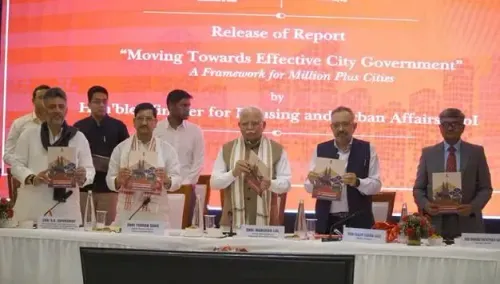
A central theme of Gauba's address was the urgent need to empower urban local bodies (ULBs). Referring to the joint report 'Moving Towards Effective City Governance', developed by NITI Aayog and the Ministry of Housing and Urban Affairs (MoHUA), he called for directly elected mayors with 5-year terms, the introduction of a Mayor-in-Council system, and the holding of timely municipal elections. He argued that cities cannot be effectively governed from state capitals and that governance must be anchored at the local level to ensure meaningful citizen participation.
Devolution and Fiscal Reform
Gauba emphasised the need for states to devolve all 18 functions to ULBs as mandated by the 74th Constitutional Amendment, including master planning, water supply, fire services, and traffic management. He flagged that while Central Finance Commission grants to ULBs have risen significantly — with their share increasing from 36% to 45% — fiscal transfers from states to cities remain inadequate. He called for regular constitution of State Finance Commissions and stressed the need to improve property tax and user-charge recovery at the municipal level.
Urban Planning and Housing Overhaul
On the planning front, Gauba urged an overhaul of the existing paradigm. He called for removing restrictive Floor Area Ratios (FARs) and building norms that constrain land supply and inflate costs. He advocated for mixed-use zoning, transit-oriented development, and land pooling to expand housing and commercial land availability. He also stressed the importance of affordable rental housing for migrant workers, industrial labour, students, and young professionals, urging states to adopt the Model Tenancy Act to boost rental housing supply.
Path Forward
Gauba urged MoHUA to link urban mission support directly to the implementation of these reforms, arguing that new Municipal Acts at the state level could unlock India's urban growth potential and advance the vision of Viksit States and Viksit Bharat. The conclave's outcomes are expected to feed into ongoing policy deliberations on urban governance reform.
Point of View
But the more consequential part of Gauba's address was the governance gap it implicitly acknowledged: money has flowed, yet cities remain structurally weak. India's ULBs still lack the authority, fiscal base, and electoral accountability to convert Central outlays into liveable outcomes. The call for directly elected mayors with fixed terms and full 74th Amendment devolution is not new — it has been on the reform agenda for over two decades. What's different is NITI Aayog now explicitly linking mission funding to governance reforms, which, if enforced, could be the lever that past exhortations lacked.
NationPress
25 Oct 2026
Frequently Asked Questions
By how much has India's urban sector budget grown since 2014?
India's urban sector budgetary outlay has grown 10-fold since 2014, according to NITI Aayog member Rajiv Gauba, who cited the launch of multiple large missions including Smart Cities, AMRUT, Pradhan Mantri Awas Yojana, Swachh Bharat, and the Urban Livelihoods Mission as key drivers.
What is the Urban Challenge Fund announced in Budget 2025-26?
The Urban Challenge Fund is a ₹1 lakh crore initiative announced in the 2025-26 Union Budget to develop Indian cities as economic growth hubs, as part of NITI Aayog's growth hub initiative. The current year's budget also allocates ₹5,000 crore each for 7 city economic regions over five years.
What governance reforms did Rajiv Gauba recommend for Indian cities?
Gauba called for directly elected mayors with 5-year terms, a Mayor-in-Council system, timely municipal elections, and devolution of all 18 functions to urban local bodies as mandated by the 74th Constitutional Amendment. He argued that cities cannot be governed effectively from state capitals.
Why does municipal finance remain a concern despite higher Central grants?
While the Central Finance Commission's share of grants to urban local bodies has risen from 36% to 45%, Gauba noted that fiscal transfers from state governments to cities remain low. He called for regular constitution of State Finance Commissions and improvements in property tax and user-charge recovery.
What planning reforms did Gauba recommend to improve urban housing?
Gauba urged removal of restrictive Floor Area Ratios and building norms, adoption of mixed-use zoning, transit-oriented development, and land pooling to expand land supply and reduce housing costs. He also called on states to adopt the Model Tenancy Act to increase affordable rental housing supply for migrant workers, students, and young professionals.