US Imposes Sanctions on Hezbollah's $100 Million Financial Network
Synopsis
In a decisive move, the US has targeted a financial network linked to Hezbollah, sanctioning individuals and companies involved in channeling over $100 million to the group. This action underscores America's commitment to combating global terrorism.
Key Takeaways
The US has sanctioned a financial network linked to Hezbollah.
The network has channeled over $100 million to the militant group.
16 individuals and entities have been designated by the US Treasury.
Hezbollah has been identified as a Foreign Terrorist Organization since 1997.
The sanctions are aimed at disrupting Hezbollah's funding and operations.
Washington, March 21 (NationPress) The United States has taken action against what it calls a vast financial network responsible for directing over $100 million to Hezbollah, imposing sanctions on various individuals and companies across multiple nations.
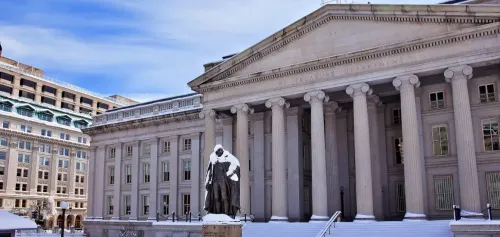
The US Department of the Treasury’s Office of Foreign Assets Control (OFAC) has officially listed 16 individuals and entities associated with Hezbollah financier Alaa Hassan Hamieh, who is accused of managing a network of firms engaged in money laundering and fundraising for the militant group.
This network, which spans Lebanon, Syria, Poland, Slovenia, Qatar, and Canada, has reportedly been involved in numerous economic projects, facilitating the diversion of funds since 2020, according to the Treasury.
“Iran is the root cause of global terrorism, and its proxies, including Hezbollah, execute Tehran’s agenda to spread chaos and destruction worldwide,” stated Treasury Secretary Scott Bessent.
“Hezbollah continues to misappropriate funds that rightfully belong to the Lebanese populace to support its terrorist endeavors. This initiative targets critical players within its international financial network that sustains its militant operations.”
The sanctions were enacted under Executive Order 13224, which focuses on organizations engaged in terrorism and their financial supporters. The United States has classified Hezbollah as a Foreign Terrorist Organization since 1997 and as a Specially Designated Global Terrorist entity since 2001.
According to the Treasury, Hezbollah finances both its military operations and social programs through a broad array of revenue generation and sanctions evasion strategies, many of which are coordinated by its financial team. Officials noted that the group has utilized its influence within the Lebanese government to misappropriate funds for its own use.
Hamieh, who previously held the position of vice president of Lebanon’s Investment Development Authority, is accused of leveraging his role in a trade agreement between Iraq and Lebanon aimed at reconstruction. Under this agreement, the agency had the authority to select beneficiaries, and it is alleged that Hamieh received millions for projects associated with Hezbollah.
The designation also includes foreign operatives, such as Syrian national Bahaa Addin Hashem and Lebanon-based Mohamad Jamil Salami, who was connected to a scheme to evade sanctions involving telecommunications equipment intended for an Iranian firm operating in Syria.
Qatar-based Raoof Fadel, recognized as the co-founder and CEO of a logistics company linked to the network's Canadian operations, was also sanctioned.
Entities functioning under the names “Seven Seas” and “Calllync” in Lebanon, Europe, and North America were also cited in the sanctions list. Authorities indicated that these companies were utilized for procurement, financial transactions, and money laundering to support Hezbollah’s operations.
As a result of these sanctions, all assets and interests in property belonging to the designated individuals and entities within US jurisdiction are frozen. US citizens are generally prohibited from engaging in transactions with them.
Point of View
This decisive action by the US underscores the ongoing fight against terrorism and the complex financial networks that support such organizations. The implications of these sanctions extend beyond immediate financial impacts, highlighting the broader geopolitical tensions at play.
NationPress
23 Sept 2026
Frequently Asked Questions
What are the sanctions against Hezbollah?
The US has sanctioned 16 individuals and entities associated with Hezbollah, targeting a financial network that has funneled over $100 million to the group.
Who is Alaa Hassan Hamieh?
Alaa Hassan Hamieh is a financier linked to Hezbollah, accused of overseeing a network of companies involved in money laundering and fundraising for the group.
What regions are affected by these sanctions?
The sanctions impact individuals and entities across Lebanon, Syria, Poland, Slovenia, Qatar, and Canada.
Why is Hezbollah designated as a terrorist organization?
Hezbollah has been designated by the US as a Foreign Terrorist Organization since 1997 due to its militant activities and connections to terrorism.
What does Executive Order 13224 entail?
Executive Order 13224 targets organizations involved in terrorism and their financial supporters, allowing the US to impose sanctions on such entities.