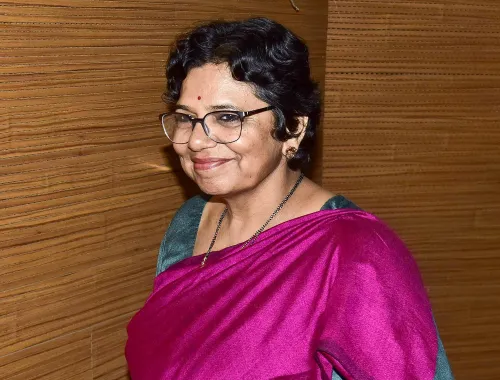
Darakshan Hassan Bhat Advocates for Women's Empowerment in Kashmir at UNHRC

Synopsis
Darakshan Hassan Bhat recently addressed the UNHRC, emphasizing the progress and challenges of women's empowerment in Jammu and Kashmir. She highlighted the importance of digital tools and the need for societal change to create a supportive environment for women.
Key Takeaways
Women's Empowerment: Addressing both progress and challenges in Jammu and Kashmir.
Digital Tools: Increasing opportunities for women through technology.
Societal Change: Need for a shift in mindset among youth regarding career aspirations.
Abstract Issues: Understanding the complexities of challenges faced by women.
Global Support: Importance of international engagement in addressing gender disparities.
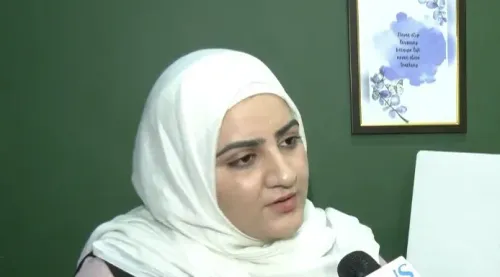
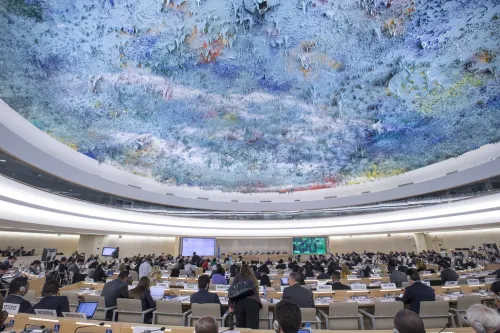
Srinagar, March 24 (NationPress) During her address at the United Nations Human Rights Council (UNHRC) in Geneva, Darakshan Hassan Bhat, the Speaker at UNHRC and President of the Kashmir Women's Organisation (KWO), spotlighted the changing dynamics of women's empowerment in Jammu and Kashmir. She articulated both the advancements made and the ongoing obstacles that women face in the region.
Bhat expressed her gratitude for the opportunity to represent her region on such a significant global stage, noting that her insights were informed by her solid foundation in gender studies and her extensive experience working directly with women in Kashmir.
"It was truly an honor to represent our region at the Geneva UNHRC convention. With my academic background in gender and women's studies combined with practical experience, we aimed to convey a well-informed narrative," she shared with IANS.
Her speech concentrated on the transformation of women and girls in Jammu and Kashmir, evaluated through essential indicators like education, political involvement, economic participation, agriculture, healthcare, and digital empowerment.
Bhat observed that women in the region are increasingly adopting digital technologies, which is opening up new economic avenues.
"We are advancing digitally quite effectively. You will see women working from their homes. Many women in Jammu and Kashmir are becoming entrepreneurs, launching businesses from their kitchens and reaching international markets," she stated, adding that traditional gender roles are slowly being redefined.
Nonetheless, she pointed out that career opportunities often remain gendered, as many women still feel reluctant to pursue certain professions due to societal views and the absence of dignified work conditions.
"Women have historically encountered limited access and opportunities, or they do not feel respected in specific jobs. Yet, things are changing rapidly," she remarked.
Bhat also highlighted the necessity for a transformation in societal attitudes, particularly among the youth.
"There has been a long-standing belief in Kashmir where everyone aspires for a government job. We need to broaden our perspectives. There are numerous other paths for growth, and our youth is now beginning to create their own brands," she explained.
Addressing the multifaceted challenges faced by women, she differentiated between "concrete" and "abstract" issues.
Concrete challenges include access to institutions, justice, and governmental support like scholarships.
Conversely, abstract issues arise from societal and familial constraints that limit women's choices.
"Abstract issues are more challenging to tackle. When your family or community restricts you from pursuing certain activities, what can be done? Working on these matters is a formidable task," she noted.
Bhat also emphasized the significance of narratives in shaping global views of Kashmir, asserting that platforms like the UNHRC can play a pivotal role in fortifying the human rights framework.
"Such platforms help unveil complex realities. There are no absolutes—everything has a broader narrative in between. Presenting that within a constrained timeframe is always a challenge," she concluded.
In her closing remarks, Bhat expressed hope that international engagement would bolster ongoing initiatives aimed at addressing gender disparities and empowering women in the region.
Point of View
It is evident that Darakshan Hassan Bhat's address at the UNHRC is a significant step toward highlighting the complexities of women's empowerment in Jammu and Kashmir. Her dual focus on progress and existing challenges underlines the need for continued efforts and societal change to foster gender equality.
NationPress
23 Sept 2026
Frequently Asked Questions
What is the focus of Darakshan Hassan Bhat's address?
Darakshan Hassan Bhat's address focused on the progress and challenges of women's empowerment in Jammu and Kashmir, emphasizing education, political participation, and digital empowerment.
Why is digital empowerment important for women in Kashmir?
Digital empowerment is crucial as it opens new economic opportunities for women, allowing them to work from home and become entrepreneurs.
What societal changes does Bhat advocate for?
Bhat calls for a shift in societal mindsets, particularly among youth, to explore diverse career opportunities beyond traditional government jobs.
What are the challenges women face in Jammu and Kashmir?
Women face challenges such as limited access to opportunities, gendered employment, and societal restrictions that affect their choices.
How does Bhat view the role of platforms like UNHRC?
Bhat believes platforms like UNHRC are vital for presenting nuanced realities and strengthening the human rights framework.