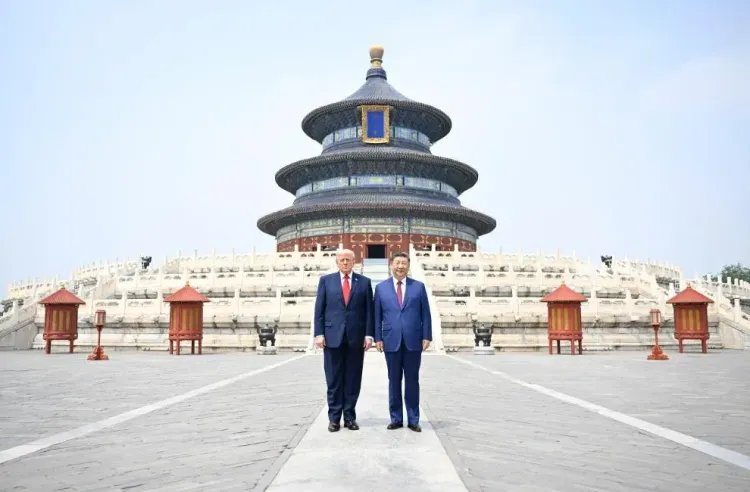
Xi Jinping, Trump visit Temple of Heaven after Beijing summit talks
Synopsis
Trump's Beijing State Visit went beyond diplomatic optics — Xi invoked the Thucydides Trap, issued a pointed warning on Taiwan, and the two sides reached a joint position on the Strait of Hormuz. Whether the warmth on display at the 600-year-old Temple of Heaven translates into durable policy convergence is the defining question.
Key Takeaways
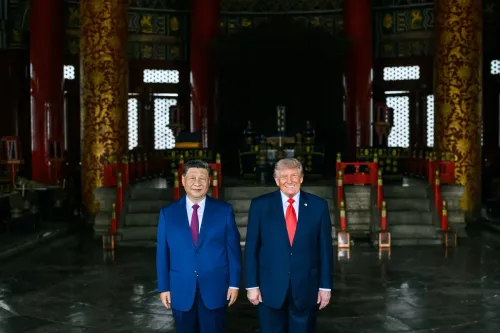
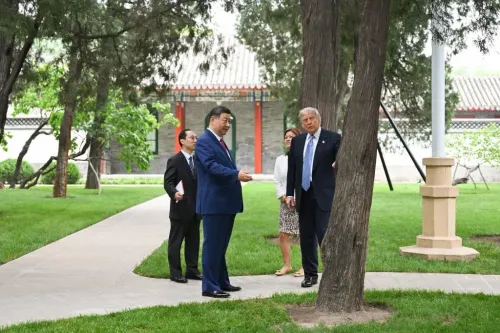
Xi Jinping and Donald Trump visited the Temple of Heaven in Beijing on 14 May , with Xi hosting Trump outside the Hall of Prayer for Good Harvests .
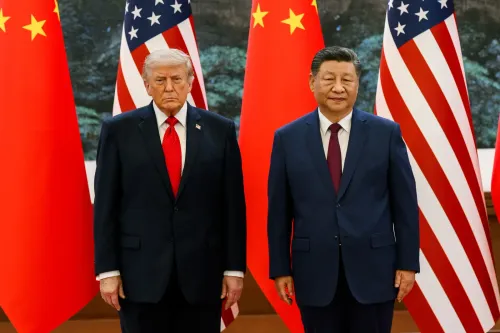
Formal talks were held at the Great Hall of the People ; the White House described it as a 'good meeting.' Xi called Taiwan 'the most important issue in China-US relations,' warning of potential 'clashes and even conflicts' if mishandled.
Both sides agreed the Strait of Hormuz must remain open to support the free flow of energy.
Economic cooperation was discussed, including expanded market access for American businesses in China and increased Chinese investment in US industries.
Trump called the visit 'a great honour' and described Xi as 'a great leader,' expressing willingness to strengthen bilateral ties.
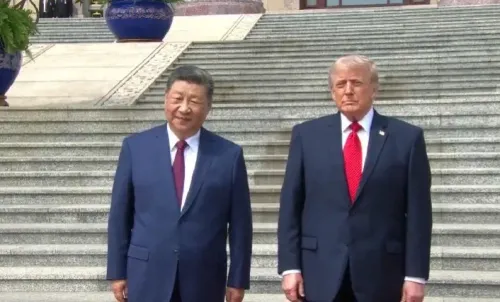
Chinese President Xi Jinping and US President Donald Trump on Thursday, 14 May visited the Temple of Heaven in Beijing, capping a high-stakes State Visit that included formal talks at the Great Hall of the People and a tour of one of China's most iconic historical landmarks.
The Temple of Heaven Visit
Xi greeted Trump outside the Hall of Prayer for Good Harvests, where the two leaders posed for photographs before taking a guided tour of the hall. During the visit, Xi explained to Trump that the temple served as a site for ancient state rituals, where Chinese rulers once prayed for national prosperity, social harmony, and favourable harvests.
'It reflects the traditional Chinese concept that the people are the foundation of a state and only when the foundation is solid will the state be stable,' Xi said, according to Xinhua.
Trump said he was impressed by the more than 600-year-old temple. He described both the United States and China as great countries with wise and great peoples, and said the two nations should deepen mutual understanding and strengthen people-to-people friendship.
Summit Talks at the Great Hall of the People
Earlier in the day, the two leaders held formal talks at the Great Hall of the People. Xi opened by framing the meeting in sweeping historical terms, noting that 'transformation not seen in a century is accelerating across the globe' and that the international situation remains 'fluid and turbulent.'
Xi posed three pointed questions about the trajectory of bilateral relations: whether China and the US could overcome the so-called Thucydides Trap, meet global challenges together, and build a future that benefits both peoples and humanity at large. The framing was a clear signal that Beijing views this visit as a potential inflection point in a relationship that has been under sustained pressure.
Taiwan and the Strait of Hormuz
On the Taiwan question, Xi was unambiguous, calling it 'the most important issue in China-US relations.' He warned that mishandling it could lead to 'clashes and even conflicts,' putting the entire bilateral relationship 'in great jeopardy,' and urged Washington to 'exercise extra caution.'
A separate White House readout described the overall meeting as a 'good meeting' in which both sides 'discussed ways to enhance economic cooperation,' including expanding market access for American businesses in China and increasing Chinese investment into US industries. Notably, both sides agreed that the Strait of Hormuz must remain open to support the free flow of energy — a rare point of explicit convergence on a global security issue.
Trump's Tone and Diplomatic Signals
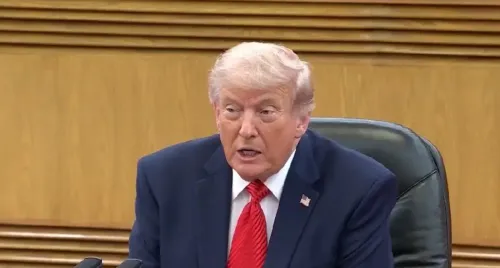
Trump called it 'a great honour' to be on a State Visit to China, referring to Xi as 'a great leader' and expressing 'tremendous respect' for both Xi and the Chinese people. He said he was willing to work with Xi to strengthen communication and cooperation, properly handle differences, and make bilateral relations 'better than ever before.'
This visit comes amid a broader recalibration of US-China ties following years of trade tensions, technology restrictions, and geopolitical friction. How the commitments made in Beijing translate into policy action in Washington and Beijing will be closely watched in the weeks ahead.
Point of View
Not merely transactional. The Taiwan warning, delivered publicly and in blunt terms, sets a clear red line even as both sides performed warmth at the Temple of Heaven. The Hormuz agreement is the most concrete deliverable to emerge, and its significance should not be understated given ongoing Middle East volatility. What remains absent from the readouts is any measurable commitment on trade or technology — the two areas where friction has been sharpest.
NationPress
26 Sept 2026
Frequently Asked Questions
Why did Xi Jinping and Trump visit the Temple of Heaven?
The Temple of Heaven visit was part of Trump's State Visit to China on 14 May, serving as a cultural and diplomatic gesture. Xi used the occasion to explain the temple's historical significance as a site of ancient Chinese state rituals, emphasising themes of national prosperity and people-centred governance.
What did Xi Jinping say about Taiwan during the Beijing summit?
Xi called Taiwan 'the most important issue in China-US relations,' warning that mishandling it could lead to 'clashes and even conflicts' and put the entire bilateral relationship 'in great jeopardy.' He urged the US side to 'exercise extra caution' on the matter.
What economic agreements were reached between the US and China?
According to a White House readout, both sides discussed enhancing economic cooperation, including expanding market access for American businesses in China and increasing Chinese investment into US industries. No specific figures or binding commitments were detailed in the public statements.
What did both sides agree on regarding the Strait of Hormuz?
The US and China agreed that the Strait of Hormuz must remain open to support the free flow of energy, according to the White House readout. This represents a rare explicit point of convergence on a global energy security issue.
What is the Thucydides Trap that Xi Jinping referenced?
The Thucydides Trap is a theory that a rising power and an established power are structurally prone to conflict. Xi invoked the concept to frame the central challenge of China-US relations, asking whether the two countries could forge a new model of major-country relations that avoids historical patterns of rivalry escalating into war.