18th BRICS Summit: India's presidency turns global weight into multilateral action
Synopsis
With BRICS now representing nearly half the world's population and 40% of global GDP, India's presidency is being watched for whether it can turn the bloc's growing weight into durable institutional outcomes — from a proposed BRICS Secretariat in New Delhi to local-currency trade frameworks — before the chairship moves to China.
Key Takeaways
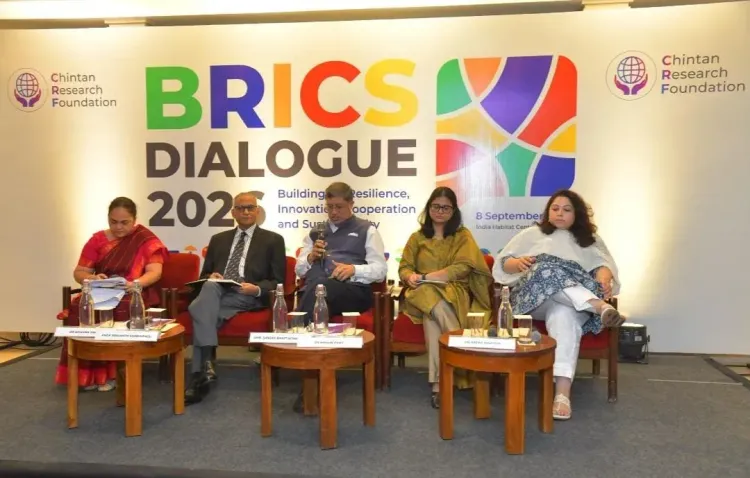
The CRF Dialogue on 8 September brought together diplomats, scholars and policymakers ahead of the 18th BRICS Summit in New Delhi .
BRICS now represents approximately 49.5% of the world's population and around 40% of global GDP following its recent expansion.
Ambassador Dammu Ravi proposed that India take the lead in establishing a BRICS Secretariat , while analyst Heena Makhija cautioned that consensus-building will be difficult.
Experts called for a BRICS Grain Exchange , interoperable paperless trade systems and greater local-currency trade as practical cooperation priorities.
Analysts stressed that India's presidency must leave behind durable mechanisms before the chairship transitions to China .
Professor Harsh V Pant of ORF raised whether BRICS can effectively advance India's multilateral agenda given growing geopolitical divergences among members.
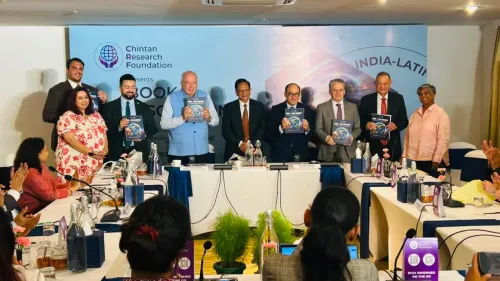
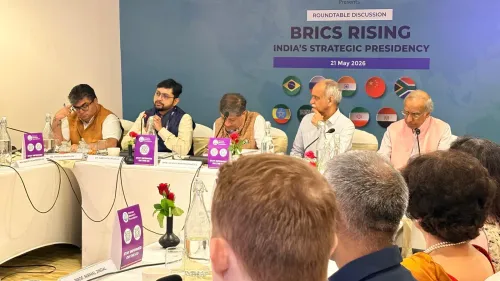
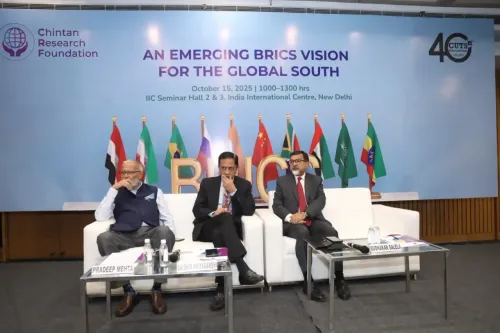
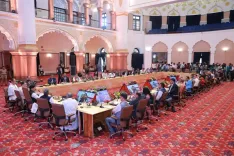
Ahead of the 18th BRICS Summit in New Delhi, top diplomats, scholars and policymakers gathered on Tuesday, 8 September to assess how India's fourth BRICS Presidency is translating the bloc's expanding membership and rising economic clout into concrete multilateral outcomes. The dialogue, organised by the Chintan Research Foundation (CRF), underscored that BRICS is entering a critical inflection point — one that will test whether its growing diversity becomes a strength or a liability.
India's Presidency at a Pivotal Moment
Experts at the CRF dialogue agreed that India's presidency arrived at an unusually complex juncture, marked by geopolitical contestation, economic fragmentation, technological disruption, and mounting pressure to reform global governance institutions. India's chairship theme — 'Building for Resilience, Innovation, Cooperation and Sustainability' — was designed to position BRICS as a platform for practical, inclusive and sustainable cooperation rather than a vehicle for ideological confrontation.
Following its recent expansion, BRICS now represents approximately 49.5 per cent of the world's population and around 40 per cent of global GDP, substantially enlarging its potential influence on economic and political debates worldwide.
Key Voices: What the Experts Said
Ambassador Dammu Ravi, Former Secretary (Economic Relations) at the Ministry of External Affairs (MEA) and India's representative at several key BRICS meetings, argued that the bloc's relevance lies in its capacity to create alternative pathways — not in dismantling existing systems. 'BRICS is at the core of the Global South. Its relevance has grown amid a rapidly changing global order. Combining strengths is critical, and trilateral cooperation can be one of the most feasible ways to advance meaningful collaboration despite differences,' he said.
On the contentious de-dollarisation debate, Ambassador Ravi was measured: 'It is not about de-dollarisation, but about creating alternative avenues for trade and financial transactions. Given the diversity within BRICS, mechanisms such as the New Development Bank, with its capacity to facilitate transactions in local currencies, can play an important role.' He further proposed that India take the lead in establishing a BRICS Secretariat.
CRF President Shishir Priyadarshi, a former Director of the World Trade Organisation (WTO), identified four pillars of geo-economic cooperation within BRICS: trade, financial cooperation, technology, and geopolitical integration. 'The challenge is building effective groupings despite geopolitical differences,' he noted.
Former BRICS Sherpa Ambassador Sanjay Bhattacharyya observed that while BRICS was originally conceived as an economic grouping, it has since evolved to engage more directly with the multilateral system. He called for BRICS to 'pursue issue-based multilateralism' and play a 'much greater role' in global rule-making, adding that bridging the digital divide must be central to that agenda.
Professor Srikanth Kondapalli stressed that in an emerging multipolar world, BRICS enables a bottom-up approach: 'BRICS is important because it enables a bottom-up approach to cooperation, allowing countries to build resilience, diversify risks and strengthen alternative economic and strategic partnerships, rather than pursuing complete decoupling from existing systems.'
Professor Harsh V Pant of the Observer Research Foundation (ORF) raised a pointed question — whether BRICS can effectively serve as a platform for advancing India's multilateral agenda — noting that geopolitical divergences among members have increasingly complicated the bloc's original geoeconomic mandate.
Institutional Challenges: The Secretariat Question
Analyst Heena Makhija highlighted that BRICS is not a charter-based organisation and has undergone both vertical and horizontal expansion, creating what she described as 'power asymmetry.' She cautioned that 'building consensus on establishing a BRICS Secretariat in New Delhi could be challenging,' given the bloc's increasingly diverse membership.
Pritam Banerjee reinforced Ambassador Ravi's financial cooperation argument, calling for innovative financial instruments within the New Development Bank (NDB)'s mandate. Sabyasachi Saha from the Research and Information System for Developing Countries (RIS), invoking India's philosophy of 'Vasudhaiva Kutumbakam', argued that BRICS must deliver tangible collective value beyond bilateral relationships among its members.
From Declarations to Implementation
The dialogue identified several areas where cooperation could yield practical results: a BRICS Grain Exchange, interoperable paperless trade systems, reduction of non-tariff barriers, and greater local-currency trade where commercially viable. These initiatives, experts argued, could strengthen economic resilience while demonstrating the real-world value of BRICS cooperation.
A central takeaway was that BRICS' future credibility hinges on its ability to move from declarations to implementation. Analysts noted that India's 2026 presidency — before the chairship passes to China — must leave behind mechanisms capable of sustaining momentum. With the transition approaching, continuity in priorities was flagged as critical to ensuring that India's contributions shape the longer-term evolution of the bloc.
What Comes Next
The 18th BRICS Summit, being held in New Delhi this week, is expected to produce declarations on several of these themes, including digital cooperation, development finance reform and South-South trade facilitation. Whether those declarations translate into actionable frameworks — rather than aspirational communiqués — will be the real measure of India's presidency.
Point of View
But the lack of a charter-based structure means any institutional legacy depends entirely on member goodwill — which, with China assuming the chair next, is far from guaranteed. The shift from declarations to implementation that experts are calling for is not a new demand; it has been made at virtually every BRICS cycle. What is new is the stakes: at nearly 40% of global GDP, a BRICS that cannot operationalise its agenda is not just a missed opportunity — it is a credibility risk for the Global South narrative that India has staked significant diplomatic capital on.
NationPress
24 Oct 2026
Frequently Asked Questions
What is the 18th BRICS Summit and where is it being held?
The 18th BRICS Summit is the annual leaders' meeting of the BRICS grouping, being held in New Delhi this week under India's fourth BRICS Presidency. It is expected to produce declarations on digital cooperation, development finance reform and South-South trade facilitation.
What is India's theme for its BRICS Presidency?
India's BRICS Presidency is organised around the theme 'Building for Resilience, Innovation, Cooperation and Sustainability.' The chairship aims to strengthen BRICS as a platform for practical, inclusive and sustainable cooperation amid geopolitical contestation and global governance reform pressures.
How large is BRICS after its recent expansion?
Following its recent expansion, BRICS represents approximately 49.5% of the world's population and around 40% of global GDP, according to figures cited at the CRF Dialogue. This significantly enhances the bloc's potential influence on global economic and political debates.
What is the proposal for a BRICS Secretariat?
Ambassador Dammu Ravi, Former Secretary (Economic Relations) at India's Ministry of External Affairs, proposed that India take the lead in establishing a BRICS Secretariat. However, analyst Heena Makhija cautioned that building consensus on a New Delhi-based secretariat could be challenging given the bloc's diverse and expanding membership.
What practical cooperation areas did experts identify for BRICS?
Experts at the CRF Dialogue identified several concrete priorities: a BRICS Grain Exchange, interoperable paperless trade systems, reduction of non-tariff barriers, greater local-currency trade where commercially viable, and innovative financial instruments within the New Development Bank's mandate.