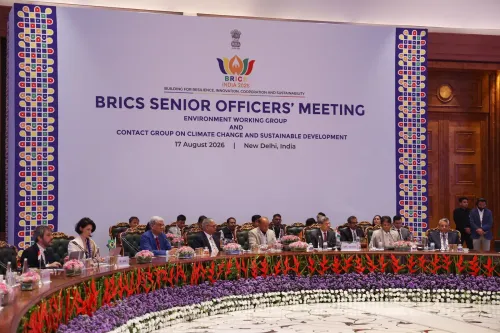
Delhi BRICS Summit 2025: Climate cooperation and global resilience on agenda
Synopsis
India's hosting of the 18th BRICS Summit in New Delhi this September is not just a diplomatic milestone — it is a test of whether the bloc can move from climate declarations to a functioning joint financial architecture. With Project Bridge, Gulf SWF co-investment, and rupee bond programmes on the table, the summit could redefine how developing nations finance the clean energy transition.
Key Takeaways
The 18th BRICS Summit is scheduled for September 2025 in New Delhi , with climate cooperation as a central pillar.
Key focus areas include agriculture resilience , disaster risk reduction , and local-currency climate financing .
India could advance three mechanisms: Project Bridge (multi-CBDC platform), Gulf Sovereign Wealth Fund co-investment in NDB projects, and a rupee bond programme .
At the 17th BRICS Summit in Rio de Janeiro , leaders agreed on the BRICS Leaders' Framework Declaration on Climate Finance and a Climate Leadership Agenda .
India's 'Viksit Bharat' vision — targeting developed-nation status by 2047 — frames its BRICS presidency priorities.
The 18th BRICS Summit, scheduled for September 2025 in New Delhi, is poised to become a pivotal moment for climate cooperation among developing nations, according to a report by South African news outlet The National. India's presidency of the bloc places climate adaptation, green finance architecture, and disaster resilience at the centre of this year's agenda.
Key Developments Ahead of the Summit
The New Delhi summit is expected to build on commitments made at previous BRICS gatherings. At the 2015 Summit in Ufa, Russia, member nations formally expressed readiness to tackle climate change at both national and global levels. More recently, at the 17th Summit in Rio de Janeiro, leaders endorsed the BRICS Leaders' Framework Declaration on Climate Finance and a broader Climate Leadership Agenda — documents that will likely form the foundation for this year's deliberations.
According to the report, the climate agenda within BRICS is increasingly shifting from discussions about the pace of emissions reductions toward practical adaptation measures — a transition that climate experts say is long overdue for high-exposure developing economies.
What the Summit Agenda Covers
A key pillar of the New Delhi Summit focuses on building resilience in agriculture and disaster risk reduction. Developing nations within the BRICS bloc face persistent climate-related risks — severe droughts, floods, heatwaves, and cyclones — that threaten food security, critical infrastructure, and macroeconomic stability. The summit is expected to advance coordinated disaster risk reduction frameworks and local-currency climate financing strategies to address these vulnerabilities.
Notably, the report highlights that across BRICS nations, a clean energy transition is already underway, with wind and solar projects outnumbering planned fossil fuel plants. What remains absent, the report argues, is a joint financial architecture to match that momentum.
Three Mechanisms India Could Accelerate
The report identifies three specific mechanisms that India, as BRICS chair, could push forward. First, amplifying the reach of Project Bridge — the blockchain-enabled multi-CBDC platform developed by BRICS central banks — as a settlement layer for climate finance transactions, reducing dollar intermediation and transaction costs for cross-border green investment within the bloc.
Second, India could advance a formal framework for strategically utilising Gulf Sovereign Wealth Fund co-investment in New Development Bank (NDB) climate projects. Third, accelerating the rupee bond programme across BRICS currencies, leveraging India's established expertise in building large-scale, low-cost digital public infrastructure (DPI) frameworks.
India's 'Viksit Bharat' Vision and BRICS Ambitions
For India as host, the summit carries additional symbolic weight. The concept of 'Viksit Bharat' — India's vision of achieving developed-nation status by 2047 — frames New Delhi's broader aspiration, one it hopes can serve as a model for all developing nations within the bloc. India's BRICS presidency, according to the report, is centred on moving beyond declarations and toward delivery on clean energy financing commitments.
With the September summit weeks away, the pressure is on India to translate the bloc's expanding global influence into concrete, bankable climate outcomes that developing nations can act on immediately.
Point of View
Gulf SWF co-investment, and rupee bonds — are technically credible, but each requires political will that BRICS has historically struggled to convert into binding commitments. The more telling signal will be whether the NDB receives fresh capitalisation mandates tied to climate outcomes, rather than broad declarations that member governments can interpret at will. For New Delhi, the summit is also a soft-power moment: positioning 'Viksit Bharat' as a template for the Global South carries real diplomatic value, but only if the climate finance numbers that emerge are verifiable and disbursable — not aspirational.
NationPress
14 Oct 2026
Frequently Asked Questions
What is the focus of the 18th BRICS Summit in New Delhi?
The 18th BRICS Summit, scheduled for September 2025 in New Delhi, is focused on climate cooperation, disaster risk reduction, and building a joint financial architecture for clean energy transition among developing nations. Agriculture resilience and local-currency climate financing are also key agenda items.
What is Project Bridge and why does it matter for BRICS climate finance?
Project Bridge is a blockchain-enabled multi-CBDC platform developed by BRICS central banks, designed to serve as a settlement layer for climate finance transactions. It aims to reduce dollar intermediation and lower transaction costs for cross-border green investment within the bloc.
What has BRICS agreed on climate change at previous summits?
At the 2015 Summit in Ufa, Russia, BRICS members expressed readiness to address climate change at national and global levels. At the 17th Summit in Rio de Janeiro, leaders adopted the BRICS Leaders' Framework Declaration on Climate Finance and a Climate Leadership Agenda.
What is India's 'Viksit Bharat' vision and how does it relate to BRICS?
'Viksit Bharat' is India's national vision of achieving developed-country status by 2047. As BRICS host and chair, India is framing this aspiration as a model for all developing nations in the bloc, linking domestic growth ambitions to the broader BRICS agenda of a multipolar, inclusive global order.
Which three mechanisms could India push at the BRICS Summit?
According to the report, India could accelerate: first, the expansion of Project Bridge for climate finance settlements; second, a formal framework for Gulf Sovereign Wealth Fund co-investment in New Development Bank climate projects; and third, a rupee bond programme across BRICS currencies leveraging India's digital public infrastructure expertise.