Aditya-L1 finds solar eruptions expand asymmetrically, sharpening space-weather forecasts
Synopsis
India's Aditya-L1 solar observatory has delivered a first: proof that coronal mass ejections expand unevenly rather than uniformly. The discovery, published in Astrophysical Journal Letters, could sharpen CME arrival-time forecasts at Earth — directly protecting satellites and communication networks as Solar Cycle 25 approaches its peak.
Key Takeaways
Aditya-L1 observations have shown for the first time that coronal mass ejections (CMEs) expand asymmetrically, not uniformly.
The study combined VELC data from Aditya-L1 with NASA SDO data and 3-D modelling to reconstruct CME geometry.
Uneven CME expansion affects the eruption's speed and arrival time at Earth , with direct consequences for satellite and communication safety.
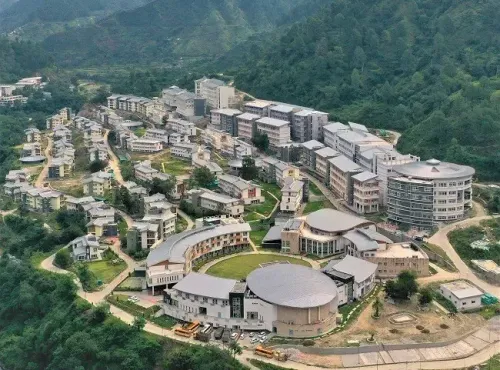
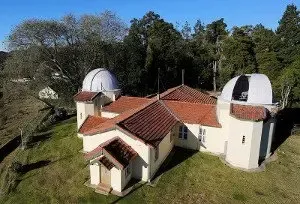
Research was led by scientists at the Indian Institute of Astrophysics (IIA) and published in Astrophysical Journal Letters .
The technique allows CME motion to be reconstructed without full multi-viewpoint space imaging, a key advance for the lower corona .
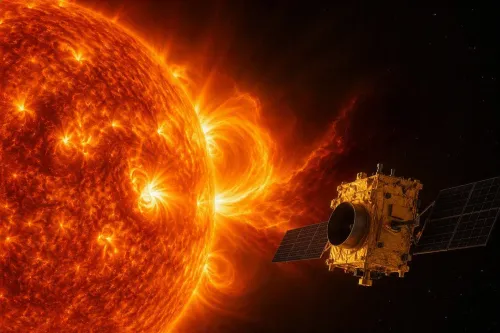
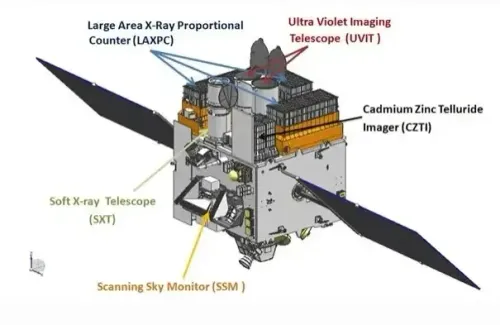
Aditya-L1, launched in September 2023 , operates from the Sun–Earth L1 Lagrange point and carries 7 payloads .
India's first space-based solar observatory, Aditya-L1, has helped scientists uncover a fundamental new detail about coronal mass ejections (CMEs): these massive solar eruptions do not expand uniformly as previously assumed, according to an official statement from the Ministry of Science & Technology released on Tuesday, 3 November 2026. The finding carries direct implications for predicting space-weather disturbances that can disrupt satellites, communication networks, and power grids on Earth.
What Aditya-L1 Observed
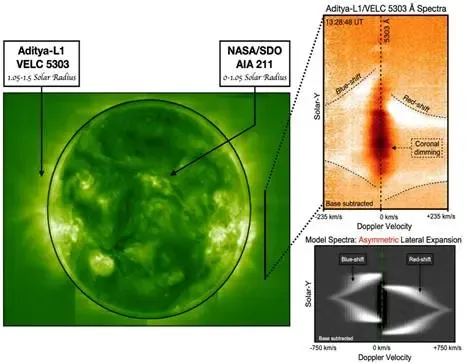
Researchers from the Indian Institute of Astrophysics (IIA) combined observations from the Visible Emission Line Coronagraph (VELC) aboard Aditya-L1 with data from NASA's Solar Dynamics Observatory (SDO) and three-dimensional modelling to reconstruct the full 3-D geometry and dynamics of a CME. The exercise revealed, for the first time, that a CME's sideways expansion is uneven — a discovery that meaningfully changes how scientists model a solar eruption's journey through the heliosphere.
Why Asymmetric Expansion Matters
'The asymmetric shape of an early CME can have important implications for how it interacts with the solar wind and experiences drag during its propagation through the heliosphere. Such effects can influence the CME's speed and, ultimately, its arrival time at Earth,' said Jayant Joshi of IIA, co-author of the study published in Astrophysical Journal Letters. In practical terms, a CME that arrives even hours earlier or later than forecast can determine whether a satellite operator has time to put systems into safe mode — making arrival-time accuracy a matter of real operational consequence.
How the Study Was Conducted
The team used a model to test how a CME's orientation and uneven lateral expansion produce specific spectral structures observed by VELC. This approach allows researchers to reconstruct a CME's motion without relying entirely on multi-viewpoint imaging from telescopes in space — a significant methodological advance. The technique is particularly valuable in the lower corona, where CMEs evolve rapidly and their motion along the line of sight cannot be obtained from imaging alone.
About Aditya-L1
Launched in September 2023, Aditya-L1 is now operational at the Sun–Earth L1 Lagrange point, providing continuous, uninterrupted observations of the Sun. It carries 7 payloads, of which VELC — an internally occulted coronagraph designed to observe the solar corona simultaneously in multiple modes — is the primary instrument. The L1 vantage point allows the satellite to monitor the Sun without the orbital eclipses that affect Earth-orbiting observatories.
What Comes Next
The IIA researchers plan to apply this reconstruction technique to other CMEs, progressively building a dataset that can improve the accuracy of space-weather models globally. The study underscores Aditya-L1's value not just as a national milestone but as a contributor to international solar science. As solar activity continues near its Solar Cycle 25 peak, the timing of these findings is particularly significant for space agencies and satellite operators worldwide.
Frequently Asked Questions
What did Aditya-L1 discover about coronal mass ejections?
Aditya-L1 helped scientists establish for the first time that coronal mass ejections expand asymmetrically rather than uniformly. This uneven expansion affects a CME's interaction with the solar wind, altering its speed and arrival time at Earth.
Why does asymmetric CME expansion matter for space weather?
Because a CME that arrives earlier or later than predicted can determine whether satellite operators have time to protect their systems. Improved arrival-time forecasts reduce the risk of damage to satellites, communication networks, and power infrastructure.
Who conducted the Aditya-L1 CME study and where was it published?
The study was conducted by researchers at the Indian Institute of Astrophysics (IIA), led by co-author Jayant Joshi, and published in Astrophysical Journal Letters. The team combined VELC data from Aditya-L1 with NASA Solar Dynamics Observatory data and 3-D modelling.
What is Aditya-L1 and where does it operate?
Aditya-L1 is India's first space-based solar observatory, launched in September 2023. It operates from the Sun–Earth L1 Lagrange point, allowing continuous, uninterrupted observation of the Sun with its 7 payloads, the primary one being the Visible Emission Line Coronagraph (VELC).
What are scientists planning to do next with this technique?
IIA researchers plan to apply the 3-D reconstruction technique to multiple other CMEs to build a broader dataset. The method is especially valuable in the lower corona, where CME evolution is rapid and cannot be fully captured by imaging alone.