Sitharaman at IIT BHU: Dikshitar's Music Holds India Together
Synopsis
At IIT BHU Varanasi, Finance Minister Nirmala Sitharaman praised the layered history and geography embedded in Muthuswami Dikshitar's Carnatic kritis and called on schools across India to introduce children to music traditions from all regions, framing cultural diversity as the foundation of national unity.
Key Takeaways
Union Finance Minister Nirmala Sitharaman spoke at IIT BHU Varanasi on November 3, 2026 .
She highlighted the compositions of Muthuswami Dikshitar as a unique blend of history, geography, and worship traditions.
She appealed to students and teachers to incorporate music from across India into education.
Dikshitar's kritis (1775–1835) are renowned for encoding temple geography and regional culture across the subcontinent.
The remarks made at a Hindustani classical heartland institution carry symbolic weight for cross-regional cultural exchange.
The appeal points toward a potential push for more diverse music curricula in Indian schools and colleges.
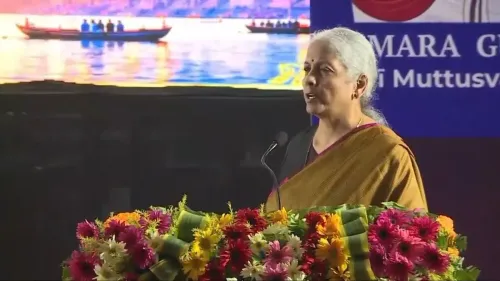
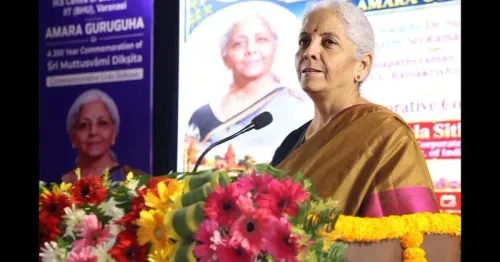
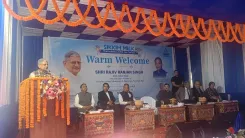
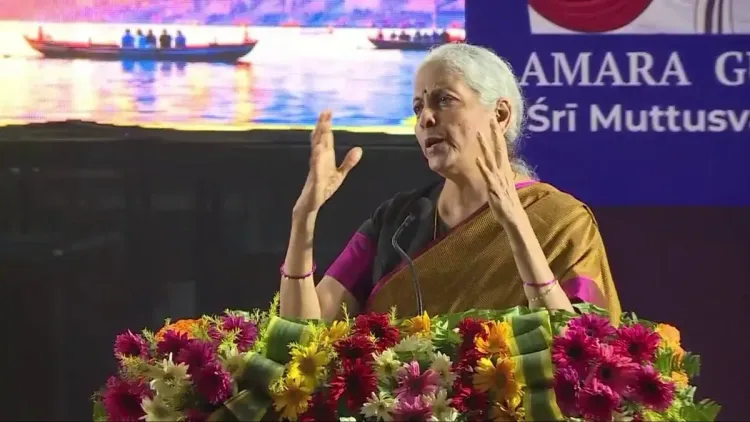
A finance minister walked into a music discussion at one of India's premier technical universities — and walked out with a plea for every Indian child. Speaking at IIT BHU Varanasi on Tuesday, November 3, 2026, Union Finance Minister Nirmala Sitharaman invoked the timeless kritis of Muthuswami Dikshitar to make a case for cross-regional music education in schools.
Sitharaman's words carried both reverence and urgency. 'Each of Sri Muthuswami Dikshitar's songs brings together a complete history, geography, cultural roots and traditions of worships all blended together,' she said. Then came the call to action: a humble but pointed appeal that music from across India — not just the region a child grows up in — should find its way into classrooms, exactly as it was being done at the event she was addressing.
Why Dikshitar Is the Right Messenger
Muthuswami Dikshitar (1775–1835) was not merely a composer. He was a cartographer of devotion. His Carnatic kritis embed the precise geography, presiding deities, local lore, and worship traditions of temples scattered across the Indian subcontinent. A student who learns a Dikshitar composition about a Varanasi shrine is, simultaneously, absorbing history, Sanskrit, regional geography, and ritual tradition. That is the layered richness Sitharaman was pointing to — and it is precisely why Carnatic music scholars regard his body of work as a living encyclopaedia of sacred India. The broader Carnatic tradition, rooted in Tamil Nadu and spreading across Karnataka, Andhra Pradesh, Kerala and beyond, rarely features in the formal music education of children in North or East India. The reverse is equally true: Hindustani classical music, with its gharana lineages and raga grammar, remains largely foreign to children in the south. Sitharaman's remark at a Varanasi institution — geographically and culturally the heartland of Hindustani tradition — made the cross-pollination point with quiet precision.Technical Campuses as Cultural Bridges
IIT BHU Varanasi, housed within the Banaras Hindu University campus, sits at a rare intersection: engineering rigour on one side, the classical arts legacy of Kashi on the other. The fact that a discussion on Dikshitar's music was happening here at all speaks to the institution's broader cultural identity. Sitharaman's endorsement of this approach — introducing students to musical traditions from other parts of India — implicitly asks other universities and schools to follow suit. Indian leaders have periodically flagged classical music as a vehicle for transmitting shared history, but the call usually stays at the level of aspiration. What made Sitharaman's framing sharper was its pedagogical specificity: she directed the appeal to students and their teachers, treating music education not as ornament but as curriculum.One Melody, Many Histories
The deeper argument embedded in her remarks is about the architecture of national unity — not the top-down, decree-driven kind, but the kind that grows when a child in Lucknow discovers a raga rooted in a Chidambaram temple, or a student in Chennai hears a thumri and feels Banaras. Music, Sitharaman suggested, does what policy cannot always do: it makes cultural diversity feel not like a fact to be managed, but a gift to be experienced. If schools and colleges take the cue, the conversation that began at IIT BHU Varanasi may eventually reach the curriculum drafters who decide what a ten-year-old hears in music class.Point of View
Targeting teachers and curricula rather than making a civilisational claim. By anchoring the argument in Dikshitar's specific compositional method — geography, temple history, ritual — she offers music education advocates a concrete intellectual hook rather than a vague appeal to unity. The choice of Varanasi, the spiritual capital of Hindustani tradition, to advocate for Carnatic music exposure adds a pointed geographic symmetry. Whether this translates into curriculum action will depend on whether the National Education Policy's arts education provisions are actually operationalised at the school level.
NationPress
3 Nov 2026
Frequently Asked Questions
Who was Muthuswami Dikshitar and why is he significant?
Muthuswami Dikshitar (1775–1835) was a celebrated Carnatic composer whose kritis uniquely blend the geography, presiding deities, local history and worship traditions of temples across India, making his music both artistic and encyclopaedic.
What did Nirmala Sitharaman say at IIT BHU Varanasi?
She said each of Dikshitar's songs brings together history, geography, cultural roots and worship traditions, and called on students and teachers to introduce music from all regions of India into classrooms to appreciate the country's cultural diversity.
Why did Sitharaman speak about music at a technical university?
IIT BHU Varanasi hosted a cultural event where classical music was being discussed. Sitharaman used the platform to make a broader point about music education and national unity.
What is the difference between Carnatic and Hindustani classical music?
Carnatic music is the classical tradition of South India, associated with Tamil Nadu, Karnataka, Andhra Pradesh and Kerala. Hindustani music is the North Indian tradition, developed through gharana lineages and prominent in states like Uttar Pradesh, Rajasthan and Bihar.
How can Indian schools introduce cross-regional music education?
Educators can incorporate listening modules, cultural appreciation sessions, and dedicated music periods that expose children to both Carnatic and Hindustani traditions, as well as folk forms from different states — an approach Sitharaman endorsed at the IIT BHU Varanasi event.