Will AI Enhance Human Employment Rather Than Replace It?
Synopsis
At the World Economic Forum 2026, industry leaders shared insights on how AI will reshape rather than replace human jobs. They emphasized that AI enhances efficiency and creates new roles while highlighting the importance of adapting organizational structures for success.
Key Takeaways
AI will transform the workplace by automating repetitive tasks.
Human workers excel in managing multiple tasks, unlike AI.
Future projections suggest a growing number of AIs complementing human roles.
AI should be viewed as a tool rather than a replacement.
Organizational adaptation is key to leveraging AI effectively.
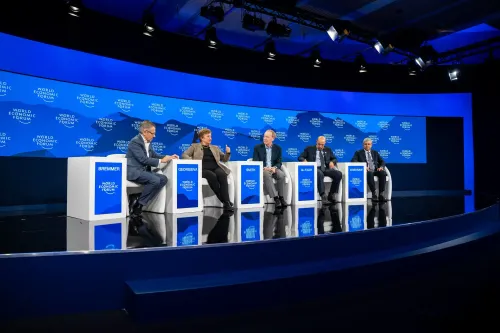
New Delhi, Jan 22 (NationPress) Leading executives from tech firms gathered at the current World Economic Forum 2026 in Davos asserted that artificial intelligence will not eliminate human jobs but will transform the nature of work through task automation.
Kian Katanforoosh, the Founder and CEO of Workera, emphasized the importance of terminology when discussing AI.
“I personally prefer not to refer to AI as agents or co-workers,” he stated during a WEF discussion, highlighting that while AI is proficient in certain tasks, it cannot surpass humans in executing “entire jobs.”
In contrast, humans manage “hundreds of tasks simultaneously.” “Predictions of a complete job replacement by AI have proven erroneous thus far,” he remarked.
Munjal Shah, co-founder and CEO of Hippocratic AI, concurred, suggesting that AI is set to significantly enhance human workforces instead of taking over their roles.
He envisioned a future of “8 billion individuals and 80 billion AIs,” where the majority of systems focus on creating new applications rather than displacing human workers.
He cited an instance of an AI system that contacted thousands of individuals during a heatwave, directing them to cooler areas and providing health recommendations. Achieving accuracy required extensive testing. “We utilize models that evaluate models that assess models,” he explained.
Kate Kallot, Founder and CEO of Amini, remarked that AI remains a “tool” and lacks the capability for value-based decision-making.
It “cannot determine the optimal outcomes” due to insufficient inputs, Kallot pointed out.
Christoph Schweizer, CEO of BCG, described the experience of working with AI as akin to collaborating with a co-worker.
“In this reality, it feels like a co-worker, regardless of what you call it,” he stated.
Schweizer contended that success hinges on how organizations adapt their structures, not merely their tools. “They will thrive if they genuinely transform how their personnel operate,” he asserted.
He stressed that AI should be approached as “a CEO problem” that requires direct attention.
Enrique Lores, President and CEO of HP, called for a balanced approach to AI, cautioning against demanding more from AI than from human employees.
In HP’s call centers, while AI occasionally provides incorrect information, overall accuracy has improved, leading to higher customer satisfaction, he noted.
Point of View
I believe that the insights shared at the World Economic Forum 2026 highlight a crucial aspect of the evolving workplace. Embracing AI as a tool for enhancement rather than replacement aligns with our national approach to fostering innovation while preserving human roles.
NationPress
24 Sept 2026
Frequently Asked Questions
Will AI take over human jobs?
Experts at the World Economic Forum 2026 believe AI will reshape jobs by automating tasks, but it won't entirely replace human employment.
How will AI affect the workforce?
AI is anticipated to enhance human employees' capabilities, leading to new roles and improved efficiency in various sectors.
What is the future of AI and humans in the workplace?
The future envisions a collaboration between humans and AI, with a significant number of AI systems augmenting human tasks rather than displacing them.