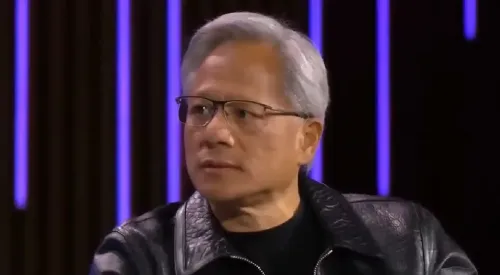
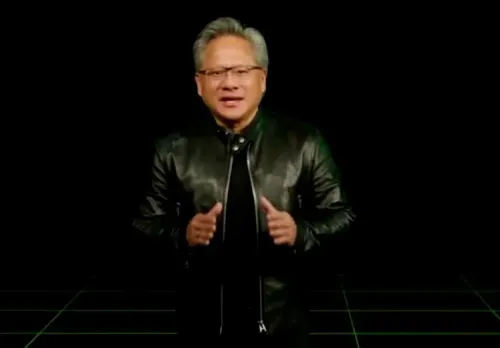
Should We Rethink Jobs in the Age of AI? Insights from Jensen Huang at Davos

Synopsis
Jensen Huang, the CEO of Nvidia, presented compelling insights at the World Economic Forum in Davos, advocating for a reevaluation of jobs in the AI era. He highlighted the potential of AI to enhance job productivity and the necessity for nations to invest in AI infrastructure.
Key Takeaways
AI enhances the purpose of jobs by automating tasks.
AI infrastructure to harness its benefits.
AI are essential in today’s workforce.
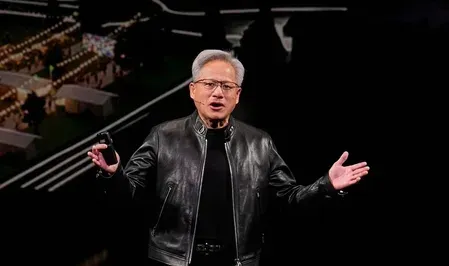
Davos, Jan 22 (NationPress) Jensen Huang, the President and CEO of Nvidia, emphasized the importance of viewing jobs through the lens of purpose rather than merely tasks in this AI era. He noted that while automation streamlines tasks, it simultaneously enhances the overall purpose of these roles, making them significantly more productive.
During the discussions at the World Economic Forum, Huang expressed enthusiasm about the influence of AI infrastructure, computing power, and GPU innovations on the forthcoming waves of technological evolution and economic advancement. He highlighted the remarkable potential of AI to not only transform industries but also generate new job opportunities.
“It’s fantastic to see job prospects expanding in skilled trades such as plumbing and electrical work. Salaries in these sectors have nearly doubled due to this surge,” he remarked during the session.
Using the role of a radiologist as an example, he stated that the essence of the job is to diagnose diseases, but AI has alleviated the tedious task of processing scans, leading to increased hiring in hospitals as the entire healthcare ecosystem grows.
Huang urged every nation to develop its own AI infrastructure, emphasizing that using AI is incredibly accessible. “It’s vital for everyone to engage with AI,” he asserted.
“Learning to utilize AI is akin to managing and leading people—skills we constantly employ. AI has the potential to bridge the technology divide, and I’m optimistic about its capability to elevate emerging countries and empower individuals,” he added.
Huang elaborated on how modern computers can interpret unstructured data and make reasoned decisions based on context, rather than simply following pre-recorded instructions.
“This is a unique opportunity to integrate industrial skills with AI, advancing into the realm of physical AI and robotics. It’s a once-in-a-lifetime chance, and we require more energy and skilled laborers,” Huang concluded.
Point of View
It is crucial to recognize the transformative potential of AI as described by Jensen Huang. His insights at the World Economic Forum underscore the need for a strategic approach to job creation in a rapidly evolving technological landscape. By embracing AI and prioritizing skill development, we can ensure that nations not only remain competitive but also empower their workforces.
NationPress
19 Sept 2026
Frequently Asked Questions
What is the main message from Jensen Huang about jobs in the AI era?
Jensen Huang emphasizes the importance of viewing jobs in terms of purpose rather than just tasks, as AI enhances job productivity through automation.
How does AI impact job creation according to Huang?
Huang suggests that automation through AI not only improves efficiency but also leads to the creation of more jobs in various sectors, including healthcare.
What skills does Huang believe are essential in the AI landscape?
Huang highlights that learning to use AI is essential and equates it to skills like managing and leading people, which are vital in today’s work environment.
What opportunities does Huang foresee with AI and skilled trades?
He sees a remarkable opportunity to combine industrial capabilities with AI , which can lead to a surge in skilled trades and enhanced job prospects.
Why does Huang consider it important for every country to build AI infrastructure?
Huang believes that developing AI infrastructure is crucial for countries to leverage AI's potential and close the technology divide.