SEBI Chairman Pandey: Regulated entities fully liable for AI tools used in markets

Synopsis
SEBI Chairman Tuhin Kanta Pandey has drawn a firm line: regulated entities — not the regulator — are fully liable for every AI or machine learning tool they deploy, whether built in-house or bought from a vendor. With an IT resilience index also in the works, SEBI is signalling that India's fast-digitalising financial markets will be held to a higher, more measurable accountability standard.
Key Takeaways
SEBI Chairman Tuhin Kanta Pandey stated on 19 August that every regulated entity is fully responsible for AI or machine learning tools it uses, in-house or third-party.
SEBI is examining an IT resilience index for market infrastructure institutions to objectively assess critical system robustness.
Pandey described India's capital markets as no longer just a barometer but an active driver of economic activity .
Growth of mutual funds and SIPs cited as evidence of broader household participation in market-linked investments.
SEBI's regulatory stance aims for proportionate, forward-looking oversight that balances market growth with investor protection.
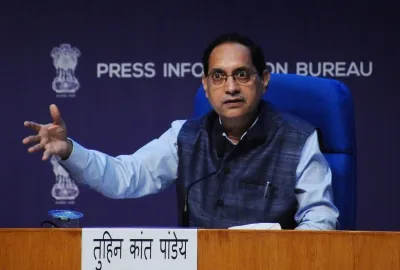
Securities and Exchange Board of India (SEBI) Chairman Tuhin Kanta Pandey on Wednesday, 19 August made clear that accountability for artificial intelligence tools in financial markets rests squarely with the entities deploying them — not with the regulator. Speaking at the 23rd FICCI Capital Markets Conference (CAPAM 2026) in New Delhi, Pandey said every SEBI-regulated entity bears full responsibility for any AI or machine learning tool it uses, regardless of whether the technology was built internally or sourced from a third party.
What Pandey Said on AI Accountability
'With AI and technology, every SEBI-regulated entity remains fully responsible for any AI or machine learning tool it uses, whether developed in-house or procured from a third party,' Pandey stated. The position signals that SEBI does not intend to absorb liability on behalf of market participants as they accelerate technology adoption — a stance that places the compliance burden firmly on brokers, asset managers, and other regulated intermediaries.
IT Resilience Index Under Examination
Beyond accountability, Pandey disclosed that SEBI is actively examining the introduction of an IT resilience index for market infrastructure institutions. The proposed framework would provide an objective benchmark for assessing the robustness of critical systems — exchanges, clearing corporations, and depositories — against technology failures and cyber threats. 'We are examining an IT resilience index for market infrastructure institutions to provide an objective framework for assessing the resilience of critical systems,' he said. No timeline for the index has been announced yet.
India's Capital Markets: From Barometer to Driver
Pandey used the CAPAM platform to articulate a broader vision for India's financial markets, arguing that they have evolved well beyond their traditional role. 'India's capital markets have transformed and are no longer merely a barometer of economic activity. They are an important driver of it,' he said. He pointed to the growth of mutual funds and systematic investment plans (SIPs) as evidence that market-linked investments are reaching more Indian households, strengthening domestic resilience even as global volatility persists.
The Road Ahead: Deeper, Fairer, More Innovative Markets
Pandey stressed that India's next growth phase would demand intelligent use of technology to widen investment opportunities, deepen financing channels, and make regulation more future-ready. He acknowledged that significant scope remains to expand capital market participation beyond current levels. 'The central question: How do we build markets that are deeper and more innovative, yet fairer, safer, and more trusted?' he said, framing it as the defining challenge for regulators and market participants alike. SEBI's regulatory approach, he added, is calibrated to ensure proportionate and forward-looking oversight that supports market growth without compromising investor protection or market integrity.
Point of View
SEBI is effectively telling the industry that 'we bought it from a vendor' will not be an acceptable defence. The proposed IT resilience index, if implemented with teeth, could become a meaningful supervisory tool — but only if SEBI publishes the methodology and enforces against laggards, rather than letting it become another self-reported compliance checkbox. India's capital market deepening story is real, but the SIP-driven retail surge also concentrates systemic risk in a way that makes technology resilience non-negotiable, not optional.
NationPress
19 Aug 2026
Frequently Asked Questions
What did SEBI Chairman Tuhin Kanta Pandey say about AI responsibility?
Pandey said every SEBI-regulated entity is fully responsible for any AI or machine learning tool it uses, whether developed in-house or procured from a third party. He made the statement at the 23rd FICCI Capital Markets Conference (CAPAM 2026) in New Delhi on 19 August.
What is the IT resilience index SEBI is considering?
SEBI is examining an IT resilience index for market infrastructure institutions — such as exchanges, clearing corporations, and depositories — to provide an objective framework for assessing the robustness of their critical systems. No timeline has been announced for its introduction.
Who does SEBI's AI accountability rule affect?
It affects all SEBI-regulated entities, including brokers, asset managers, investment advisers, and other market intermediaries that deploy AI or machine learning tools in their operations, regardless of whether those tools are proprietary or sourced externally.
Why is SEBI focusing on technology regulation now?
The rapid adoption of AI and digital tools across financial markets has raised questions about accountability and systemic risk. Pandey noted that India's next phase of growth requires intelligent use of technology, making it essential for regulation to keep pace without stifling market development.
What is SEBI's broader vision for India's capital markets?
Pandey described India's capital markets as having evolved from a barometer of economic activity to an active driver of it. He called for markets that are deeper, more innovative, yet fairer, safer, and more trusted, with expanded participation beyond current levels.