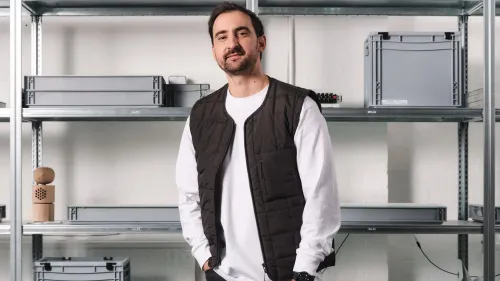
Nothing CEO Carl Pei: India set to produce global electronics giants

Synopsis
Nothing CEO Carl Pei is placing a structural bet on India — not just as a factory, but as a future home of global consumer electronics brands. His plan to spin CMF into a majority Indian-owned, India-headquartered company with its own R&D is the sharpest signal yet that the 'assemble here, design elsewhere' model has a serious challenger.
Key Takeaways
Nothing CEO Carl Pei stated on 21 September that India will produce global consumer electronics companies, calling R&D the decisive next step after manufacturing.
India is already the world's second-largest smartphone manufacturer , with a large youth population and deep software talent pool.
Pei cited Japan, South Korea, and China as precedents where manufacturing scale eventually produced global brands.
Nothing plans to spin out its CMF brand as a majority Indian-owned , India-headquartered standalone company with local R&D capabilities.
In 2015 , Indian smartphone brands held close to half of domestic sales; Pei argues the next wave depends on in-house product development.
Nothing CEO Carl Pei on Monday, 21 September declared that India is on course to produce its own global consumer electronics champions, citing the country's position as the world's second-largest smartphone manufacturer, its large youth population, and a deep software talent pool. The remarks, made in New Delhi, come as debate intensifies over whether Indian brands can move beyond assembly to true product ownership.
The R&D Gap India Must Close
Pei argued that manufacturing capability alone is insufficient. According to Pei, the critical missing piece for India is the ability to develop and continuously improve products through in-house research and development — the quality that separates sustainable global brands from contract-assembly operators.
'Manufacturing is step one. Step two is R&D,' Pei said, adding that India already possesses much of the industrial foundation required to advance to the next stage.
He drew a direct line between R&D investment and brand durability, arguing that companies relying on products developed by manufacturing partners cannot sustain long-term growth in the way that Japanese, South Korean, and Chinese firms eventually did.
India at an Inflection Point, Says Pei
Pei said his eight years in China gave him a first-hand view of how a manufacturing ecosystem can evolve into a global consumer electronics powerhouse, and that India is now at a comparable inflection point. He pointed to 2015 as a reference point, when domestic brands accounted for close to half of all smartphone sales in India, with one Indian brand briefly overtaking Samsung to become the best-selling smartphone in the country.
That window, Pei suggested, closed partly because those brands lacked the R&D depth to sustain momentum. The next opportunity, he argued, belongs to whoever builds genuine engineering and product development capability within India.
'India will produce global consumer electronics companies. The only question is when, and that depends on who builds them,' Pei said.
Nothing to Spin Out CMF as a Standalone Indian Company
Pei said Nothing intends to contribute to this trajectory by spinning out its CMF brand as a standalone Indian company. The new entity will be majority Indian-owned and headquartered in India, with its own team and R&D capabilities on the ground. Nothing will retain a shareholding and continue as a partner in the business.
The move is notable: it represents one of the few instances of a global consumer electronics brand explicitly restructuring to give an Indian entity operational and ownership primacy, rather than treating India purely as a manufacturing or sales market.
What This Signals for India's Electronics Ambitions
India's electronics manufacturing sector has grown rapidly under production-linked incentive schemes, attracting assembly operations from Apple, Samsung, and a range of component suppliers. However, critics have long noted that the value addition remains concentrated at the lower end of the supply chain, with design, software, and chipset development largely absent.
Pei's framing — that R&D capability is the defining variable — echoes concerns raised by Indian industry bodies and policymakers. Whether the CMF spin-out becomes a template others follow will depend significantly on whether India's talent base and regulatory environment can support sustained product development at scale.
Point of View
But the CMF spin-out is the real story. India has heard the 'manufacturing to R&D' argument before — from policymakers, industry bodies, and visiting CEOs — without a structural follow-through. What makes this different is that a sitting global brand CEO is backing the thesis with equity and organisation design, not just rhetoric. The harder question is whether CMF can build genuine IP in a market where talent retention, semiconductor access, and procurement scale still favour incumbents. India produced dominant domestic smartphone brands in 2015 and lost them within three years. The inflection-point narrative is compelling; the execution variables are brutal.
NationPress
21 Sept 2026
Frequently Asked Questions
What did Nothing CEO Carl Pei say about India's electronics industry?
Carl Pei said India is on track to produce its own global consumer electronics brands, arguing that the country already has the manufacturing base and talent pool needed, and that investing in in-house R&D is the critical next step. He made these remarks in New Delhi on 21 September 2026.
What is the CMF brand spin-out that Nothing is planning?
Nothing intends to spin out its CMF brand as a standalone company that will be majority Indian-owned, headquartered in India, and equipped with its own team and R&D capabilities. Nothing will remain a shareholder and partner in the new entity.
Why does Carl Pei believe India can become a consumer electronics powerhouse?
Pei draws on his eight years in China to argue that any country that builds consumer electronics at scale eventually produces global brands of its own. He sees India at a similar inflection point, supported by its status as the world's second-largest smartphone manufacturer and a large software talent pool.
What is the R&D gap Pei says India needs to close?
According to Pei, the missing piece is not manufacturing capacity but the ability to develop and continuously improve products through in-house research and development. He argues this capability is what allows companies to sustain global growth rather than depending on products designed by manufacturing partners.
How does India's 2015 smartphone market factor into Pei's argument?
Pei noted that in 2015 Indian brands accounted for close to half of all smartphone sales domestically, with one brand briefly outselling Samsung. He uses this as evidence of latent brand-building potential, while arguing that the lack of R&D depth ultimately prevented those brands from sustaining their position.