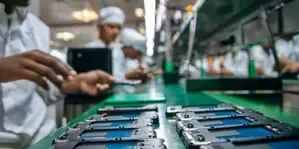
India captures 18% of global smartphone output in China+1 shift

Synopsis
India now assembles nearly a quarter of all Apple iPhones and has become the US's top smartphone import source — yet domestic value addition sits at just 23 per cent. The real race isn't for assembly share; it's for the $120–150 billion semiconductor value chain India is betting it can build by 2035.
Key Takeaways
India held roughly 18 per cent of global smartphone production by 2025 , making it the world's second-largest producer.
China , India , and Vietnam together account for more than 90 per cent of global smartphone output.
India's domestic mobile phone production has grown more than twentyfold in under a decade; exports have surged more than 100-fold .
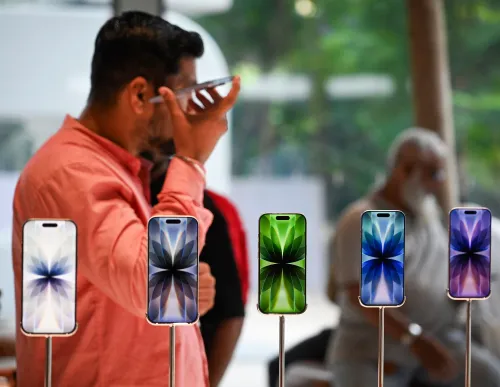
India now assembles nearly a quarter of Apple's iPhones and is the largest source of smartphones imported into the United States .
Google plans to end Chinese manufacturing of some Pixel devices by 2027 , shifting production to India.
The government has committed approximately $10 billion under Semicon India , targeting a $120–150 billion semiconductor value chain by 2035 .
India has emerged as the primary alternative to China in the global smartphone supply chain, with its share of worldwide handset production climbing to roughly 18 per cent by 2025, according to a new industry report. The surge reflects a structural realignment as multinational companies pursue a 'China plus one' manufacturing strategy, reducing concentration risk without fully exiting Chinese facilities.
How the Numbers Stack Up
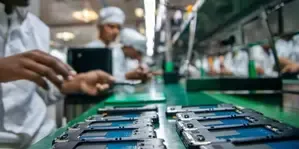
By 2025, China, India, and Vietnam together accounted for more than 90 per cent of global smartphone production, according to the report. China retained its dominant position at approximately 63 per cent of output, but India's share — negligible less than a decade ago — has climbed to around 18 per cent, making it the second-largest producer globally.
Domestic mobile phone production has expanded more than twentyfold in under ten years, while exports have surged more than 100-fold over the same period — a scale of growth rarely seen in any manufacturing category.
The PLI Effect and Apple's India Pivot
India's rise has been driven in significant part by the Production Linked Incentive (PLI) scheme, which rewards manufacturers for scaling output and meeting localisation targets, the report noted. The policy has attracted marquee names: India now assembles nearly a quarter of all Apple iPhones globally and has become the largest source of smartphones imported into the United States.
Google is also shifting Pixel smartphone production toward India and reportedly plans to end Chinese manufacturing of certain devices by 2027. These moves signal that India is no longer merely a cost-arbitrage destination but an increasingly strategic node in global electronics supply chains.
The Limits of the Shift
The emerging global strategy, the report emphasised, is 'not to replace China but to reduce dependence on it by developing additional manufacturing centres.' China remains central to the broader electronics ecosystem as the world's largest smartphone producer and a dominant supplier of integrated circuits and display panels.
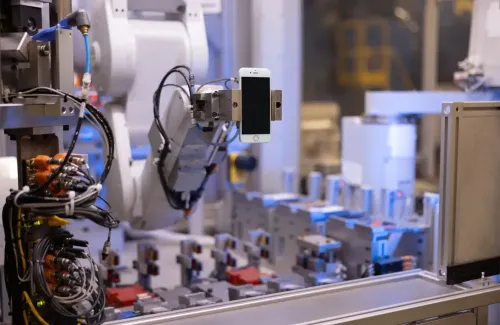
India's own value addition in mobile phones has risen to around 23 per cent, but most components — including critical sub-assemblies — continue to be imported. Scaling domestic value addition is the next frontier, with ambitions spanning circuit boards, camera modules, batteries, displays, and semiconductors.
The Semiconductor Bet
To move up the value chain, the Indian government has committed approximately $10 billion through its Semicon India programme for semiconductor development, with additional funding targeting chip design, manufacturing equipment, specialty materials, and skilled engineers.
The country's stated ambition is to build a $120 billion to $150 billion semiconductor value chain by 2035, according to the report. If achieved, this would transform India from an assembly hub into a full-spectrum electronics manufacturing power — though analysts caution that semiconductor ecosystems take decades to mature.
What Comes Next
India's trajectory in global smartphone manufacturing is now well established, but sustaining momentum will require closing the component gap. With global tech majors deepening their India commitments and government incentives still in force, the next phase of growth will test whether the country can move beyond final assembly into the higher-value layers of the electronics supply chain.
Point of View
Not a statistical artefact — but the celebratory framing obscures a more complex reality. Domestic value addition at 23 per cent means the country is still largely an assembly floor for components designed and made elsewhere, primarily in China. The PLI scheme has been effective at attracting final-stage manufacturing, but the harder problem — building a competitive component and semiconductor ecosystem — remains largely unsolved. The $10 billion Semicon India commitment is a start, yet global semiconductor fabs take a decade or more to reach maturity. India's window to convert assembly dominance into supply-chain depth is real, but it is not guaranteed.
NationPress
15 Oct 2026
Frequently Asked Questions
What is India's share of global smartphone production in 2025?
India accounted for roughly 18 per cent of global smartphone production by 2025, making it the world's second-largest producer after China, which held approximately 63 per cent. Together with Vietnam, the three countries produced more than 90 per cent of the world's smartphones.
What is the 'China plus one' strategy and how does India benefit?
The 'China plus one' strategy refers to multinational companies retaining Chinese manufacturing while building alternative production bases to reduce supply-chain concentration risk. India has been one of the primary beneficiaries, attracting major manufacturers including Apple and Google on the back of PLI incentives and a large domestic market.
How has the PLI scheme helped India's smartphone manufacturing?
The Production Linked Incentive (PLI) scheme rewards manufacturers for scaling output and meeting localisation targets, making India more competitive as a production destination. It has helped attract global brands, with India now assembling nearly a quarter of Apple's iPhones and becoming the largest source of smartphones imported into the United States.
What is India's semiconductor ambition and how much has the government invested?
India aims to build a $120 billion to $150 billion semiconductor value chain by 2035. The government has committed approximately $10 billion through the Semicon India programme, targeting chip design, manufacturing equipment, specialty materials, and skilled engineer development.
Is India replacing China in electronics manufacturing?
No — the stated global strategy is to reduce dependence on China, not replace it. China remains the world's largest smartphone producer and a dominant supplier of integrated circuits and display panels. India's role is to serve as a significant alternative manufacturing centre, particularly for final assembly.