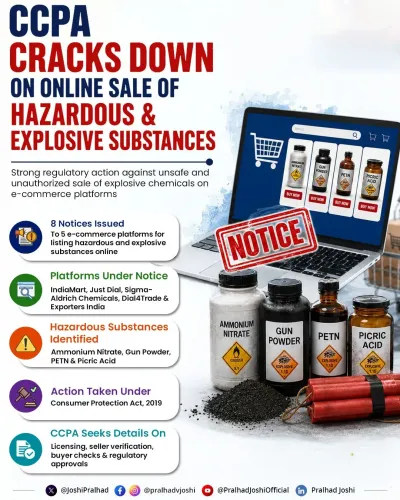
CCPA fines Dial4Trade ₹10 lakh for selling ammonium nitrate online

Synopsis
India's consumer protection watchdog has fined an e-commerce platform ₹10 lakh for selling ammonium nitrate — a classified explosive — like an ordinary product, complete with blast imagery and no licence checks. The CCPA's rejection of the platform's B2B defence sets a landmark precedent: intermediary status is no shield when basic safety safeguards are missing.
Key Takeaways
The CCPA imposed a ₹10 lakh penalty on Dial4Trade Technologies Private Limited on 2 September for listing ammonium nitrate without mandatory safeguards.
The order was passed under Sections 10, 20 and 21 of the Consumer Protection Act, 2019 .
Dial4Trade must immediately stop listing, advertising, or facilitating sale of ammonium nitrate and other explosives under the Explosives Act, 1884 .
Key lapses included no PESO licence disclosure, no buyer identity verification, and no transaction traceability as required under the Ammonium Nitrate Rules, 2012 .
The platform's B2B intermediary defence was rejected as the substance was available in single-unit quantities with no institutional-buyer checks.
The ruling sets a precedent for e-commerce liability over listings of hazardous and regulated substances in India.
The Central Consumer Protection Authority (CCPA) on Wednesday, 2 September imposed a penalty of ₹10 lakh on Dial4Trade Technologies Private Limited for listing, hosting, advertising, and facilitating the sale of ammonium nitrate on its e-commerce platform without the mandatory regulatory safeguards required under Indian law. The order marks a significant regulatory intervention in how digital marketplaces handle classified explosive substances.
The Order and Its Legal Basis
The final order was passed under Sections 10, 20 and 21 of the Consumer Protection Act, 2019. The CCPA is headed by Chief Commissioner Nidhi Khare, alongside Commissioner Anupam Mishra. Beyond the financial penalty, the authority has directed Dial4Trade to immediately cease listing, hosting, advertising, or facilitating the sale of ammonium nitrate and any other substance classified as an explosive under the Explosives Act, 1884.
What the CCPA Found
During its examination, the authority identified multiple critical lapses in Dial4Trade's platform. Ammonium nitrate was made available for purchase without disclosure of the seller's valid licence issued by the Petroleum and Explosives Safety Organisation (PESO), without verification of the buyer's identity or licensed status, and without any mechanism to ensure transaction traceability as required under the Ammonium Nitrate Rules, 2012.
The CCPA also noted that the product listing failed to caution users about the legal restrictions governing the possession and use of ammonium nitrate, or the consequences of unauthorised possession. Notably, the listing was accompanied by images depicting explosions and blast effects — imagery the authority concluded was more likely to attract attention to the product than to communicate its hazardous and strictly regulated nature.
Misleading Advertisement and Unfair Trade Practice
The CCPA held that a product listing hosted on a digital marketplace and communicated to the public via the internet qualifies as an 'advertisement' under the Consumer Protection Act, 2019. It further observed that presenting a regulated explosive as an ordinary consumer product — without informing users that lawful purchase requires a prescribed licence — constitutes both a misleading advertisement and an unfair trade practice.
Platform's B2B Defence Rejected
Dial4Trade had argued in its defence that it operates as a business-to-business (B2B) marketplace intermediary and should therefore not be held liable for listings uploaded by third-party sellers. The CCPA rejected this argument outright. The authority noted that the platform allowed the substance to be purchased in quantities as low as a single unit, and had neither minimum-order requirements nor institutional-buyer verification mechanisms typically associated with a genuine B2B marketplace.
Broader Implications for E-Commerce Platforms
This case sets a precedent for how Indian regulators may approach digital platforms that host listings of hazardous or tightly regulated substances. It signals that intermediary status alone does not shield a platform from liability when basic safeguards — licence verification, buyer identity checks, and adequate hazard disclosures — are absent. E-commerce operators across sectors dealing in chemicals, pharmaceuticals, or other regulated goods may now face heightened scrutiny. The CCPA's intervention is expected to prompt a wider review of listing policies across Indian digital marketplaces.
Point of View
It cannot credibly claim it serves only licensed institutions. What this case also exposes is the broader regulatory gap in Indian e-commerce, where the burden of policing hazardous listings has historically fallen on enforcement agencies rather than on platforms themselves. Expect the CCPA and allied regulators to use this order as a template for future action against marketplaces that profit from regulated-substance listings while outsourcing all compliance risk to sellers.
NationPress
18 Oct 2026
Frequently Asked Questions
Why did the CCPA fine Dial4Trade?
The CCPA fined Dial4Trade ₹10 lakh for listing ammonium nitrate — a classified explosive — on its e-commerce platform without mandatory safeguards including PESO licence disclosure, buyer identity verification, and transaction traceability required under the Ammonium Nitrate Rules, 2012. The authority also found the listing accompanied by explosion imagery and lacking any hazard warnings.
What is ammonium nitrate and why is it regulated?
Ammonium nitrate is a chemical compound classified as an explosive under India's Explosives Act, 1884. Its purchase, possession, and use are tightly regulated under the Ammonium Nitrate Rules, 2012, which require buyers and sellers to hold valid licences issued by the Petroleum and Explosives Safety Organisation (PESO).
What action has the CCPA directed Dial4Trade to take?
The CCPA has directed Dial4Trade to immediately stop listing, hosting, advertising, or facilitating the sale of ammonium nitrate and any other substance classified as an explosive under the Explosives Act, 1884, on its platform.
Why was Dial4Trade's B2B intermediary defence rejected?
The CCPA rejected the defence because the platform allowed ammonium nitrate to be purchased in quantities as low as a single unit, without minimum-order requirements or institutional-buyer verification — conditions inconsistent with a genuine B2B marketplace.
What does this ruling mean for other e-commerce platforms in India?
The ruling sets a precedent that digital marketplaces can be held liable under the Consumer Protection Act, 2019, for hosting listings of hazardous or regulated substances without adequate safeguards, regardless of whether the actual seller is a third party. Platforms dealing in chemicals or other regulated goods may now face heightened regulatory scrutiny.