BYD's 'pirate business model' threatens Western automakers, report warns
Synopsis
A Politico report accuses BYD of building its global EV dominance — 4.6 million vehicles sold in 2025, more than double Tesla's output — on a 'pirate' playbook of copying, state subsidies, and aggressive dumping. With Volkswagen already down 80% on China earnings and facing 1 lakh job cuts worldwide, the report argues the West is losing an industrial war it has barely acknowledged fighting.
Key Takeaways
BYD sold approximately 4.6 million vehicles in 2025 , including 2.26 million pure battery-electric cars, surpassing Tesla's roughly 1.6 million deliveries.
A Politico report alleges BYD's rise is built on a 'copy, absorb, subsidise, scale, dump and dominate' strategy, backed by state support and forced technology transfer from foreign joint ventures.
Volkswagen's China earnings have reportedly fallen more than 80 per cent over the past decade; the company plans to cut 35,000 jobs in Germany by 2030 and is weighing up to 1 lakh job cuts globally.
The European Union has proposed a 17 per cent countervailing duty on Chinese EVs, but internal fragmentation has reportedly weakened the bloc's response.
Chinese automakers are reportedly using Canada and Mexico as entry points to build dealer networks ahead of potential US market access.
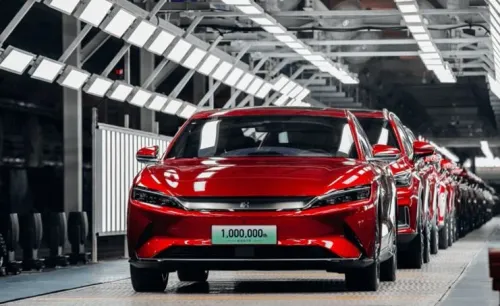
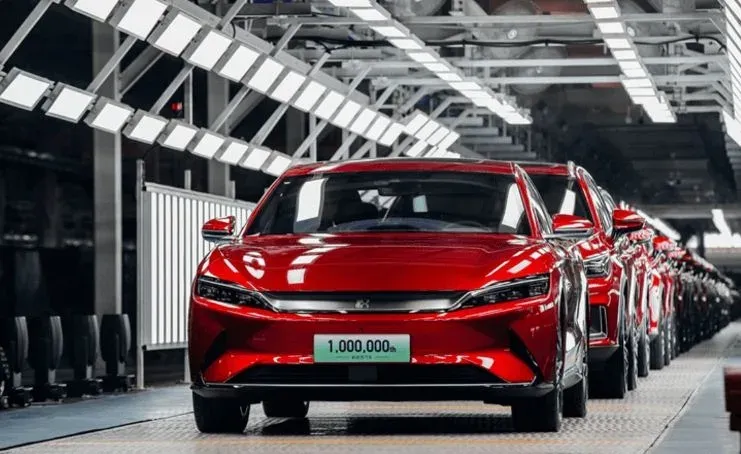
Chinese electric-vehicle giant BYD has overtaken rivals to claim the top spot in the global EV market, allegedly through a 'pirate business model' built on copying, reverse engineering, state subsidies, and aggressive pricing — raising alarm bells across Europe and North America about the future of their domestic auto industries, according to a new report by European media outlet Politico.
BYD's Scale and Market Dominance
BYD sold approximately 4.6 million vehicles in 2025, including 2.26 million pure battery-electric cars — comfortably surpassing Tesla's roughly 1.6 million deliveries in the same period. The numbers underline a dramatic shift in the global EV hierarchy, with the Shenzhen-based automaker now setting the pace that Western manufacturers are scrambling to match.
The report describes BYD's ascent as the product of a deliberate strategy: 'copy, absorb, subsidise, scale, dump and dominate'. Its earliest models, it alleged, were copies of Japanese automaker designs. BYD subsequently moved to produce batteries, motors, electronics, powertrains, and semiconductors entirely in-house through reverse engineering, achieving a degree of vertical integration that legacy Western automakers have struggled to replicate.
How State Support Amplified the Advantage
According to the report, BYD's vertical integration was supercharged by sustained state support and privileged access to China's enormous domestic consumer market. Foreign automakers, the report noted, were offered entry into that market through joint ventures — described as a 'devil's bargain' of forced technology transfer, which critics argue effectively handed Chinese manufacturers the intellectual capital needed to compete globally.
This combination — captive home market, state backing, and absorbed foreign technology — allowed BYD and other Chinese automakers to scale rapidly and then expand into Europe and other regions at price points that legacy manufacturers find difficult to match without restructuring.
The Toll on European Automakers
The consequences for established European brands have reportedly been severe. The report singled out Volkswagen, noting that its China earnings have fallen more than 80 per cent over the past decade. The German automaker is reportedly planning to cut 35,000 jobs in Germany by 2030, is considering the closure of as many as four factories in the country, and is weighing up to 1 lakh job cuts worldwide — a scale of restructuring the report described as 'once unthinkable'.
Mercedes-Benz and BMW are also reportedly facing mounting pressure as Chinese automakers gain market share across Europe. The report warned starkly: 'This will not end well unless the West unites. BYD is not just another automaker — it is a pirate ship with a balance sheet, weakening both Europe's and America's industrial bases, one cheap EV at a time.'
Europe's Fragmented Response
European Union officials have proposed a 17 per cent countervailing duty on Chinese electric vehicles. However, the report alleged that the bloc's response has been undermined by internal fragmentation, with member states divided over trade concerns and the implications of restricting Chinese investment. The lack of a unified front, critics argue, has diluted the effectiveness of any protective measures.
Notably, this is not the first time the EU has grappled with the challenge of coordinating a collective industrial response to Chinese competition — a pattern that has repeatedly hampered decisive action across sectors from solar panels to steel.
North America in the Crosshairs
Chinese automakers are reportedly using Canada and Mexico as strategic staging grounds for eventual entry into the United States market. The approach, according to the report, involves building dealer networks and studying consumer preferences while awaiting regulatory access — a patient, long-game strategy that mirrors how Chinese manufacturers have historically entered other protected markets.
With the US market still largely insulated by tariffs, the pressure on Europe is expected to intensify in the near term as Chinese EV exports that cannot enter America are redirected westward. How Western governments and automakers respond in the coming months could determine whether the legacy auto industry undergoes managed transformation — or an accelerated decline.
Point of View
But the underlying data is harder to dismiss: BYD's output has more than doubled Tesla's, and Volkswagen's China collapse is not a cyclical dip — it is a structural retreat. What the report underplays is Western complicity: decades of joint-venture deals that prioritised short-term market access over long-term IP protection effectively subsidised BYD's knowledge base. The EU's 17 per cent duty, if it materialises uniformly, is a belated corrective — but with member states divided and Chinese investment deeply embedded in European supply chains, coherent industrial policy remains elusive. The real question is whether the West can coordinate fast enough, or whether the restructuring already under way at Volkswagen is merely the opening act.
NationPress
16 Jul 2026
Frequently Asked Questions
What is BYD's alleged 'pirate business model'?
According to a Politico report, BYD's rise is attributed to a strategy described as 'copy, absorb, subsidise, scale, dump and dominate.' The company allegedly copied Japanese automaker designs early on, then reverse-engineered foreign technology absorbed through joint ventures, before scaling production with state subsidies and selling at prices Western rivals struggle to match.
How do BYD's 2025 sales compare with Tesla's?
BYD sold approximately 4.6 million vehicles in 2025, including 2.26 million pure battery-electric cars, compared with Tesla's roughly 1.6 million deliveries in the same period. This makes BYD the world's largest EV seller by volume, according to the Politico report.
How has Chinese EV competition affected Volkswagen?
Volkswagen's China earnings have reportedly fallen more than 80 per cent over the past decade. The automaker is planning to cut 35,000 jobs in Germany by 2030, is considering closing up to four German factories, and is weighing as many as 1 lakh job cuts worldwide — a restructuring the Politico report described as 'once unthinkable.'
What has the European Union done to counter Chinese EV imports?
EU officials have proposed a 17 per cent countervailing duty on Chinese electric vehicles. However, the Politico report alleged that the bloc's response has been fragmented, with member states divided over trade concerns and Chinese investment ties, limiting the effectiveness of the proposed measures.
Why are Chinese automakers targeting Canada and Mexico?
According to the report, Chinese automakers are using Canada and Mexico as strategic footholds to build dealer networks and study North American consumer preferences while awaiting regulatory access to the US market — a long-game approach designed to position them for eventual entry into the world's second-largest auto market.