Clean energy tops 50% of India's power demand for second year running
Synopsis
For the second year in a row, clean energy sources — solar, hydro, and nuclear combined — covered more than half of India's electricity demand at a single peak moment on 6 July 2025. With renewables already outpacing thermal in installed capacity at 282.7 GW versus 250.8 GW, the grid is shifting structurally — but the real test is evening demand, where storage gaps still leave fossil fuels indispensable.
Key Takeaways
Clean energy supplied 50.02% of India's 221.5 GW electricity demand at 11:46 am IST on 6 July 2025 , per the Power Ministry's MERIT platform.
This is the second consecutive year clean energy has crossed the 50% threshold at a peak demand moment.
Clean energy has exceeded 45% of total demand on 50 days since May 2025, according to CEEW .
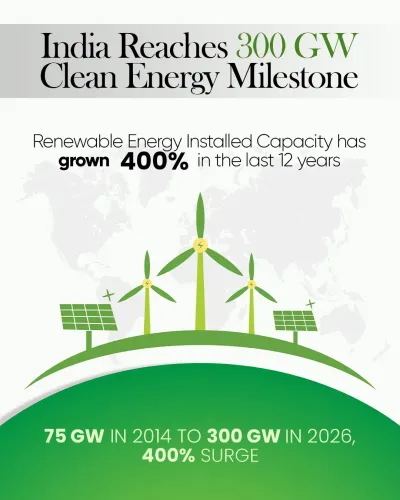
India's installed renewable energy capacity stands at 282.7 GW , now exceeding thermal capacity of 250.8 GW out of a total 542.3 GW .
Peak demand hit an all-time high of 270.8 GW in May 2025 ; the government projects 271 GW peak demand in 2026 .
Experts flag affordable energy storage as the critical next step to sustain clean-energy shares during evening demand peaks.
India crossed a landmark threshold in its energy transition on 6 July 2025, when clean energy sources — comprising renewable energy, hydropower, and nuclear power — supplied 50.02 per cent of the country's total electricity demand of 221.5 GW at 11:46 am IST. According to data from the Power Ministry's Merit Order Despatch of Electricity for Rejuvenation of Income and Transparency (MERIT) platform, this marks the second consecutive year that non-fossil fuel sources have met more than half of India's electricity needs at a given peak moment.
What the Data Shows
The milestone is not an isolated spike. According to research by the Council on Energy, Environment and Water (CEEW), clean energy has exceeded 45 per cent of India's total electricity demand on 50 days since May 2025 alone — pointing to a structural shift in the national grid rather than a one-off achievement. The consistency of these readings, experts say, signals that the supply mix is undergoing a durable transformation.
Disha Aggarwal, Fellow at CEEW, said: 'This already signals a lasting change in the supply mix. CEEW research shows that the next frontier will be to scale flexible energy storage, along with large-scale and distributed renewable energy systems, to meet increasing shares of the evening demand with low-cost renewables.'
Grid Demand and the Monsoon Effect
Power demand has moderated in recent weeks as widespread monsoon rainfall brought relief from extreme summer temperatures. Data from the state-run Grid Controller of India showed peak power demand at 222.5 GW on 6 July, rising to 230 GW on 7 July. Both figures remain well below the all-time peak of 270.8 GW recorded in May 2025 during an intense heatwave. In 2025, India's peak demand had reached 243 GW in June — slightly lower than the prior year's record of 250 GW in May. The government has projected peak demand to touch 271 GW in 2026.
India's Installed Capacity Snapshot
India's total installed power generation capacity stood at 542.3 GW as of 31 May 2025. Of this, thermal power accounts for 250.8 GW, while renewable energy capacity has reached 282.7 GW — meaning clean energy sources now constitute the larger share of installed capacity, even as grid balancing and evening-demand coverage remain ongoing challenges.
The Road Ahead: Storage and Evening Demand
Notably, the 50 per cent milestone was recorded during peak daytime hours, when solar generation is at its strongest. The harder test — and the next frontier, according to CEEW — is sustaining high clean-energy shares during evening demand peaks, when solar output drops and grid operators must rely on storage, hydro, or thermal backup. Scaling affordable battery storage and distributed renewable systems will be critical to extending these gains beyond daylight hours. This comes amid India's broader commitment to achieving 500 GW of non-fossil fuel capacity by 2030, a target that now looks increasingly within reach on the installed-capacity front.
Point of View
But it needs context: it was captured at 11:46 am, when solar irradiance is near its daily maximum. The harder and more consequential metric is what happens between 6 pm and 10 pm, when demand stays elevated and solar disappears. India's renewable installed capacity has quietly overtaken thermal — 282.7 GW versus 250.8 GW — yet the grid's evening dependency on coal has not shifted at the same pace. The milestone is a genuine signal of structural change; it is not yet proof of 24-hour clean supply. Until battery storage and pumped hydro scale meaningfully, peak-hour optics risk overstating the depth of India's energy transition.
NationPress
7 Oct 2026
Frequently Asked Questions
What clean energy milestone did India achieve on 6 July 2025?
Clean energy sources — including renewables, hydropower, and nuclear — supplied 50.02 per cent of India's total electricity demand of 221.5 GW at 11:46 am IST on 6 July 2025, according to the Power Ministry's MERIT platform. This is the second consecutive year India has crossed the 50 per cent clean energy threshold at a peak demand moment.
Why does the 50 per cent milestone matter for India's energy transition?
It reflects a structural shift in India's power supply mix, not a one-off event. CEEW data shows clean energy has exceeded 45 per cent of total demand on 50 days since May 2025, indicating that non-fossil fuel sources are consistently covering a larger share of grid demand as renewable capacity expands.
How does India's installed renewable capacity compare to thermal power?
As of 31 May 2025, India's renewable energy capacity stands at 282.7 GW, surpassing thermal capacity of 250.8 GW out of a total installed base of 542.3 GW. This makes renewables the largest single category of installed generation capacity in the country.
What is the next challenge for India's clean energy grid?
According to CEEW Fellow Disha Aggarwal, the next frontier is scaling flexible energy storage and distributed renewable systems to meet evening demand — when solar output drops — with low-cost clean power. Without affordable storage, high clean-energy shares during daytime hours do not automatically translate into round-the-clock clean supply.
What is India's peak power demand outlook for 2026?
The government has projected India's peak power demand to reach 271 GW in 2026. The all-time peak so far was 270.8 GW, recorded in May 2025 during an intense heatwave, highlighting the scale of demand management that the grid must handle as temperatures rise.