DigiLocker adds Family IDs of 4 states, covers 37 crore citizens
Synopsis
DigiLocker has quietly expanded its scope from individual documents to household welfare IDs — onboarding Family ID credentials from four of India's most populous states in a single move. Over 37 crore citizens can now access Jan Aadhaar, Mahasarathi, MP Samagra, and UP Family ID digitally, removing a persistent documentation barrier for millions seeking subsidies, insurance, and pensions.
Key Takeaways
DigiLocker has integrated Family ID credentials from Rajasthan , Maharashtra , Madhya Pradesh , and Uttar Pradesh as of 17 June 2025 .
The move covers more than 37 crore citizens across the four states.
Rajasthan's Jan Aadhaar (7.5 crore residents), Maharashtra's Mahasarathi (14 crore), MP Samagra (9.5 crore), and UP Family ID (6 crore+) are now accessible via DigiLocker.
Citizens can also enrol for a new Family ID digitally through DigiLocker, without visiting a government office.
The integration supports access to welfare schemes including Chiranjeevi health insurance , PDS , scholarships, and pensions — without physical paperwork.
DigiLocker, India's flagship digital document wallet, has integrated Family ID credentials from Rajasthan, Maharashtra, Madhya Pradesh, and Uttar Pradesh, bringing more than 37 crore citizens under its paperless identity umbrella. The Ministry of Electronics and Information Technology (MeitY) announced the development on Wednesday, 17 June, calling it a significant step toward simplifying access to government services and welfare schemes.
What the Integration Enables
Citizens in the four states can now fetch their respective Family IDs directly into their DigiLocker accounts by signing into the app or website, searching for the relevant state service, entering required details, and granting consent. The document is then retrieved and stored instantly. Notably, DigiLocker is also connected as a requestor to each state's Family ID system, allowing eligible residents to enrol for a new Family ID digitally — without visiting a government office.
State-by-State Breakdown
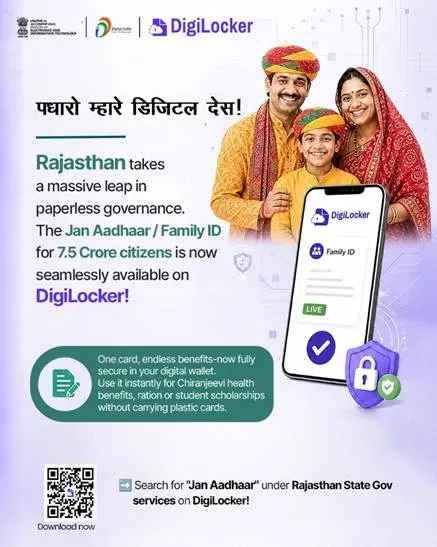
In Rajasthan, approximately 7.5 crore residents can now access their Jan Aadhaar — the state's primary household identity credential — through DigiLocker. Jan Aadhaar is linked to flagship welfare programmes including the Chiranjeevi health insurance scheme, the Public Distribution System (PDS), and state scholarships.
Maharashtra's Mahasarathi Family ID, now available to around 14 crore residents via DigiLocker, serves as a foundational household identifier for state scheme delivery. In Madhya Pradesh, roughly 9.5 crore residents gain digital access to their MP Samagra ID, which plays a central role in welfare disbursement across the state. Uttar Pradesh adds more than 6 crore residents who can now access their UP Family ID to apply for scholarships, pensions, and other state schemes without carrying physical documents.
Why This Matters for Governance
The integration marks a substantive expansion of DigiLocker's role beyond individual identity documents — such as driving licences and mark sheets — into household-level welfare credentials. This comes amid the Centre's broader push for paperless, consent-based governance under the Digital India framework. By linking Family IDs to DigiLocker, the government aims to reduce the friction citizens face when proving eligibility for subsidies, insurance, and social protection schemes.
According to MeitY, the verified digital document can be presented directly during service delivery, eliminating the need to photocopy or physically carry household identity papers. The integration is expected to strengthen last-mile access to welfare, particularly for residents in semi-urban and rural areas who frequently face documentation barriers.
What Comes Next
With four large states now on board, DigiLocker's Family ID coverage spans some of India's most populous regions. The Centre has not announced a timeline for extending the integration to other states, but the architecture — which allows both fetching of existing IDs and fresh digital enrolment — positions the platform for broader rollout. Observers note that the success of this initiative will depend on citizen awareness and the readiness of state agencies to accept DigiLocker-stored credentials in lieu of physical documents.
Point of View
This could meaningfully reduce exclusion errors in PDS, health insurance, and pension delivery. The caveat is implementation: four states are now integrated, but the platform's value is only as strong as the acceptance infrastructure on the ground.
NationPress
19 Sept 2026
Frequently Asked Questions
What is the DigiLocker Family ID integration announced on 17 June?
MeitY has integrated Family ID credentials from Rajasthan, Maharashtra, Madhya Pradesh, and Uttar Pradesh into DigiLocker, allowing over 37 crore citizens to digitally access, store, and share their household identity documents. Citizens can fetch existing IDs or enrol for new ones directly through the DigiLocker app or website.
Which states and Family IDs are now available on DigiLocker?
Four states are covered: Rajasthan's Jan Aadhaar (around 7.5 crore residents), Maharashtra's Mahasarathi (around 14 crore), Madhya Pradesh's MP Samagra (around 9.5 crore), and Uttar Pradesh's UP Family ID (over 6 crore residents).
How can citizens access their Family ID on DigiLocker?
Citizens can sign into the DigiLocker app or website, search for their state's Family ID service, enter the required details, and grant consent. The document is then fetched and stored instantly in their DigiLocker account.
What welfare schemes are linked to these Family IDs?
The Family IDs are linked to a range of state welfare programmes, including Rajasthan's Chiranjeevi health insurance scheme and PDS, as well as scholarships, pensions, and other state schemes in Maharashtra, Madhya Pradesh, and Uttar Pradesh.
Can citizens enrol for a new Family ID through DigiLocker?
Yes. DigiLocker is connected as a requestor to each state's Family ID system, enabling eligible residents to apply for a new Family ID digitally and provide consent from within the platform, without needing to visit a government office.