e-MERLIN study finds black holes in 1 in 4 nearby galaxies

Synopsis
A high-resolution radio survey using e-MERLIN has found compact black hole activity in roughly one in four of 280 nearby galaxies — far more than previously known. The study, co-led by an IIA astronomer, suggests that quiet, low-level black hole growth may be the norm in today's Universe, not the exception, overturning assumptions built on surveys that lacked the resolution to see it.
Key Takeaways
Aru Beri of the Indian Institute of Astrophysics (IIA) co-led the international study using the e-MERLIN radio array .
Compact radio emission was detected in nearly one-quarter of 280 nearby galaxies from the Palomar sample.
A smaller fraction of detected sources showed jet-like radio structures extending over several parsecs.
Findings were corroborated with X-ray data from NASA's Chandra X-ray Observatory .
The study suggests faint, low-level black hole activity is the dominant mode of black hole growth in the present-day Universe.
It is among the first statistically complete, high-resolution radio surveys capable of isolating faint nuclear activity in nearby galaxies.
An international research team, including Dr. Aru Beri of the Indian Institute of Astrophysics (IIA), has used the e-MERLIN radio array to detect compact radio emission from the centres of nearly one-quarter of 280 nearby galaxies, uncovering a previously hidden population of weakly accreting supermassive black holes. The findings, announced on Monday, 6 July, were confirmed in an official statement from the Ministry of Science and Technology.
What the Study Found
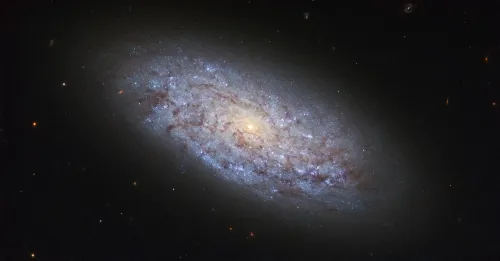
The researchers observed nearby galaxies drawn from the Palomar sample, probing their central regions at parsec-scale resolution — a level of detail rarely achieved in large-sample radio surveys. Compact radio emission was detected in roughly 25% of the galaxies examined, pointing to low-level supermassive black hole activity that conventional instruments had consistently missed.
Most of the detected sources appear extremely compact, while a smaller fraction displays jet-like radio structures extending over several parsecs — evidence of energy being injected into the surrounding interstellar medium.
Why These Black Holes Had Gone Undetected
Astronomers have long known that nearly every large galaxy harbours a supermassive black hole at its core. The challenge, according to the ministry statement, is that many of these black holes are extremely faint during periods of minimal accretion. Earlier surveys either lacked the sensitivity and angular resolution needed to isolate weak nuclear emission from surrounding stellar activity, or worked with smaller, potentially biased galaxy samples.
This study represents one of the first statistically complete, high-resolution radio surveys capable of distinguishing faint black hole activity at the galactic centre — a methodological advance that the research team says changes the picture of how common active black holes actually are.
Chandra X-Ray Data Adds Confirmation
To strengthen the radio findings, the team complemented the e-MERLIN observations with X-ray data from NASA's Chandra X-ray Observatory. The multi-wavelength approach helped rule out contamination from star-forming regions and lent greater confidence to the identification of genuine nuclear activity.
Significance for Galaxy Evolution
The results carry broad implications for understanding how galaxies develop over cosmic time. Weakly accreting black holes, even when operating at a fraction of their peak capacity, can inject energy into their surroundings through jets and outflows — processes that regulate star formation rates and shape the long-term structure of galaxies.
Critically, the study suggests that faint, low-level black hole activity may represent the dominant mode of black hole growth in the present-day Universe — a finding that challenges models built primarily around the more dramatic, luminous episodes of black hole feeding observed at earlier cosmic epochs.
IIA, an autonomous institution under the Department of Science and Technology (DST), contributed to the study through Dr. Beri's observational work. With this survey establishing a new statistical baseline, follow-up observations at higher sensitivity are expected to probe the jet-formation and feedback mechanisms of these elusive objects in greater detail.
Point of View
But the more consequential finding is methodological. For decades, the absence of detected nuclear activity in most galaxies was taken as evidence that black holes were dormant; this study suggests the instruments were simply not sharp enough. That distinction matters enormously for galaxy-evolution models, which have underweighted continuous low-level feedback. The involvement of an IIA researcher in a statistically complete, multi-wavelength survey of this scale also signals a quiet but meaningful shift in India's contribution to observational cosmology — one that deserves more attention than it typically receives in domestic science coverage.
NationPress
5 Oct 2026
Frequently Asked Questions
What did the e-MERLIN radio survey of nearby galaxies find?
The survey detected compact radio emission — a signature of black hole activity — at the centres of nearly one-quarter of 280 nearby galaxies. This revealed a hidden population of weakly accreting supermassive black holes that earlier, lower-resolution surveys had consistently missed.
Who is Dr. Aru Beri and what was her role in the study?
Dr. Aru Beri is a researcher at the Indian Institute of Astrophysics (IIA), an autonomous institution under the Department of Science and Technology. She was part of the international team that conducted the high-resolution e-MERLIN observations and analysed the Palomar-sample galaxies.
Why had these black holes not been detected before?
Earlier surveys lacked the angular resolution and sensitivity needed to separate faint nuclear radio emission from the surrounding stellar activity in a galaxy's core. They also often worked with smaller, potentially biased samples, making it difficult to draw statistically robust conclusions.
What role did NASA's Chandra X-ray Observatory play?
Chandra X-ray data were used alongside the e-MERLIN radio observations to cross-validate the detections and rule out contamination from star-forming regions, strengthening the case that the signals originate from genuine black hole activity at galactic centres.
Why does faint black hole activity matter for galaxy evolution?
Even weakly accreting black holes can inject energy into surrounding gas through jets and outflows, influencing star formation rates and the long-term structure of galaxies. The study's finding that this low-level activity may be the dominant mode of black hole growth today reshapes how scientists model galaxy development over cosmic time.