EU plans new trade tools to curb 'unsustainable' €1bn daily deficit with China
Synopsis
The EU is moving beyond statements to legislation: a new 'country-agnostic' diversification instrument aimed squarely at a €1 billion-per-day trade deficit with China. With France pushing hard and Germany and Spain pumping the brakes, the real story is whether Brussels can hold its internal coalition together long enough to make Beijing take notice.
Key Takeaways
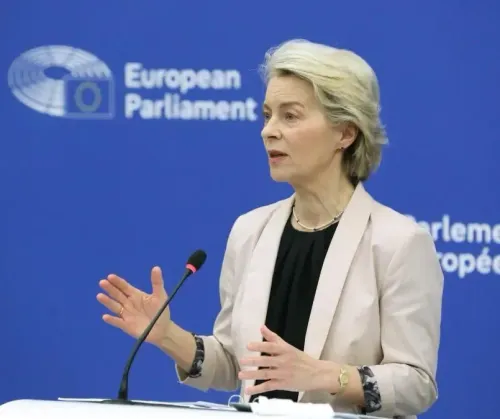
European Commission President Ursula von der Leyen announced new tools to counter the 'growing and unsustainable' EU–China trade deficit at the European Council summit.
The proposed diversification instrument is described as country-agnostic, targeting supply chain concentration in critical sectors.
European Council President António Costa cited a €1 billion trade deficit per day with China as unsustainable.
The EU's stated strategy is 'de-risking, not decoupling' , with dialogue with Beijing described as remaining crucial.
Germany and Spain are reportedly cautious about provoking Beijing, while France has led calls for stronger measures against Chinese overcapacity and subsidies.
China has already threatened retaliation against any escalatory EU trade measures.
The European Commission is developing new instruments to address macroeconomic imbalances, with European Commission President Ursula von der Leyen singling out the 'growing and unsustainable' trade deficit with China as the primary target. The announcement came at the closing press conference of the European Council summit, where EU leaders reportedly showed unified support for a more assertive European trade posture.
The Diversification Instrument
Von der Leyen described the proposed mechanism as a 'country-agnostic' diversification instrument, designed to help European companies in specific sectors reduce their dependence on single-source suppliers more rapidly. She acknowledged that supply chain diversification has so far been too slow. 'Europe has already built an extensive toolbox in recent years. Now we must use it more proactively and more strategically to defend our European interests,' she said.
According to reports, the instrument would require companies to source critical components from more than one or two countries, eliminating chokepoints that could be 'weaponised' by adversarial states — a framing widely understood as a reference to China.
The Scale of the Problem
European Council President António Costa was direct about the urgency, describing the current trajectory as untenable. 'Our strategy is clear: de-risking, not decoupling, while we engage in dialogue,' he said. 'But we need to address the challenges we are facing. A €1 billion trade deficit per day is simply unsustainable. We cannot continue to raise these issues without any concrete results.'
The €1 billion-per-day figure underscores the scale of the structural imbalance that Brussels is now seeking to legislate against.
Divisions Within the Bloc
Not all EU member states back a harder line on Beijing. Germany, heavily reliant on Chinese export markets, and Spain, which has positioned itself as a gateway for Chinese investment into Europe, are both reportedly wary of provoking retaliation. China has already signalled it would respond to any escalatory measures.
Senior diplomats, according to reports, have stressed that maintaining open dialogue with Beijing is especially important given what they described as the 'erratic behaviour' of the US government and its assertive trade agenda — suggesting that some in Brussels see the China relationship as a hedge against transatlantic uncertainty.
France Pushes for Stronger Measures
France has been the most vocal advocate for robust tools to contain what it characterises as China's overcapacity and market-distorting subsidies. French officials have suggested the leaders' summit marks a decisive shift, with Brussels adopting a harder line on Beijing than at any point in recent years.
Von der Leyen, for her part, emphasised that dialogue with China remains crucial even as the EU moves to sharpen its defensive instruments — a 'de-risking, not decoupling' formulation that has become the bloc's official strategic vocabulary. Whether the new tools can bridge the gap between France's assertiveness and Germany's caution will be the central test of the initiative's credibility.
Point of View
Not decoupling' formula is doing a lot of diplomatic work here — and may be doing too much. A €1 billion daily deficit is a structural problem that rhetorical balance cannot fix. The real tension is internal: France wants enforcement, Germany wants market access, and Spain wants Chinese investment. Until Brussels resolves that triangle, the new diversification instrument risks being another well-framed announcement that China will wait out. The timing is also notable — senior EU diplomats are reportedly factoring in US unpredictability as a reason to keep Beijing close, which means the leverage Brussels thinks it has may be weaker than the summit optics suggest.
NationPress
21 Jun 2026
Frequently Asked Questions
What new trade tools is the EU developing against China?
The European Commission is developing a 'country-agnostic' diversification instrument that would require companies to source critical components from multiple countries, reducing dependence on single suppliers — primarily aimed at reducing reliance on China. The tool is intended to accelerate supply chain diversification, which EU President von der Leyen said has been too slow.
How large is the EU's trade deficit with China?
European Council President António Costa cited a deficit of €1 billion per day with China, describing it as 'simply unsustainable.' The scale of this imbalance is the central justification for the new instruments being developed by the European Commission.
What does 'de-risking, not decoupling' mean for EU-China relations?
It is the EU's official strategic framing, meaning the bloc aims to reduce dangerous dependencies on China — particularly in critical supply chains — without severing commercial ties altogether. Both von der Leyen and Costa stressed that dialogue with Beijing remains crucial even as new defensive tools are developed.
Which EU countries are opposed to a harder line on China?
Germany and Spain are reportedly the most cautious, given Germany's deep export dependence on the Chinese market and Spain's role as a hub for Chinese investment in Europe. Both countries are wary of triggering retaliation from Beijing, which has already threatened to respond to escalatory measures.
Why is France pushing for stronger EU trade measures against China?
France has led calls for tools to address what it describes as China's overcapacity and market-distorting subsidies. French officials have framed the recent European Council summit as evidence that Brussels is adopting a materially harder line on Beijing than in previous years.