Adani Electricity, BMC end 3-year darkness at Gorai Beach with 90 streetlights
Synopsis
For nearly three years, one of Mumbai's most visited beaches went dark after sunset — not for lack of intent, but because conventional lighting kept failing the coastline's salt-laced, roadless terrain. Adani Electricity and BMC's bespoke 90-pole solution at Gorai Beach is as much an engineering story as a civic one.
Key Takeaways
AEML and BMC have illuminated a 2.5-km stretch of Gorai Beach , Borivali West , ending nearly three years of darkness.
90 streetlight poles were installed using HDPE pipe sleeves , reinforced concrete foundations, and protective cable ducting to resist coastal corrosion.
5.25-metre poles with custom brackets ensure uniform lighting across the beach's uneven rocky-sandy terrain.
A ladder-based maintenance system was introduced to service poles without heavy machinery, given the absence of service roads.
The project is expected to boost evening footfall, improve surveillance, and revive livelihoods tied to tourist activity after dark.
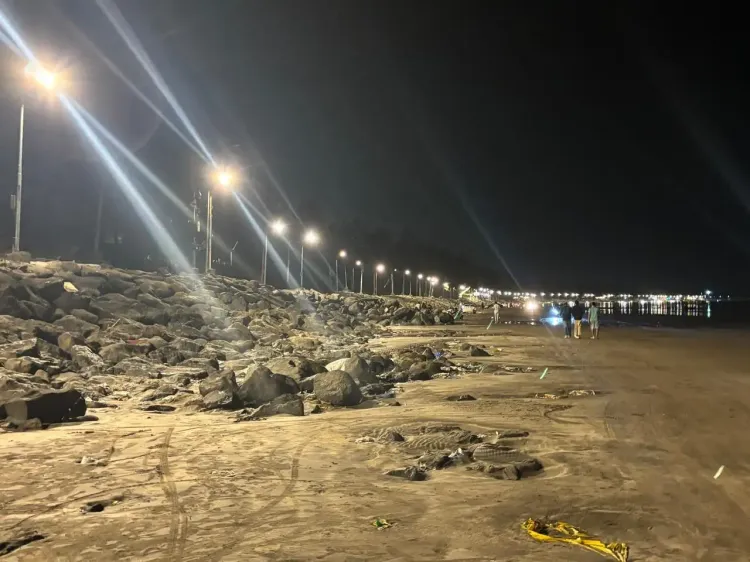
Adani Electricity Mumbai Limited (AEML), in coordination with the Brihanmumbai Municipal Corporation (BMC), has illuminated a 2.5-km stretch of Gorai Beach in Borivali West, Mumbai, ending nearly three years of darkness along one of the city's most visited shorelines. The project, completed as of 5 May 2025, involved the installation of 90 specialised streetlight poles engineered to withstand the beach's harsh coastal conditions.
Why the Beach Stayed Dark for Three Years
The 2.5-km Gorai Beach stretch had remained unlit for close to three years, raising persistent safety concerns after sunset and curtailing evening access despite high daily footfall. Conventional lighting infrastructure had repeatedly failed due to the site's challenging terrain — a mix of rocky and sandy surfaces — compounded by high salinity levels that caused rapid corrosion of poles and underground cabling. The absence of service roads further complicated maintenance efforts, making standard installation methods unviable.
The Engineering Solution
To overcome these obstacles, AEML's Mira-Bhayander division partnered with the BMC to design a customised, corrosion-resistant lighting system. The project deployed high-density polyethylene (HDPE) pipe sleeves, reinforced concrete foundations, and protective ducting for underground cables. Advanced insulated cabling and multiple earthing points were installed to ensure electrical safety and long-term reliability.
The team erected 5.25-metre poles fitted with specially designed brackets to deliver uniform illumination across the uneven terrain. A ladder-based maintenance system was introduced to service the poles without requiring heavy machinery — a critical adaptation given the lack of access roads along the stretch.
Community and Civic Impact
Rossi D'Souza, Sarpanch of Gorai Gaothan Panchayat, welcomed the development, noting that safety concerns had long affected both residents and visitors.
Point of View
But because standard solutions corroded in weeks — points to a wider gap in how Indian cities plan coastal public works. The AEML-BMC collaboration's use of HDPE ducting and ladder-based servicing deserves scrutiny not just as a feel-good story but as a replicable model: Mumbai has hundreds of kilometres of coastline where similar terrain challenges go unaddressed. The real question is whether this remains a one-off or seeds a coastal infrastructure policy.
NationPress
22 Sept 2026
Frequently Asked Questions
Why was Gorai Beach without streetlights for nearly three years?
Gorai Beach's 2.5-km stretch in Borivali West remained unlit for close to three years because conventional lighting infrastructure repeatedly failed due to the beach's mix of rocky and sandy terrain and high coastal salinity, which caused rapid corrosion of poles and underground cables. The absence of service roads also made standard installation and maintenance methods unworkable.
What engineering measures were used to light Gorai Beach?
AEML and BMC installed 90 streetlight poles using high-density polyethylene (HDPE) pipe sleeves, reinforced concrete foundations, and protective ducting for underground cables to prevent corrosion. Advanced insulated cabling, multiple earthing points, and 5.25-metre poles with custom brackets were also deployed for safety and uniform illumination.
Who led the Gorai Beach lighting project?
Adani Electricity Mumbai Limited (AEML), through its Mira-Bhayander division, led the project in close coordination with the Brihanmumbai Municipal Corporation (BMC). The two organisations jointly designed a customised solution suited to the beach's harsh coastal environment.
How does the Gorai Beach lighting affect local residents and visitors?
The illumination has improved safety and visibility along the 2.5-km stretch, enabled better surveillance, and increased evening footfall. For local vendors and businesses dependent on tourist traffic, it is expected to revive economic activity that had declined after dark, according to Gorai Gaothan Panchayat Sarpanch Rossi D'Souza.
Can the Gorai Beach lighting model be replicated elsewhere?
The project's use of HDPE ducting, corrosion-resistant infrastructure, and a ladder-based maintenance system — designed for terrains without service roads — offers a potential template for other coastal or terrain-challenged public spaces across Mumbai and other Indian coastal cities.