How is the Government Planning to Use AI to Address Grid Congestion and Enhance Renewable Integration?
Synopsis
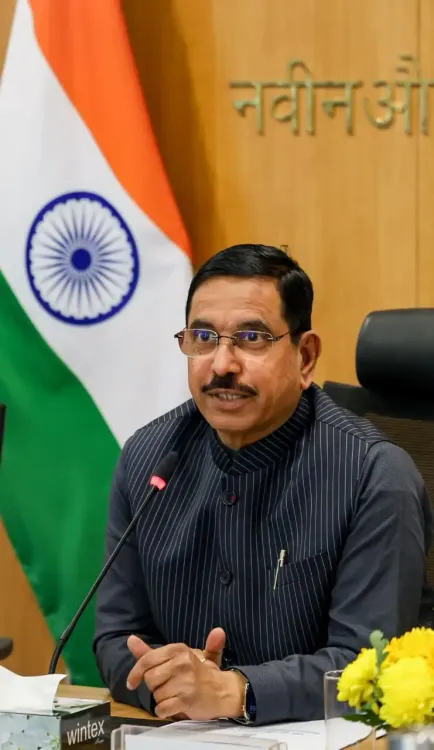
In a significant step towards modernizing India's power sector, Union Minister Pralhad Joshi has announced the government's commitment to employ AI solutions to combat grid congestion and optimize renewable energy integration. This initiative is poised to revolutionize energy management and bolster the nation's renewable energy goals.
Key Takeaways
The government is adopting AI solutions to combat grid congestion and curtail renewable energy loss.
Battery Energy Storage Systems are becoming more affordable, with costs decreasing due to government initiatives.
India's battery storage demand is projected to reach 411 GW by 2032.
The AI Impact Summit emphasized the integration of digital intelligence with solar energy deployment.
Innovative digital models are being introduced to enhance power distribution systems.
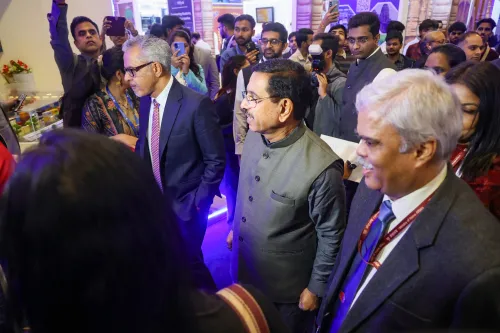
New Delhi, Feb 18 (NationPress) Union Minister for New and Renewable Energy, Pralhad Joshi, announced on Wednesday that the government is set to advocate for artificial intelligence (AI)-driven solutions to address persistent challenges within the energy sector, particularly focusing on grid congestion and the curtailment of renewable energy.
At the AI Impact Summit, he revealed that the Centre has initiated projects utilizing AI technologies to enhance grid stability and prevent the wastage of clean energy.
“We will tackle issues related to grid stability and curtailment shortly,” Joshi stated.
He elaborated that capacity curtailment, which occurs when renewable energy cannot be transmitted due to grid congestion, needs urgent attention.
“Solutions based on AI technology will facilitate more efficient grid management and smoother integration of renewable energy,” the minister emphasized.
Additionally, Joshi noted that the prices of Battery Energy Storage Systems (BESS) are decreasing thanks to the government’s viability gap funding (VGF) initiative.
India's demand for battery storage is projected to rise significantly to 411 gigawatts (GW) by 2032.
He mentioned that recent government bids have revealed a reduction in the discovered tariff from Rs 3.3 per unit to Rs 3.1 per unit.
Joshi expressed optimism that battery storage costs would continue to decline with increased deployment, akin to the dramatic decrease in solar power costs over the years.
This trend is expected to revolutionize the energy landscape in India. The renewable energy ministry also highlighted the Global Mission on AI for Energy during the summit, which aims to merge solar power deployment with digital intelligence.
The objective is to facilitate real-time optimization and smarter grid management via advanced technologies.
Joshi pointed out that innovative digital frameworks are being implemented to enhance the power distribution system.
He cited the “One Solar” web application developed by BSES Rajdhani Power Limited, alongside digital twin solutions and GIS-based modernization of distribution networks.
These initiatives are expected to bolster grid stability and minimize disruptions. In a separate announcement, India has established a joint offshore wind taskforce with the United Kingdom.
This initiative was launched with the participation of UK Deputy Prime Minister David Lammy and British High Commissioner to India Lindy Cameron.
Point of View
It is imperative to note that the government's focus on leveraging AI for energy management represents a positive shift towards addressing long-standing issues. This initiative not only highlights the importance of innovation in the energy sector but also aligns with global trends aimed at sustainable development. It is crucial for stakeholders to support these advancements as they hold the potential to significantly enhance India's energy resilience.
NationPress
7 Oct 2026
Frequently Asked Questions
What is the government’s plan regarding AI in the power sector?
The government plans to implement AI-driven solutions to address grid congestion and renewable energy curtailment, aiming to enhance grid stability and improve energy management.
How will AI technology help in the energy sector?
AI technology will facilitate more efficient grid management, allowing for smoother integration of renewable energy and reducing instances of energy curtailment.
What is the significance of Battery Energy Storage Systems (BESS)?
BESS is crucial for storing renewable energy, and the government's funding initiatives are driving down costs, making them more accessible as India's demand for battery storage is set to rise.