Is India Truly Committed to Accelerating the Global Clean Energy Transition?

Synopsis
India is taking significant strides towards a sustainable future, with Union Minister Pralhad Joshi asserting the nation's commitment to a faster and fairer clean energy transition. This commitment not only supports environmental goals but also stimulates economic growth and innovation. Learn how India is poised to lead the way in renewable energy expansion on the global stage.
Key Takeaways
India aims for a faster and fairer clean energy transition.
Commitment to reducing emissions intensity by 2030.
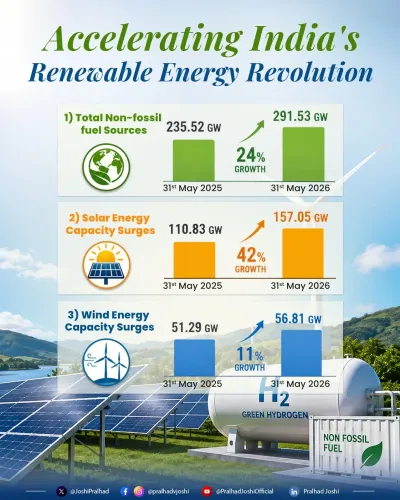
Focus on expanding renewable energy capacity.
Global leadership in combating climate change.
AI as a tool for innovation in clean energy.
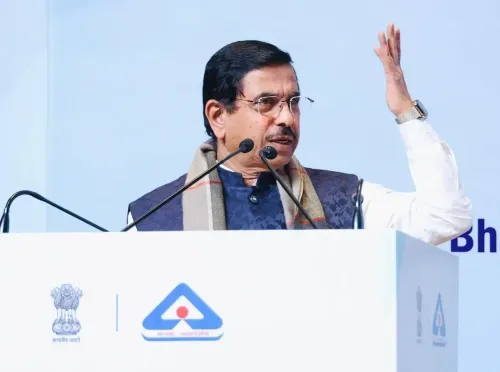
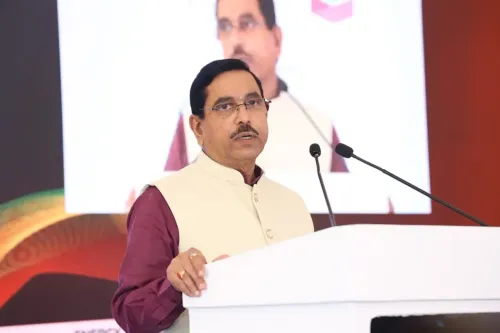
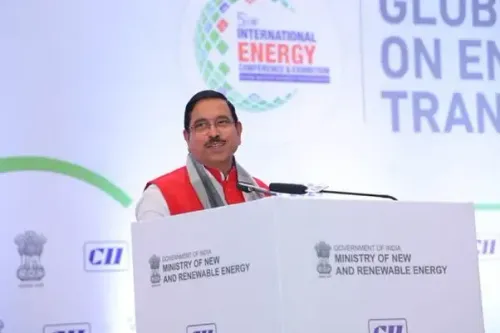
New Delhi, Feb 22 (NationPress) The Union Minister of New and Renewable Energy, Pralhad Joshi, emphasized on Sunday that India is dedicated to making the global clean energy transition both quicker and fairer, while also being development-oriented for the well-being of both people and the planet.
In an X post, in response to UN Secretary-General Antonio Guterres, the minister highlighted that India’s clean energy journey is founded on action, ambition, and inclusion.
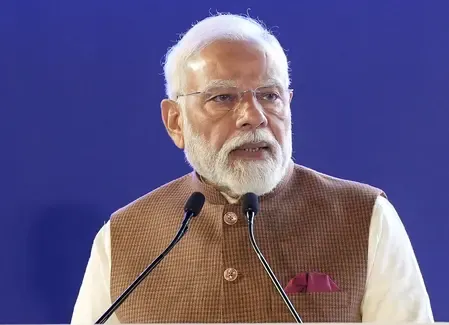
“Under the guidance of PM Narendra Modi, we are significantly enhancing our renewable capacity, while simultaneously empowering industry, livelihoods, and innovation,” Joshi remarked.
Guterres had noted that India is demonstrating how it is feasible to broaden clean energy access while advancing industrial growth.
“Together, let's transform climate necessity into development opportunity and expedite the clean energy transition for people and the planet,” he stated in an X post.
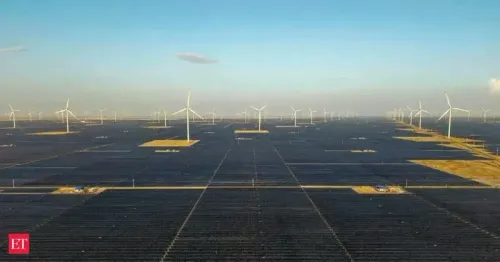
India is establishing itself as a global frontrunner in the expansion of renewable energy.
The country is committed to decreasing its GDP emissions intensity of greenhouse gases by 2030 to 45% below 2005 levels, increasing the share of non-fossil fuel electric power capacity to 50%, and creating a carbon sink of 2.5 to 3 billion tonnes.
Remarkably, India has already fulfilled nearly two-thirds of its nationally determined contributions in combating climate change, achieving this milestone four years ahead of schedule.
At the ‘India AI Impact Summit 2026’, Guterres addressed the risks associated with AI fragmentation, urging for global interoperability standards to ensure better outcomes.
He mentioned that international cooperation is increasingly challenging.
“Technological rivalry is on the rise. Without a common baseline, fragmentation prevails, leading to different regions and countries operating under incompatible policies and technical standards,” he cautioned. While addressing the Summit, he stated that reaching an agreement on how to test systems and assess risks will lead to interoperability.
Guterres also advocated for science-led AI guardrails to protect individuals and expedite innovation. According to the UN Secretary-General, AI guardrails must foster confidence and provide clarity for businesses to accelerate innovation in the correct direction.
Point of View
It is imperative to recognize that India's commitment to clean energy reflects a broader global responsibility. The proactive measures taken by the government under the leadership of PM Modi should be acknowledged, as they not only aim to combat climate change but also ensure that development is inclusive and equitable. This approach is essential for fostering a sustainable future for all.
NationPress
19 Sept 2026
Frequently Asked Questions
What commitments has India made regarding clean energy?
India has pledged to reduce GDP emissions intensity by 45% from 2005 levels by 2030 and to increase non-fossil fuel electric power capacity to 50%.
How is India achieving its clean energy goals?
India is expanding its renewable energy capacity significantly under the leadership of PM Modi, focusing on inclusive growth that supports both industry and innovation.
What is the significance of Guterres' comments?
UN Secretary-General Guterres highlights India's ability to balance clean energy access with industrial growth, emphasizing the importance of global cooperation in achieving sustainability.
What is the current status of India's climate change efforts?
India has already met nearly two-thirds of its nationally determined contributions in combating climate change, achieving this ahead of schedule.
What role does AI play in India's clean energy strategy?
AI is seen as a tool for enhancing innovation and efficiency in clean energy efforts, with calls for science-led guardrails to ensure responsible advancement.