Is the Next Decade Truly India's? Insights from Pralhad Joshi

Synopsis
Discover how India’s energy transition is more than just an environmental effort; it's a pathway to industrial growth and job creation. Join Union Minister Pralhad Joshi as he reveals insights from Davos, emphasizing India’s potential in the global energy landscape.
Key Takeaways
India's energy transition is a growth enabler.
267 GW of installed non-fossil energy capacity achieved.
Renewables account for 52% of total installed power capacity.
PM Surya Ghar aims for 10 million rooftops generating 30 GW .
Farmers benefit from solarized irrigation pumps.
Davos, Jan 22 (NationPress) The energy transition in India is strategically crafted as a means for industrial expansion, job creation, and enhancing global competitiveness, especially for developing nations, stated Union Minister for New and Renewable Energy, Pralhad Joshi, during a significant session at the World Economic Forum Annual Meeting.
In his address focused on “Energy: The Great Funding Gap”, the Minister emphasized that under Prime Minister Narendra Modi's leadership, India's clean energy transition has evolved into a people-centric development movement, while also fortifying energy security and reducing costs for industries.
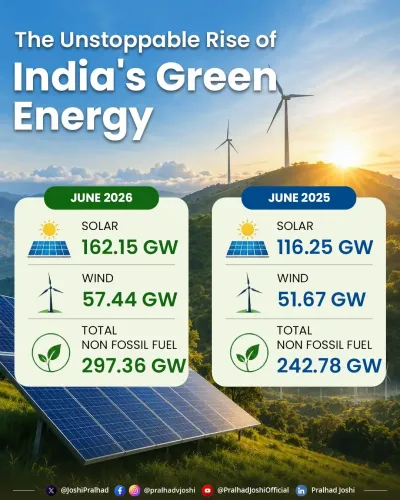
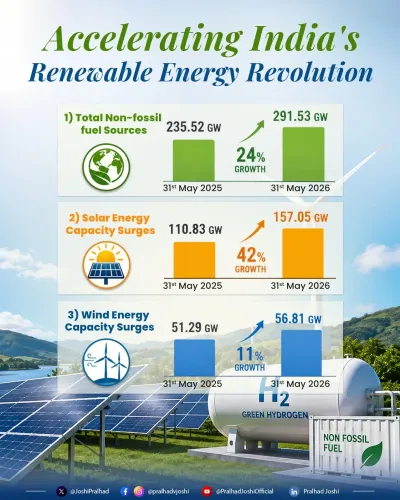
He noted that India has successfully installed 267 GW of non-fossil energy capacity, with renewable sources now contributing approximately 52 percent of the nation's total installed power capacity, significantly ahead of previous benchmarks.
Minister Joshi highlighted that India perceives the energy transition as not just an environmental necessity but as a catalyst for growth, facilitating rapid industrial development and making energy more accessible for both businesses and households.
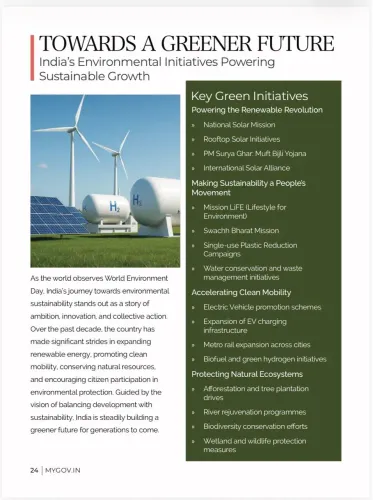
He brought attention to flagship decentralized renewable energy initiatives, such as the PM Surya Ghar: Muft Bijli Yojana, which has facilitated the setup of rooftop solar systems in 2.7 million households over the past two years, aiming for a target of 10 million households, anticipated to yield around 30 GW of power.
Additionally, under the PM-KUSUM scheme, over 2.1 million farmers have solarized their irrigation pumps, significantly diminishing reliance on subsidized grid electricity while enabling these farmers to generate extra income through surplus energy sales.
“These initiatives provide not only affordable energy but also transform consumers into ‘prosumers’, enhancing household incomes and rural livelihoods,” the Minister commented.
By replacing expensive subsidized electricity with cost-effective solar power, the resulting savings have led to reduced tariffs for both industries and households, indicating a historic transformation in India's power landscape. Joshi remarked that electricity tariffs are declining due to the renewable energy revolution.
The Union Minister underscored India's robust domestic manufacturing capacity within the renewable energy supply chain. He noted that the nation has established 144 GW of solar module manufacturing capabilities, with solar cell production reaching 27 GW, projected to expand to approximately 50 GW shortly.
Moreover, he indicated that India is nearing the completion of the entire manufacturing cycle, with plans for wafer and ingot manufacturing to commence soon.
In addition to solar manufacturing, the Minister emphasized the swift advancement in wind energy, battery storage, and pumped storage solutions, which are crucial for maintaining reliability and grid stability. These initiatives are not only fortifying India's clean energy supply chains but also generating substantial employment opportunities and bolstering the country's industrial competitiveness.
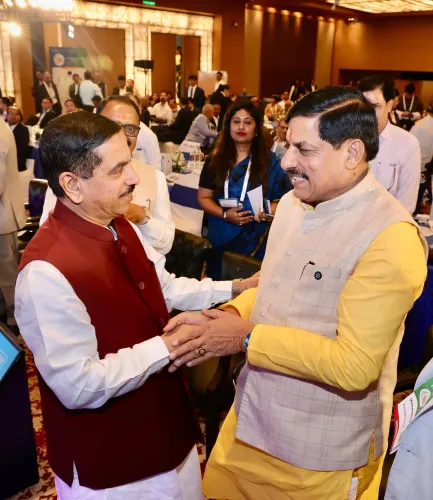
During bilateral discussions, Joshi met with Dr. Tareq Abu Ghazaleh, Jordan's Minister of Investment, and Ms. Zeina Toukan, Minister of Planning and International Cooperation, to explore enhanced cooperation and investment opportunities.
He also engaged with Amon Murwira, Zimbabwe's Minister of Foreign Affairs and International Trade, focusing on deepening renewable energy collaboration between India and Zimbabwe.
Joshi's meeting with Dr. Fatih Birol, Executive Director of the International Energy Agency, centered on strengthening the IEA's focus on India-specific data, analysis, and policy recommendations, as well as investigating innovative financial strategies to reduce capital costs.
Point of View
It is evident that India's ambitious energy transition strategy under Pralhad Joshi's guidance is a pivotal step towards achieving sustainable growth. By focusing on renewable energy, India not only addresses environmental challenges but also positions itself as a leader in global competitiveness—an approach that deserves attention and support.
NationPress
30 Sept 2026
Frequently Asked Questions
What is the PM Surya Ghar: Muft Bijli Yojana?
It is a flagship initiative aimed at promoting rooftop solar installations, targeting 10 million households to generate approximately 30 GW of power.
How much renewable energy capacity has India installed?
India has achieved 267 GW of installed non-fossil energy capacity, with renewables making up about 52 percent of the total installed power capacity.
What is the significance of the PM-KUSUM scheme?
This scheme solarizes irrigation pumps for farmers, reducing their dependence on subsidized grid power and allowing them to earn additional income from surplus energy.
What is the future outlook for India’s solar manufacturing capacity?
India's solar module manufacturing capacity stands at 144 GW, with plans to increase solar cell production to around 50 GW in the near future.
How is India enhancing its global energy partnerships?
India is actively engaging in bilateral discussions with countries like Jordan and Zimbabwe to enhance cooperation in renewable energy investments.