Gujarat pitches ₹1,000-crore semiconductor plant in Singapore, South Korea roadshow
Synopsis
Gujarat's pre-VGGS 2027 roadshow across Singapore and South Korea has surfaced a ₹1,000-crore semiconductor equipment facility interest in Sanand — the most concrete headline from over 45 engagements spanning chips, shipbuilding, clean energy, and biotech. With the summit just weeks away, the state is racing to convert diplomatic meetings into signed deals.
Key Takeaways
Bharat SemiTech has expressed interest in a ₹1,000-crore semiconductor equipment manufacturing facility in Sanand , Gujarat.
A delegation led by Minister Arjun Modhwadia conducted 20 engagements in Singapore and 25 in South Korea between 19 and 26 October .
The outreach was part of preparations for the 11th Vibrant Gujarat Global Summit (VGGS) , scheduled in Gandhinagar from 10 to 12 January 2027 .
South Korean companies recommended Gujarat appoint a dedicated single point of contact (SPOC) to facilitate investor engagement.
Sectors covered include semiconductors, shipbuilding, green hydrogen, biotechnology, data centres, and agri-tech.
The team toured facilities including Micron Semiconductor , Hanwha Ocean , and Seoul Semiconductor .
Gujarat's bid to build a semiconductor manufacturing ecosystem received a significant push as Bharat SemiTech expressed interest in setting up a semiconductor equipment manufacturing facility with a proposed investment of around ₹1,000 crore in Sanand, emerging as a headline prospect from the state government's eight-day business outreach programme across Singapore and South Korea. The outreach, concluded ahead of the Vibrant Gujarat Global Summit (VGGS) 2027, saw the delegation engage with over 45 companies and institutions across both countries.
The Delegation and Its Mandate
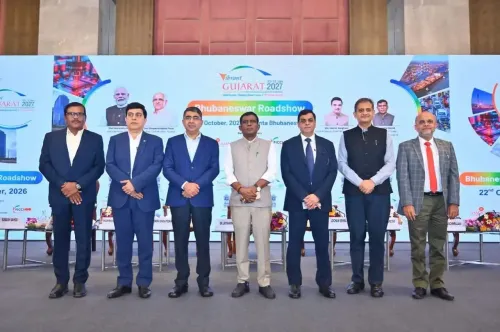
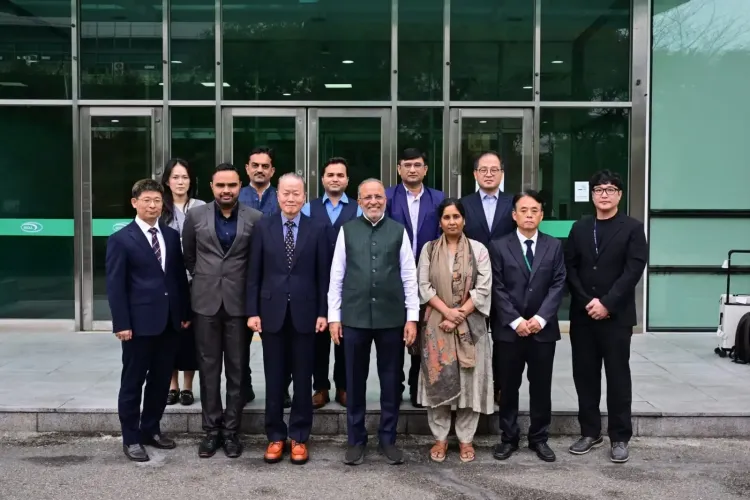
A high-level Gujarat government team led by Forest, Environment, Climate Change, Science and Technology Minister Arjun Modhwadia visited Singapore and South Korea from 19 to 26 October as part of preparations for the 11th edition of VGGS, scheduled in Gandhinagar from 10 to 12 January 2027. The delegation included Science and Technology Department Secretary P Bharathi as nodal officer, Planning Department Secretary Adra Agarwal, Joint Director (IT) Wasim Mansuri, and GIFT City AVP (Business Operations) Nisarg Acharya. Representatives of the Gujarat State Electronics Mission, FICCI, and KPMG were also part of the team.
Key Engagements in Singapore
In Singapore, the team held 20 engagements — comprising nine one-to-one business meetings, two government-to-government meetings, five roundtable discussions, and four site visits. The delegation met Singapore Minister of State for Foreign Affairs and Trade and Industry Gan Siow Huang and held discussions with India's High Commissioner to Singapore, Dr Shilpak Ambule, on strengthening economic ties.
Facility tours included visits to Micron Semiconductor, Global Tech Solutions, ASMPT's Yishun facility, and A*STAR Fusionopolis. Business meetings were also conducted with companies such as Redwood Interior, Autodesk, Guardant AMEA, Keppel Infrastructure, Itochu Corporation, Agrocorp International, SMIT Salvage, and De Nora Water Technologies. The delegation additionally engaged with the Singapore Semiconductor Industry Association, the Singapore Indian Chamber of Commerce and Industry, and the ASEAN Innovation Business Platform, among others.
South Korea: 25 Engagements Across Key Sectors
The team subsequently travelled to South Korea, where it completed 25 engagements — including 15 one-to-one business meetings, three roundtable discussions, and seven site visits. Facilities visited included HJ Heavy Industries, Hanwha Ocean, Hanyang Engineering, GnBS Eco, Gachon University MRI Research Centre, Dawon Medax BNCT Centre, and Seoul Semiconductor.
Discussions with South Korean companies covered a broad spectrum: semiconductors, display technology, data centres, shipbuilding, chemicals, biotechnology, clean energy, robotics, agricultural technology, and industrial infrastructure. Among the participating companies were Hanwha Maritime Services Division, Daesun Shipbuilding and Engineering, HD Hyundai, Nova Data Centre, CORESTEMCHEMON, Dongwoo Fine-Chem, and TagHive, among others. South Korean companies notably suggested that the Gujarat government appoint a dedicated single point of contact (SPOC) to streamline investor engagement and project facilitation.
Sectors in Focus and the Road to VGGS 2027
The outreach positioned Gujarat as a destination for investment across semiconductors, advanced manufacturing, maritime services, healthcare, green hydrogen, digital technology, water management, and agriculture and food processing. This comes amid India's broader national push to build domestic semiconductor capacity — with the Centre having already approved several chip-linked incentive schemes — making state-level efforts like Gujarat's increasingly significant in the overall supply chain picture.
The Gujarat government expects the engagements to translate into concrete investment proposals, technology collaborations, and business partnerships before VGGS 2027 opens in Gandhinagar in January. The summit's 11th edition will be a key test of how much of the outreach converts into signed agreements on the ground.
Point of View
MoU announcements at VGGS, and variable execution thereafter. The Bharat SemiTech interest in Sanand is notable precisely because semiconductor equipment manufacturing — not just assembly — is a rarer and higher-value proposition. Yet 'expressed interest' is a long way from ground-breaking, and South Korean companies' request for a dedicated SPOC signals that investors find Gujarat's current facilitation architecture fragmented. The real measure of this outreach will be how many of these 45-plus engagements appear as committed investments on the VGGS 2027 floor — and how many are still at the 'discussion stage' by then.
NationPress
7 Nov 2026
Frequently Asked Questions
What is the ₹1,000-crore semiconductor project in Gujarat?
It is a proposed semiconductor equipment manufacturing facility in Sanand, Gujarat, in which Bharat SemiTech has expressed investment interest of around ₹1,000 crore. The proposal emerged from Gujarat's eight-day business outreach in Singapore and South Korea ahead of VGGS 2027.
What is the Vibrant Gujarat Global Summit 2027?
The Vibrant Gujarat Global Summit (VGGS) is a biennial investment summit hosted by the Gujarat government in Gandhinagar. The 11th edition is scheduled from 10 to 12 January 2027, and the recent Singapore-South Korea roadshow was part of pre-summit investor outreach.
Which countries did the Gujarat delegation visit, and what was covered?
The delegation visited Singapore and South Korea from 19 to 26 October, completing 20 engagements in Singapore and 25 in South Korea. Topics covered included semiconductors, shipbuilding, clean energy, biotechnology, data centres, and agri-tech.
What did South Korean companies recommend to the Gujarat government?
South Korean companies suggested that Gujarat appoint a dedicated single point of contact (SPOC) to streamline investor engagement and assist with project-related requirements, indicating a need for more structured facilitation.
Why is Gujarat focusing on semiconductor investments?
Gujarat is positioning itself within India's broader national push to build domestic semiconductor manufacturing capacity, with Sanand — already home to electronics and auto manufacturing — being developed as a potential chip-sector hub ahead of VGGS 2027.