India ranks 5th in global digital economy, 4th on CHIPS-AI index: IPCIDE report

Synopsis
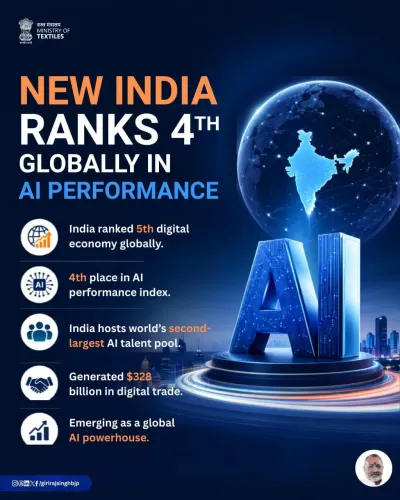
India is now the world's fifth-largest digital economy and fourth on the CHIPS-AI index — outranking Germany, France, Japan, and Canada. But the IPCIDE report surfaces a stark contradiction: India holds 26% of global AI users and the world's second-largest AI talent pool, yet commands just 1% of global private AI investment. That gap is the defining challenge of India's next digital phase.
Key Takeaways
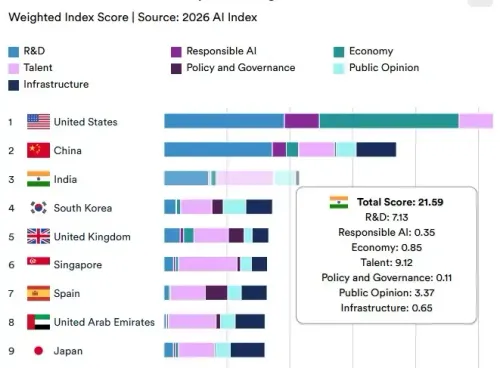
India ranked 5th in global digital economy rankings and 4th on the CHIPS-AI index , per the IPCIDE report covering 71 countries .
India generated $328 billion in digitally delivered trade and accounts for ~50% of BRICS digitally delivered services.
India holds 26% of global AI users but only 1% of global private AI investment — a critical gap flagged by the report.
India ranks second globally in AI talent, behind only the United States .
Three of the top five digital economies — China , Singapore , and India — are now from the Indo-Pacific , signalling a tripolar digital order.
72% of global AI users are now in developing countries; India and China together account for nearly two-fifths of worldwide AI adoption.
India has climbed to fifth place in global digital economy rankings and secured fourth position on the CHIPS-AI index, according to a new report released on Friday, 29 May by the ICRIER-Prosus Centre for Internet and Digital Economy (IPCIDE). The study, covering 71 countries and 96 per cent of global GDP, found that India outpaced major developed economies including Germany, France, Japan, and Canada in digital performance.
Key Rankings and Trade Performance
India generated $328 billion in digitally delivered trade and now hosts the world's second-largest AI talent pool, trailing only the United States. The country accounts for roughly 50 per cent of BRICS digitally delivered services and ranked behind only the US, China, and Singapore in AI performance.
Notably, three of the world's top five digital economies — China, Singapore, and India — are now from the Indo-Pacific region, signalling what the report describes as the emergence of a tripolar digital order alongside the traditional North Atlantic pole. This represents a structural realignment that few analysts had projected at the pace it has materialised.
AI Adoption vs Investment: A Critical Gap
India commands 26 per cent of global AI users but accounts for just 1 per cent of global private AI investment — a disparity the report flags as a defining challenge. India and China together accounted for nearly two-fifths of worldwide AI adoption, even as 72 per cent of all AI users globally are now in developing countries.
The report also notes that advanced chips, compute infrastructure, and large language models remain concentrated among a small group of countries and firms, creating structural asymmetries that could limit India's ability to convert adoption into economic value without targeted intervention.
What the Report Says India Must Do Next
India's long-term competitiveness, according to the IPCIDE report, hinges on mobilising risk capital, expanding compute access, strengthening university-startup linkages, and building AI commercialisation pathways. The country currently ranks second globally in AI talent but lacks comparable levels of long-term venture capital and computing infrastructure.
Pramod Bhasin, Chairperson of ICRIER, said: 'India has built strong foundations through connectivity, entrepreneurship and digital public infrastructure. The next phase of growth depends on how effectively we leverage AI, deepen innovation capabilities and strengthen digital trust.'
Broader Implications for India's Digital Strategy
This comes amid intensifying global competition for AI leadership, with the US and China both accelerating domestic chip production and compute investments. India's position as a high-adoption, low-investment economy creates both an opportunity — a large base for AI-native product development — and a vulnerability, if private capital and infrastructure do not follow. The report's findings are expected to inform upcoming policy discussions on India's national AI mission and compute subsidy frameworks.
Point of View
But the 26%-versus-1% mismatch — commanding over a quarter of global AI users while attracting just a fraction of private AI investment — is the number that should dominate the policy conversation, not the ranking. Talent and adoption without capital and compute is a ceiling, not a launchpad. The tripolar Indo-Pacific framing is analytically interesting, but India's position in that triad is structurally weaker than China's or Singapore's until domestic venture depth and chip-access policy catch up. The report's recommendations on university-startup linkages and compute subsidies are not new; the question is whether this iteration of the national AI mission will attach measurable targets and accountability mechanisms to them.
NationPress
12 Oct 2026
Frequently Asked Questions
Where does India rank in the global digital economy in 2025?
India ranks fifth in global digital economy standings, according to the IPCIDE report covering 71 countries. The country outperformed major developed economies including Germany, France, Japan, and Canada in digital performance.
What is the CHIPS-AI index and how did India perform on it?
The CHIPS-AI index measures a country's competitiveness in advanced chip access and AI capability. India ranked fourth on this index, behind only the United States, China, and Singapore, according to the IPCIDE report released on 29 May 2025.
Why is India's AI investment gap a concern despite high adoption?
India accounts for 26% of global AI users but attracts just 1% of global private AI investment. The IPCIDE report warns this gap — combined with limited compute infrastructure — could prevent India from converting its large user base into sustainable economic and technological leadership.
What is India's standing in global AI talent?
India ranks second globally in AI talent, behind only the United States. However, the IPCIDE report notes that this talent advantage is not yet matched by comparable levels of long-term venture capital or computing infrastructure.
What does the IPCIDE report recommend for India's digital future?
The report recommends that India mobilise risk capital, expand compute access, strengthen university-startup linkages, and build clearer AI commercialisation pathways. These steps are identified as critical for converting India's digital adoption base into long-term competitive advantage.