India C&I energy storage to surge 30x, hit 31 GWh by 2032: IESA-CES report
Synopsis
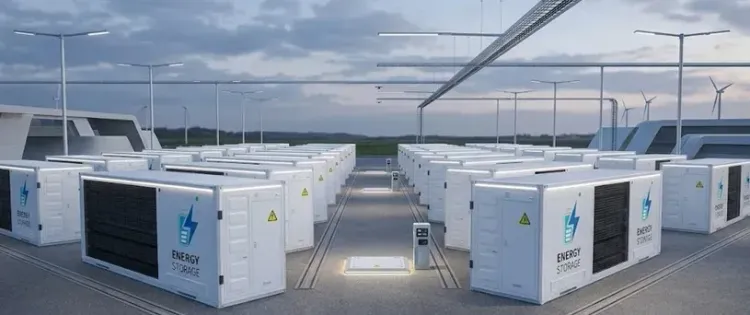
India's commercial and industrial energy storage market is on the cusp of a structural transformation — a 30-fold expansion from under 1 GWh today to as much as 31 GWh by 2032. The IESA-CES report frames this not as incremental growth but as a sector-wide shift from backup power to strategic energy management, with policy reform holding the key to whether India hits the upper or lower end of the forecast.
Key Takeaways
India's C&I ESS installations projected to grow over 30-fold — from under 1 GWh in 2025 to 23–31 GWh by 2032 .
Joint report by India Energy Storage Alliance (IESA) and Customized Energy Solutions (CES) released on 18 June 2026 .
BAU scenario projects 22–23 GWh ; Rapid Adoption scenario projects up to 31 GWh by 2032.
Key drivers include rising electricity tariffs, renewable energy adoption, and India's decarbonisation targets.
Report to be showcased at 12th India Energy Storage Week 2026 , 8–10 July 2026 , at Yashobhoomi (IICC), New Delhi .
Event will host over 200 exhibitors and 10,000+ industry leaders from 30+ countries .
Cumulative energy storage system (ESS) installations in India's commercial and industrial (C&I) sector are projected to expand more than 30-fold — from under 1 GWh in 2025 to between 23 GWh and 31 GWh by 2032, according to a joint report by the India Energy Storage Alliance (IESA) and Customized Energy Solutions (CES) released on 18 June 2026. The findings mark one of the most ambitious storage growth projections for any emerging market segment in South Asia.
Key Drivers Behind the Surge
The report attributes the projected leap to a confluence of structural forces: rising electricity tariffs, growing demand for reliable and high-quality power supply, rapid renewable energy adoption, cost-optimisation pressures, and India's national decarbonisation commitments. Together, these factors are pushing C&I consumers to treat energy storage not as a contingency measure but as a core operational asset.
This comes amid a broader national push to integrate storage into India's energy transition, with the Centre having set aggressive targets for renewable capacity addition over the next decade.
Two Scenarios, One Direction
The report models two distinct growth trajectories. Under the Business-as-Usual (BAU) scenario, ESS installations in the C&I segment are expected to reach 22–23 GWh by 2032. The more optimistic Rapid Adoption (RA) scenario — contingent on market-friendly regulatory reforms and continued technological advancement — could push installations to 31 GWh within the same timeframe.
The gap between the two scenarios underscores how critical policy clarity will be in determining whether India captures the upper end of its storage potential.
What Industry Leaders Said
Debmalya Sen, President of IESA, said: 'India's C&I energy storage market is at a pivotal moment. The sector is transitioning from backup and peak shaving to a strategic asset for energy optimisation, resilience, and decarbonisation. The insights from this report will help stakeholders shift from reactive power management to proactive energy leadership.'
Vinayak Walimbe, Managing Director of CES, noted that C&I consumers can now make smarter, data-driven decisions that drive both cost savings and sustainability, given regulatory clarity, proven business models, and advanced storage technologies.
Report to Debut at India Energy Storage Week 2026
The findings will be formally presented at the 12th India Energy Storage Week (IESW) 2026, scheduled for 8–10 July 2026 at Yashobhoomi (IICC), New Delhi. The event — billed as a global platform for clean energy transition — will bring together the full value chain spanning e-mobility, battery manufacturing, recycling, stationary storage, and green hydrogen.
The conference is expected to host over 200 exhibitors and more than 10,000 industry leaders from over 30 countries, facilitating policy advocacy, technical exchange, and high-impact networking. Notably, this is the twelfth consecutive edition of the event, reflecting sustained institutional momentum behind India's storage ecosystem.
With the C&I segment historically underserved by grid reliability, the projected 30x growth signals a structural inflection — one that will test whether India's regulatory and manufacturing infrastructure can keep pace with demand.
Point of View
But the 8 GWh spread between the BAU and Rapid Adoption scenarios reveals the real story: India's storage ambitions remain hostage to regulatory pace. The C&I segment has long been a captive victim of grid unreliability, which means latent demand is genuine — but converting it into installed capacity requires tariff structures and grid codes that currently lag behind the technology. If the Centre moves on market-friendly storage regulations before 2027, the upper scenario is credible; if it doesn't, the BAU path will look optimistic by 2030.
NationPress
22 Sept 2026
Frequently Asked Questions
How much is India's C&I energy storage expected to grow by 2032?
India's commercial and industrial ESS installations are projected to grow over 30-fold, from under 1 GWh in 2025 to between 23 GWh and 31 GWh by 2032, according to the IESA-CES report released on 18 June 2026. The range reflects two scenarios — business-as-usual and rapid adoption — depending on regulatory and technological progress.
What is driving the growth in India's commercial energy storage market?
The primary drivers include rising electricity tariffs, demand for reliable power, rapid renewable energy adoption, cost-optimisation pressures, and India's national decarbonisation goals. The IESA-CES report identifies these as structural forces pushing C&I consumers to treat storage as a strategic asset rather than a backup measure.
What is the difference between the BAU and Rapid Adoption scenarios in the report?
The Business-as-Usual (BAU) scenario projects ESS installations reaching 22–23 GWh by 2032, while the Rapid Adoption (RA) scenario projects up to 31 GWh, contingent on market-friendly reforms and technological advances. The 8 GWh gap highlights how significantly policy decisions will shape the market's trajectory.
What is India Energy Storage Week 2026 and when is it held?
India Energy Storage Week (IESW) 2026 is the 12th edition of a global clean energy transition platform, scheduled for 8–10 July 2026 at Yashobhoomi (IICC) in New Delhi. It will host over 200 exhibitors and more than 10,000 industry leaders from over 30 countries, covering e-mobility, battery manufacturing, stationary storage, and green hydrogen.
Who published the India C&I energy storage report?
The report was jointly published by the India Energy Storage Alliance (IESA) and Customized Energy Solutions (CES). It will be formally presented at the 12th India Energy Storage Week 2026 in New Delhi in July.