India's Energy Storage Capacity Projected to Increase Significantly by 2033: Latest Report
Synopsis
India's energy storage sector is on the brink of transformation, with projections indicating its capacity could soar to 346 GWh by 2033. This growth, fueled by new projects and favorable policies, positions India as a leader in global energy storage. Discover the insights from the recent report.
Key Takeaways
India's BESS projects are reaching a capacity of 92 GWh .
Projected growth to 346 GWh by 2033 under base scenario.
69 new BESS tenders issued, marking a 35% increase .
Pumped hydro to grow from 7 GW to 107 GW .
Supportive policies are enhancing investment viability.
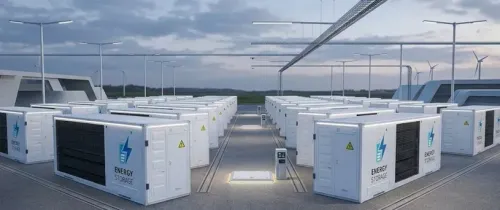
New Delhi, March 20 (NationPress) The stationary energy storage industry in India is experiencing significant advancements, with the total capacity of Battery Energy Storage Systems (BESS) projects in development hitting an impressive 92 GWh, as per a report published on Friday.
The report from the India Energy Storage Alliance (IESA) forecasts that the cumulative installed capacity, currently under 1 GWh, could skyrocket to 346 GWh by 2033.
Activity within the sector has surged, with 69 new BESS tenders amounting to 102 GWh issued in the past year, reflecting a 35 percent increase over 2024, according to the findings.
“The installed capacity for stationary storage is expected to reach 346 GWh by 2033 under base projections, potentially escalating to 544 GWh if policy support persists,” the report states.
It also highlights that pumped hydro energy storage is poised for substantial growth, with capacity estimates projected to rise from 7 GW in 2025 to 107 GW by 2033.
S.C. Saxena, the Chairman and Managing Director of GRID India, emphasized the necessity of large-scale energy storage as India’s power system grapples with growing demand fluctuations.
He noted that declining costs and favorable policies are propelling the swift adoption of both battery and pumped hydro storage solutions.
Debmalya Sen, President of IESA, remarked that the white paper outlines a strategic plan to assist India in achieving its goal of 500 GW of non-fossil fuel capacity by 2030, with energy storage playing a pivotal role.
The report credited the sector's expansion to initiatives such as Energy Storage Obligations, Viability Gap Funding, and regulatory measures like transmission charge exemptions, which have enhanced investment attractiveness.
With nearly 5 GWh of new capacity set to be operational in 2026, the sector is gearing up for a substantial growth phase, positioning India as a vital player in the global energy storage arena.
The report was unveiled at the Stationary Energy Storage India (SESI) 2026 conference.
Point of View
It is evident that India's energy storage sector is positioned for remarkable growth, driven by policy support and technological advancements. This aligns with the country's broader goals of enhancing renewable energy capabilities and reducing dependence on fossil fuels.
NationPress
22 Sept 2026
Frequently Asked Questions
What is the current capacity of India's energy storage sector?
As of now, the cumulative installed capacity is under 1 GWh, but it's expected to grow significantly.
How many new BESS tenders were issued recently?
In the past year, 69 new BESS tenders totaling 102 GWh have been issued.
What is the expected capacity of pumped hydro energy storage by 2033?
Pumped hydro energy storage capacity is projected to increase from 7 GW in 2025 to 107 GW by 2033.
What factors are driving the growth of energy storage in India?
Falling costs, supportive policies, and initiatives like Energy Storage Obligations are key drivers.
When was the report on India's energy storage sector presented?
The report was presented at the Stationary Energy Storage India (SESI) 2026 conference.