India-EU FTA: 125 regulatory provisions reshape trade beyond tariffs
Synopsis
The India-EU Free Trade Agreement is not a conventional tariff deal — it is a 20-chapter regulatory architecture with 125 cooperation provisions. The real contest, as the report puts it, has shifted from customs schedules to inter-agency trust, with pharmaceuticals, carbon pricing, and supply-chain integration all in play.
Key Takeaways
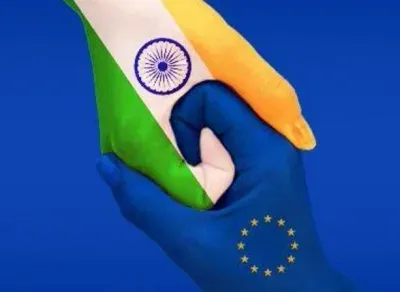
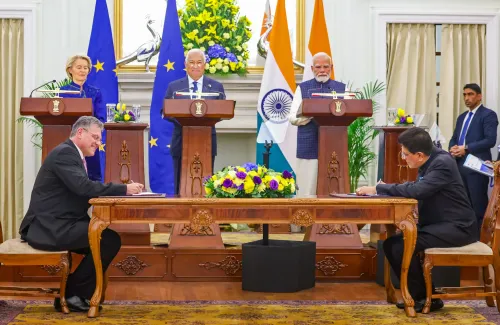
The India-EU Free Trade Agreement , concluded in New Delhi earlier this year, spans 20 chapters and embeds approximately 125 regulatory cooperation provisions .
The pact prioritises regulatory trust over tariff cuts, reflecting a broader shift in how major economies structure trade diplomacy.
India's pharmaceutical exports to Europe have been constrained by non-tariff barriers — regulatory approvals and pharmacovigilance — not duties; the FTA directly addresses this.
A carbon-border annex and technical consultation mechanisms align the agreement with the EU's decarbonisation agenda, including the Carbon Border Adjustment Mechanism.
The FTA complements India's IMEC connectivity ambitions by providing an institutional framework for deeper economic integration with Europe and the Gulf.
The India-European Union Free Trade Agreement, concluded in New Delhi earlier this year, is less a conventional tariff-cutting exercise and more an institutional architecture for long-term regulatory coordination, according to a new report. Spanning 20 chapters and embedding roughly 125 cooperation provisions, the pact prioritises consultation, transparency, and agency-level trust over customs schedules.
Regulatory Cooperation at the Core
The report notes that the agreement's design reflects a broader shift in how major economies are approaching trade diplomacy. As countries seek to reduce risky supply-chain dependencies without retreating from globalisation, free trade agreements are increasingly being structured as frameworks for building trusted economic relationships rather than simply instruments for lowering tariffs.
The distinction matters. India is a leading global supplier of generic medicines, yet its access to European markets has historically been constrained not by tariffs but by regulatory approvals, pharmacovigilance standards, and compliance systems. The FTA addresses this directly.
'Tariff elimination does not by itself produce market access. It shifts the contest to a different terrain, one where trust between regulators, not customs schedules, determines outcomes,' the report observed.
Pharmaceuticals and Medical Devices
The agreement secures tariff commitments for drugs and medical devices, but critically redirects the focus toward regulatory cooperation and inter-agency trust. According to the report, structured regulatory engagement under the FTA may, over time, encourage greater harmonisation of approval processes across the EU, improving market access while reinforcing the integrity of the single market.
This is a significant development for India's pharmaceutical sector, which has long argued that non-tariff barriers — not duties — are the primary obstacle to scaling exports to Europe.
Carbon Pricing and Industrial Decarbonisation
The FTA also frames engagement on carbon pricing and industrial decarbonisation, creating a carbon-border annex and technical consultation mechanisms. This positions the agreement as a vehicle for aligning India's industrial policy with the EU's evolving environmental standards, including the Carbon Border Adjustment Mechanism (CBAM), which is set to affect Indian exports in energy-intensive sectors.
Strategic Gains for India
Beyond market access, the report argues that the FTA's gains for India extend into capital formation, technology transfer, and research collaboration — areas where Europe remains a significant provider. For India to grow its manufacturing capacity and innovation infrastructure, and to strengthen its case as a trusted global supply-chain partner, European capital and technology are seen as essential inputs.
The agreement also dovetails with India's broader connectivity ambitions. As New Delhi pursues deeper economic integration with the Gulf and Europe through initiatives such as the India-Middle East-Europe Economic Corridor (IMEC), the FTA provides an institutional framework that could make those ambitions more commercially meaningful.
What Comes Next
The architecture embedded in the agreement will be tested in implementation. Regulatory harmonisation across a bloc of 27 EU member states is inherently complex, and the pace at which consultation mechanisms translate into tangible approvals will determine whether the pact delivers on its promise. Industry bodies and trade analysts are expected to track the activation of these cooperation provisions closely in the months ahead.
Point of View
But the harder question is whether 125 cooperation provisions on paper translate into faster pharmaceutical approvals and genuine carbon-pricing alignment in practice. The EU's single market has historically moved slowly on third-country regulatory harmonisation, and India's track record on compliance standardisation is uneven. The IMEC framing is strategically appealing, but economic corridors require commercial density that institutional frameworks alone cannot generate. The real test of this agreement will come not at signing, but in the first round of agency-level consultations — and whether either side treats them as binding commitments or diplomatic courtesies.
NationPress
29 Sept 2026
Frequently Asked Questions
What is the India-EU Free Trade Agreement?
The India-EU Free Trade Agreement is a comprehensive trade pact concluded in New Delhi earlier this year, spanning 20 chapters and embedding approximately 125 regulatory cooperation provisions. Unlike conventional FTAs focused primarily on tariff reduction, this agreement prioritises consultation, transparency, and institutional coordination between Indian and European regulatory agencies.
Why does the India-EU FTA emphasise regulatory cooperation over tariff cuts?
The report argues that tariff elimination alone does not produce market access — it shifts competition to regulatory terrain where inter-agency trust determines outcomes. For India's pharmaceutical sector, for instance, European market access has been blocked not by duties but by approval processes and pharmacovigilance standards, making regulatory cooperation the more meaningful lever.
How does the FTA affect India's pharmaceutical exports to Europe?
The agreement secures tariff commitments for drugs and medical devices while redirecting focus to regulatory cooperation. Structured engagement under the FTA may over time encourage harmonisation of approval processes across the EU, potentially easing the non-tariff barriers that have historically constrained Indian generic medicine exports to European markets.
What is the carbon-border annex in the India-EU FTA?
The FTA includes a carbon-border annex and technical consultation mechanisms that frame engagement on carbon pricing and industrial decarbonisation. This is significant given the EU's Carbon Border Adjustment Mechanism, which is set to affect Indian exports in energy-intensive sectors.
How does the India-EU FTA connect to IMEC?
The report notes that as India pursues deeper economic integration with the Gulf and Europe through the India-Middle East-Europe Economic Corridor (IMEC), the FTA provides an institutional framework that could make those connectivity ambitions more commercially meaningful by establishing trusted regulatory and trade relationships.