EU-India FTA: How the trade deal opens new export doors for India
Synopsis
The EU-India FTA isn't just a trade deal — it's a structural correction. For the first time, Indian textile exporters will compete on near-equal tariff terms with Bangladesh and Turkey in the EU market, while GCCs and IT services firms gain regulatory predictability for cross-border supply. The asymmetry — India at 11% of EU trade, the EU at just 1.7% of India's — is the gap this agreement is built to close.
Key Takeaways
The EU-India FTA has been finalised, with the EU committing to eliminate tariffs on over 90 per cent of tariff lines , covering 91 per cent of trade value .
In 2024 , the EU was India's second-largest trading partner , accounting for 11 per cent of India's total global trade; India was the EU's tenth-largest at just 1.7 per cent .
Indian textiles and apparel exporters stand to gain by closing the tariff gap with competitors Bangladesh , Pakistan , and Turkey .
The deal includes specific services trade commitments , benefiting India's ICT sector and expanding Global Capability Centres (GCCs) .
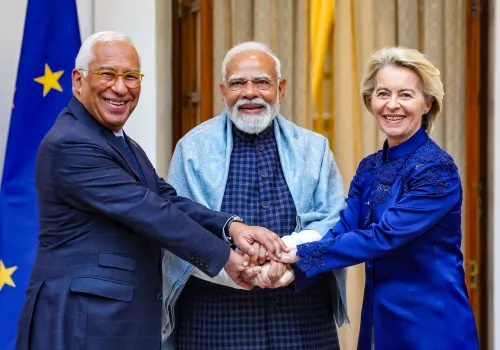
PM Modi's recent four-nation Europe tour provided fresh diplomatic momentum to the agreement.
India's market of nearly 1.5 billion people and a growing middle class is seen as a key long-term demand source for EU exporters.
The finalisation of the EU-India Free Trade Agreement (FTA) marks a pivotal shift in India's external economic engagement, according to a new report by the Politeia Research Foundation (PRF) published in India Narrative. The agreement, which gained fresh momentum following Prime Minister Narendra Modi's recent four-nation Europe tour aimed at consolidating strategic ties, is expected to significantly expand bilateral trade flows and deepen integration into global value chains.
The Trade Gap the FTA Addresses
In 2024, the European Union was India's second-largest trading partner after China, accounting for 11 per cent of India's total global trade. By contrast, India ranked as the EU's tenth-largest trading partner, representing just 1.7 per cent of the EU's global trade — a stark asymmetry that the FTA is designed to begin correcting.
The PRF report notes that the EU has committed to eliminating tariffs on over 90 per cent of tariff lines, covering 91 per cent of trade value. This creates a substantial window for Indian exporters to grow their share of EU imports across multiple sectors.
Textiles and MSMEs: A Structural Advantage
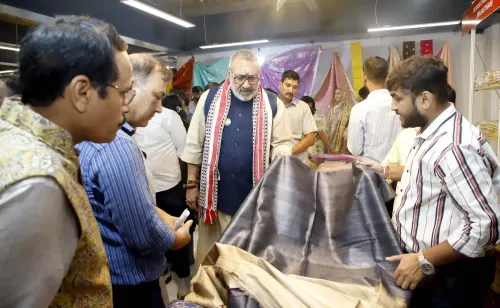
One of the most consequential gains is in textiles and apparel. Indian exporters have historically faced a tariff disadvantage in the EU compared with competitors such as Bangladesh, Pakistan, and Turkey, all of which benefit from preferential access under existing EU frameworks. The FTA corrects this imbalance by improving India's tariff treatment, potentially boosting one of the country's most employment-intensive sectors — one deeply linked to MSME clusters and regional production networks.
According to the PRF report, the gains here are 'not only commercial but also developmental,' given the sector's role in job creation and small-firm participation.
Services Trade and Digital Economy
The agreement also carries specific commitments on trade in services — particularly relevant for India, whose comparative strength lies in ICT and business process services. The FTA is expected to improve predictability for cross-border services supply and strengthen links between Indian service providers and European clients.
Notably, the deal could accelerate the expansion of Global Capability Centres (GCCs) in India by providing a more stable regulatory framework for EU-facing service delivery — a sector that has seen rapid growth in recent years and is increasingly central to India's digital economy ambitions.
Strategic Context: Modi's Europe Tour
The PRF analysis places the FTA within the broader context of Prime Minister Modi's four-nation European tour, which was aimed partly at consolidating strategic partnerships amid a shifting geopolitical and trading landscape. With global supply chains being restructured and major economies seeking to reduce dependence on single partners, the EU-India FTA is seen as part of a wider effort by both sides to diversify economic relationships.
'By reducing barriers to goods and services, the agreement can help the EU diversify its partnerships and strengthen its presence in one of the world's fastest-growing markets, while enabling India to expand exports, attract investment, upgrade its industries and integrate more deeply into global value chains,' the PRF report states.
What Comes Next
With a market of close to 1.5 billion people and an expanding middle class, India offers the EU a significant source of long-term demand growth and export diversification. For India, the FTA represents an opportunity to access advanced technologies, industrial inputs, and high-value EU markets at more competitive terms. Implementation timelines and sectoral guidelines will be closely watched by industry bodies and exporters in the months ahead.
Point of View
But the real test is sectoral implementation — particularly whether India's MSME-heavy textile clusters can actually scale to absorb the new market access before better-organised competitors do. The services chapter is arguably the more durable gain: GCC expansion and ICT services are already India's strongest suit in Europe, and regulatory predictability here could compound faster than goods trade gains. What the deal does not yet resolve is the EU's Carbon Border Adjustment Mechanism and data localisation friction — two structural fault lines that could quietly erode the FTA's commercial value if left unaddressed in implementing rules.
NationPress
15 Sept 2026
Frequently Asked Questions
What is the EU-India Free Trade Agreement?
The EU-India Free Trade Agreement is a bilateral trade deal that reduces barriers to goods and services between India and the European Union. Under the agreement, the EU has committed to eliminating tariffs on over 90 per cent of tariff lines, covering 91 per cent of trade value, opening significant new export opportunities for Indian industries.
How does the EU-India FTA benefit Indian exporters?
Indian exporters — particularly in textiles, apparel, ICT, and business services — gain improved tariff treatment and market access in the EU. Textile exporters specifically close a longstanding tariff disadvantage against competitors like Bangladesh, Pakistan, and Turkey, which previously enjoyed preferential EU access.
What is the current state of EU-India trade?
In 2024, the EU was India's second-largest trading partner, accounting for 11 per cent of India's total global trade. India, however, was only the EU's tenth-largest partner, representing 1.7 per cent of EU global trade — an asymmetry the FTA is designed to help correct.
How does the FTA affect India's IT and services sector?
The FTA includes specific commitments on trade in services, improving regulatory predictability for cross-border ICT and business process services. It is also expected to support the expansion of Global Capability Centres (GCCs) in India by strengthening links between Indian service providers and European clients.
What role did PM Modi's Europe tour play in the FTA?
Prime Minister Narendra Modi's recent four-nation Europe tour was aimed partly at consolidating strategic ties with key European partners amid a shifting geopolitical and trading landscape. The tour provided fresh diplomatic momentum to the EU-India FTA, framing it as part of a broader effort by both sides to diversify economic partnerships.