BRICS STI Meet: India's Jitendra Singh calls for global tech cooperation
Synopsis
At the 14th BRICS STI Ministerial Meeting, India's MoS Dr. Jitendra Singh framed emerging technology — from AI to quantum computing — as a geopolitical frontier, not just a scientific one. With India holding the BRICS Presidency in 2026, New Delhi is positioning itself as the architect of a Global South-centric innovation order.
Key Takeaways
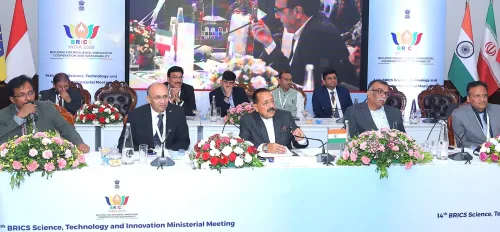
Jitendra Singh addressed the 14th BRICS STI Ministerial Meeting on 21 August in New Delhi .
India's BRICS Presidency 2026 theme: 'Building for Resilience, Innovation, Cooperation and Sustainability' .
Singh called for BRICS collaboration in AI, quantum technologies, biotechnology, geospatial tech , and high-performance computing .
India highlighted the National Quantum Mission , National Supercomputing Mission , BioE3 Policy , and Digital Public Infrastructure as model frameworks.
A comprehensive review of BRICS STI priorities was completed during India's presidency to align with emerging scientific frontiers.
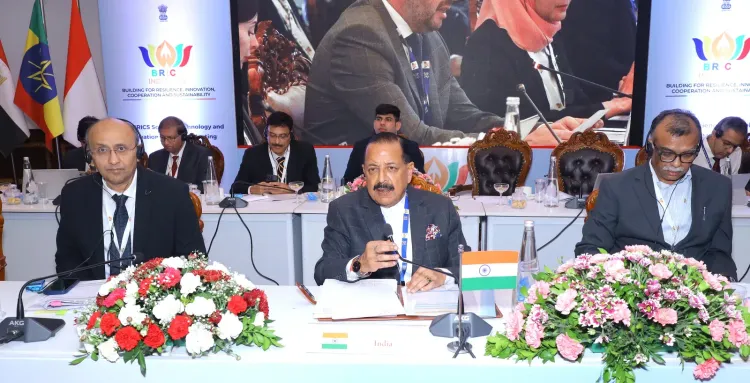
Union Minister of State for Science and Technology and Earth Sciences Dr. Jitendra Singh on Thursday, 21 August called for stronger international cooperation to keep emerging technologies accessible, affordable, trusted and sustainable, speaking at the 14th BRICS Science, Technology and Innovation (STI) Ministerial Meeting in New Delhi. The minister urged BRICS partners to move beyond dialogue and pursue concrete pathways for collaboration across frontier research, innovation financing, and talent mobility.
Key Developments at the Ministerial Meeting
Dr. Singh outlined a broad agenda for BRICS cooperation, pressing member nations to deepen engagement in research infrastructure sharing, startup partnerships, and capacity building. He argued that such cooperation can help build a future-ready BRICS STI architecture capable of responding to global challenges while supporting the aspirations of the Global South.
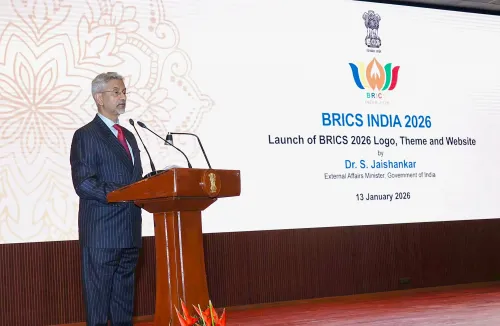
Welcoming delegations from BRICS member countries, Dr. Singh announced that India has chosen 'Building for Resilience, Innovation, Cooperation and Sustainability' as the theme of its BRICS Presidency in 2026 — a framing that positions science and technology as central to inclusive growth and equitable partnerships.
India's STI Priorities Under the Spotlight
The minister highlighted the rapid global transformation driven by technologies including Artificial Intelligence, quantum technologies, advanced materials, biotechnology, photonics, geospatial technologies, and high-performance computing. He said India remains committed to an open, inclusive, and human-centric approach to science and innovation.
Dr. Singh pointed to several flagship national programmes as evidence of this commitment: the National Quantum Mission, the National Supercomputing Mission, the BioE3 Policy, the National Geospatial Policy, and the expanding Digital Public Infrastructure ecosystem. These initiatives, he said, reflect an approach where innovation directly improves people's lives and supports sustainable economic transformation.
BRICS STI Architecture: Evolution and Ambitions
Dr. Singh acknowledged the role of the STI Steering Committee, senior officials, and various STI Working Groups in sustaining dialogue and translating it into tangible outcomes. He noted that BRICS STI cooperation has matured into a robust platform encompassing research collaboration, innovation partnerships, young scientist exchanges, shared research infrastructures, and thematic working groups.
During India's presidency, a comprehensive review of BRICS STI priorities was undertaken to align cooperation with emerging scientific frontiers and the developmental aspirations of member societies. This comes amid growing global competition over technology standards and supply chains, making multilateral STI frameworks increasingly strategic.
What This Means for the Global South
Notably, Dr. Singh's remarks placed significant emphasis on the Global South — a deliberate signal that India views BRICS STI cooperation not merely as a scientific exercise but as a geopolitical instrument for equitable development. BRICS nations collectively represent a vast population base, significant scientific talent, and rapidly growing research capabilities, positioning the bloc to shape the next generation of technology governance norms.
With India holding the BRICS Presidency in 2026, the outcomes of this ministerial meeting are expected to feed into broader BRICS summitry later in the year, setting the STI agenda for the bloc's next phase.
Point of View
Quantum standards, and digital infrastructure norms. The emphasis on 'accessible, affordable, trusted' tech is a pointed contrast to how critics frame Western-led frameworks. The real test will be whether BRICS STI cooperation produces binding commitments or remains a talking shop — past ministerial meetings have generated communiqués without measurable outcomes. India's domestic programme credentials are strong, but translating them into a multilateral architecture that includes China and Russia alongside Brazil and South Africa is a diplomatic challenge the theme alone cannot resolve.
NationPress
5 Oct 2026
Frequently Asked Questions
What is the BRICS STI Ministerial Meeting?
The BRICS Science, Technology and Innovation (STI) Ministerial Meeting is a high-level forum where science ministers of BRICS member nations coordinate on research collaboration, innovation policy, and technology cooperation. The 14th edition was held on 21 August in New Delhi, with India holding the BRICS Presidency in 2026.
What did Dr. Jitendra Singh say at the BRICS STI meeting?
Dr. Singh called for stronger international cooperation to keep emerging technologies accessible, affordable, trusted, and sustainable. He urged BRICS partners to pursue practical collaboration in frontier research, innovation financing, talent mobility, research infrastructure sharing, startup partnerships, and capacity building.
What is India's BRICS Presidency theme for 2026?
India has chosen 'Building for Resilience, Innovation, Cooperation and Sustainability' as its BRICS Presidency theme for 2026. The theme positions science, technology, and innovation as central to inclusive growth, sustainable development, and equitable partnerships among nations.
Which Indian science and technology initiatives were highlighted at the meeting?
Dr. Singh referenced the National Quantum Mission, National Supercomputing Mission, BioE3 Policy, National Geospatial Policy, and India's expanding Digital Public Infrastructure ecosystem as examples of India's human-centric approach to innovation.
Why does BRICS STI cooperation matter for the Global South?
BRICS nations collectively represent a large population base and growing research capabilities, making the bloc well-placed to shape equitable technology governance norms. Dr. Singh argued that deeper STI cooperation can help build an innovation ecosystem that addresses the developmental aspirations of Global South nations rather than replicating frameworks designed for advanced economies.