Jitendra Singh, South Africa Minister Push Next-Gen Tech Tie-Up
Synopsis
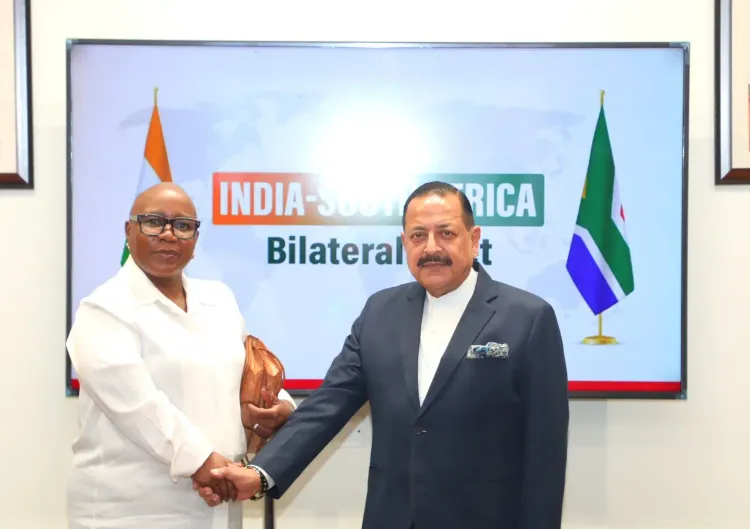
Union Science and Technology Minister Dr. Jitendra Singh met South Africa's Dr Nomalungelo Gina in New Delhi, calling for a Next-Generation Technology Partnership in AI, digital infrastructure and advanced manufacturing, ahead of the BRICS STI Ministerial in Chennai in August 2026.
Key Takeaways
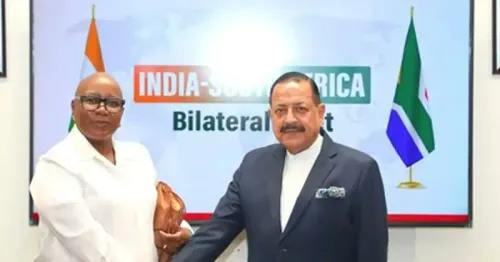
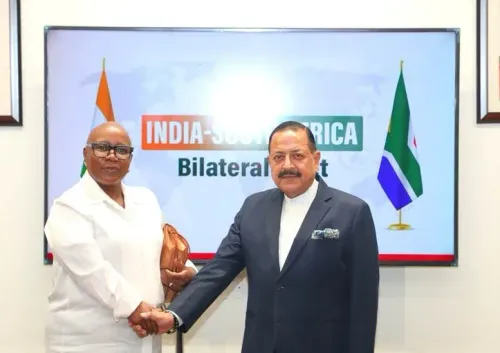
Jitendra Singh met South Africa's Dr Nomalungelo Gina and her delegation on June 3, 2026.
India proposed a 'Next-Generation Technology Partnership' focused on emerging technologies.
Priority areas: Artificial Intelligence, Digital Infrastructure, Advanced Manufacturing, Advanced Materials and Geospatial Technologies.
Both sides cited nearly 150 co-funded research projects already underway.
South Africa invited to BRICS STI Ministerial in Chennai in August 2026.
India invited to Science Forum South Africa 2026.
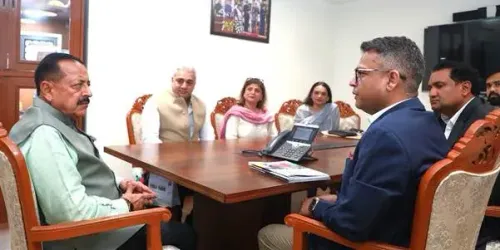
Union Science and Technology Minister Dr. Jitendra Singh held bilateral talks with South Africa's Minister of Science, Technology and Innovation Dr Nomalungelo Gina in New Delhi on June 3, 2026, calling for a 'Next-Generation Technology Partnership' anchored in emerging technologies. The visiting minister led a high-level delegation that sought to scale up cooperation in Artificial Intelligence, Digital Infrastructure and Advanced Manufacturing, with both sides agreeing to deepen joint work under the India-South Africa Joint Committee mechanism.
Context
In his post on X, Dr. Jitendra Singh said he had, 'On behalf of India, called for Next-Generation Technology Partnership, focused on Emerging Technologies,' and noted that the South African side 'sought to scale up bilateral cooperation in future technologies, with Artificial Intelligence, Digital Infrastructure and Advanced Manufacturing as key priorities.'
The minister framed the meeting as a continuation of a long-running scientific relationship, asserting that 'the two countries possess complementary strengths that can be leveraged to create affordable, scalable and inclusive technological solutions for the developing world.' He said discussions yielded a decision to intensify collaboration in Advanced Materials and Manufacturing, Geospatial Technologies and Digital Infrastructure.
Policy backdrop
India and South Africa have anchored their scientific cooperation in a formal Science and Technology Cooperation Agreement signed in 1995, which created the institutional framework for joint research funding and laboratory linkages. The current engagement builds on that base, with the India-South Africa Joint Committee identifying the priority verticals reiterated at the talks.
The minister also referenced the existing portfolio of joint work, noting that the two countries 'have already built an extensive network of collaborative research initiatives, including nearly 150 co-funded projects across diverse scientific disciplines.' These projects span the BRICS Science, Technology and Innovation Framework Programme, which was launched in 2015 to support co-funded research across member states, and complementary initiatives under the India-Brazil-South Africa (IBSA) Dialogue Forum established in 2003.
Stakeholders and impact
The agenda places scientific researchers, start-ups and technology innovators in both countries at the centre of a Global South push to deliver low-cost, scalable solutions. India has progressively positioned its digital public infrastructure stack, AI capabilities and advanced materials research as building blocks for developing-country deployment, while South Africa brings strengths in astronomy, geosciences and advanced manufacturing.
The repeated emphasis on 'affordable, scalable and inclusive' technology signals that the bilateral track is being calibrated for developing-world contexts rather than frontier competition with industrialised economies. Successive India-Africa Forum Summits since 2008 have flagged science, technology and innovation as a pillar of capacity-building, and the Pretoria-Delhi channel is among the most active under that umbrella.
What's next
Dr. Jitendra Singh 'invited South Africa's active participation in the BRICS Science, Technology and Innovation Ministerial Meeting scheduled to be held at Chennai in August 2026.' The Chennai meeting will be a key marker of India's stewardship of the BRICS STI track and is expected to produce a fresh declaration on joint research priorities.
In return, the South African side 'invited India to participate in the Science Forum South Africa 2026, one of Africa's premier platforms for global scientific dialogue, knowledge exchange and innovation partnerships.' The reciprocal invitations point to a sustained calendar of engagement through 2026, with the AI, digital infrastructure and advanced manufacturing baskets likely to anchor deliverables.
If the Chennai ministerial produces concrete co-funding commitments in these verticals, the India-South Africa channel could emerge as a template for how BRICS partners convert framework agreements into deployable technology for the wider Global South.
Point of View
Using BRICS and IBSA platforms to project digital public infrastructure, AI and advanced materials capacity. By framing the partnership around 'affordable, scalable and inclusive' solutions, Delhi is signalling differentiation from Western and Chinese tech offers to African partners. The Chennai ministerial in August 2026 will be the real test of whether this rhetoric converts into co-funded projects with measurable deliverables. Reciprocal invitations to Science Forum South Africa 2026 suggest both sides are locking in a sustained calendar rather than a one-off engagement.
NationPress
18 Oct 2026
Frequently Asked Questions
Who did Dr Jitendra Singh meet from South Africa?
Dr. Jitendra Singh met Dr Nomalungelo Gina, South Africa's Minister of Science, Technology and Innovation, who led a high-level delegation to India on June 3, 2026.
What is the India-South Africa Next-Generation Technology Partnership?
It is a proposed bilateral framework, called for by India, that focuses on emerging technologies including Artificial Intelligence, Digital Infrastructure and Advanced Manufacturing as priority areas for joint work.
When is the BRICS Science and Technology Ministerial Meeting in Chennai?
The BRICS Science, Technology and Innovation Ministerial Meeting is scheduled to be held at Chennai in August 2026, and India has invited South Africa to participate actively.
How many joint research projects do India and South Africa have?
According to the minister's post, the two countries have built an extensive network of nearly 150 co-funded research projects across diverse scientific disciplines.
What is Science Forum South Africa 2026?
Science Forum South Africa 2026 is described as one of Africa's premier platforms for global scientific dialogue, knowledge exchange and innovation partnerships, and India has been invited to participate.