India eyes 10 lakh chip talent gap as global semiconductor sector booms

Synopsis
The global chip sector needs 10 lakh professionals it does not have — and India's electronics minister says the country is positioning itself to fill that gap. With a target to scale trained semiconductor talent from 75,000 to 5 lakh students, and manufacturing already underway, India is making its most explicit bid yet to become the world's semiconductor talent hub.
Key Takeaways
Ashwini Vaishnaw said the global semiconductor industry faces a shortage of nearly 10 lakh skilled professionals as of 19 June .
The global chip sector is valued at around $800 billion and is expected to cross $1 trillion within a year.
Around 10 lakh new jobs are projected in the semiconductor sector globally by 2032 .
Nearly 75,000 students have already benefited from semiconductor design programmes; the government targets scaling this to 5 lakh students .
Semiconductor manufacturing has commenced in India, with skills training to expand alongside production capacity.
STPI centres are being strengthened in Tier-2 and Tier-3 cities to broaden India's tech and startup ecosystem.
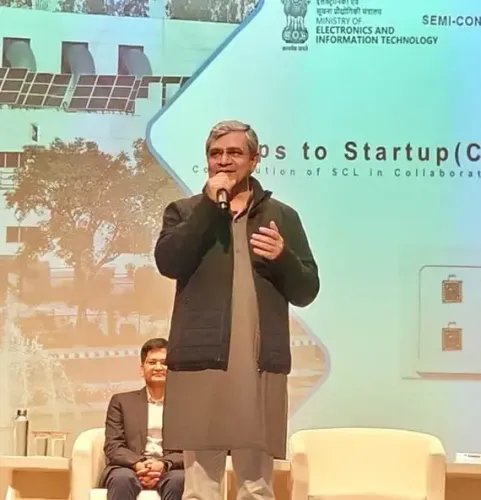
Union Minister for Electronics and Information Technology Ashwini Vaishnaw on Friday, 19 June said the global semiconductor industry faces a shortage of nearly 10 lakh skilled professionals, positioning India to emerge as a critical supplier of trained talent for one of the world's fastest-growing sectors. The minister made the remarks while addressing an event at the Software Technology Parks of India (STPI) centre in Patna.
The Scale of the Global Opportunity
Vaishnaw noted that the global semiconductor industry is currently valued at approximately $800 billion and is expected to cross the $1 trillion mark within a year. Looking further ahead, he said around 10 lakh jobs are projected to emerge in the sector globally by 2032 — even as the industry simultaneously grapples with an equivalent shortfall of trained professionals.
'By 2032, around 10 lakh jobs are expected to emerge in the semiconductor sector globally. At the same time, the industry is facing a shortage of nearly 10 lakh skilled professionals,' Vaishnaw said.
India's Two-Pronged Strategy
The minister outlined a dual approach centred on semiconductor design and semiconductor manufacturing. On the design front, the government is working to establish world-class capabilities domestically and ensure Indian graduates rank among the best-trained talent globally. 'When students graduate with semiconductor design skills, they should be considered among the top talent in the world and should immediately find opportunities in the industry,' he said.
On manufacturing, Vaishnaw confirmed that semiconductor production activities have already commenced in India, with skills training programmes for manufacturing roles to be developed in step with scaling production capacity. India has been advancing semiconductor design, fabrication, and packaging under its national semiconductor mission, with several projects currently under implementation.
From 75,000 to 5 Lakh Students
Vaishnaw disclosed that nearly 75,000 students have already secured attractive opportunities through semiconductor design-related programmes and government initiatives. The ministry has now set a sharply higher target. 'Our target is to increase this number from 75,000 to 5 lakh students,' he said — a more than sixfold scale-up that would represent one of the largest single-sector talent pipelines in the country.
Startups and Tier-2, Tier-3 City Push
Beyond semiconductors, the minister used his Patna visit to highlight the government's broader push to decentralise India's technology ecosystem. He said STPI centres are being strengthened across Tier-2 and Tier-3 cities to support innovation and entrepreneurship outside the major metropolitan hubs. Vaishnaw also interacted with young entrepreneurs at the centre, hearing their experiences and discussing ways to deepen government support for startups and technology-led enterprises.
With global chipmakers scouting for skilled talent and India's engineering graduate base among the world's largest, the coming years will test whether policy ambition can be converted into a verifiable talent pipeline at scale.
Point of View
Which is far more defensible given where India actually stands on fab capacity today. The jump from 75,000 to 5 lakh trained students is a sixfold scale-up with no detailed timeline or institutional roadmap attached — the same gap that has plagued earlier skill-mission targets. India's semiconductor mission has attracted investment commitments, but translating design-trained graduates into globally competitive talent requires industry partnerships and curriculum depth that government announcements alone cannot guarantee. The Patna venue is also a signal: the political optics of taking the chip story to Bihar matter as much as the policy substance.
NationPress
19 Sept 2026
Frequently Asked Questions
What is the global semiconductor talent shortage mentioned by Ashwini Vaishnaw?
The global semiconductor industry is facing a shortage of nearly 10 lakh skilled professionals even as around 10 lakh new jobs are expected to emerge in the sector by 2032, according to Union Minister Ashwini Vaishnaw. He made the remarks at the STPI centre in Patna on 19 June.
How big is the global semiconductor industry today?
The global semiconductor industry is currently valued at approximately $800 billion and is expected to cross the $1 trillion mark within a year, according to Vaishnaw.
What is India's target for semiconductor-trained students?
The government aims to scale the number of students trained in semiconductor design from the current 75,000 to 5 lakh. Nearly 75,000 students have already received opportunities through related programmes and initiatives.
What is India's strategy to capitalise on the chip talent gap?
India is pursuing a two-pronged strategy focused on semiconductor design and manufacturing. The government is building domestic design capabilities, training graduates to global standards, and expanding manufacturing skills training in line with growing production capacity under India's national semiconductor mission.
Why did Vaishnaw visit the STPI centre in Patna?
Vaishnaw visited the Software Technology Parks of India centre in Patna to address the semiconductor talent opportunity and to highlight the government's push to expand India's startup and technology ecosystem into Tier-2 and Tier-3 cities. He also interacted with young entrepreneurs at the centre.