Dr Priti Adani at CHIPS 2026: Human talent key to India's semiconductor mission
Synopsis
At the CHIPS 2026 conclave in Ahmedabad, Adani University President Dr Priti Adani made a pointed argument: India's semiconductor ambitions will be won or lost not in its fabs, but in its classrooms and labs. With ISM-backed projects at Dholera and Sanand gaining pace, the race to build a matching talent pipeline has never been more urgent.
Key Takeaways
Dr Priti Adani , President of Adani University , called for stronger industry-academia collaboration to build India's semiconductor talent base at CHIPS 2026 in Ahmedabad on 24 October 2026 .
The conclave featured speakers from Qualcomm , NXP Semiconductors , Micron Technology , Synopsys , and Infineon Technologies , covering the full semiconductor value chain.
Three panel discussions addressed domestic chip design, semiconductor manufacturing, and career pathways in the semiconductor ecosystem.
The event was organised with IIT Mandi , the VLSI Society of India , and Cyril Amarchand Mangaldas , and included the Gujarat State Electronics Mission .
Adani University plans specialised semiconductor programmes — including executive education and faculty development — at its upcoming global campus in Ahmedabad .
Gujarat's Dholera and Sanand projects are advancing the state's role within India's broader semiconductor strategy, backed by the India Semiconductor Mission .
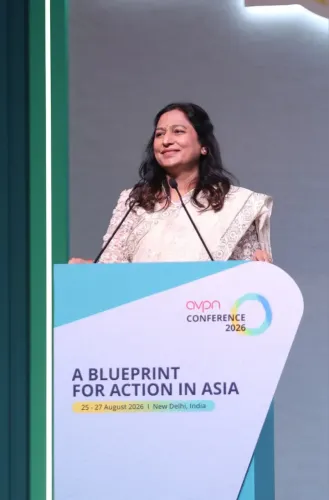
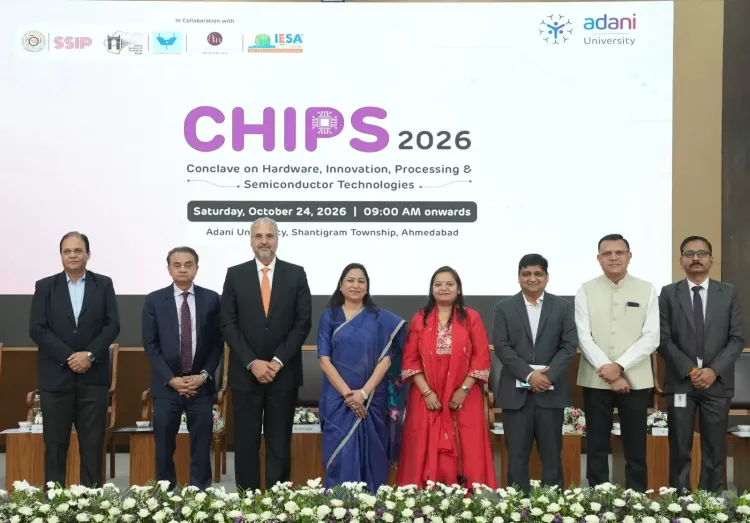
Dr Priti Adani, President of Adani University, on 24 October 2026 urged stronger collaboration between industry and academia to cultivate the skilled workforce India needs to build a robust semiconductor ecosystem. Speaking at the 'Conclave on Hardware, Innovation, Processing and Semiconductor Technologies (CHIPS) 2026' hosted by Adani University in Ahmedabad, she argued that world-class fabrication plants alone cannot sustain a competitive semiconductor sector without equally world-class human capital behind them.
The Core Message: Human Intelligence Over Machine Dependence
'The true measure of our technological progress will not be how intelligent our machines become. It will be how wisely we develop and use human intelligence to build a better future,' Dr Priti Adani said at the conclave. Her remarks come at a moment when India's semiconductor ambitions are accelerating on multiple fronts — from government-backed fabrication projects to AI-driven demand for advanced chips and data infrastructure.
Who Was in the Room
The conclave drew keynote speakers from global semiconductor and technology heavyweights — Qualcomm, NXP Semiconductors, Micron Technology, Synopsys, Infineon Technologies, and law firm Cyril Amarchand Mangaldas. Their addresses covered the full semiconductor value chain: wireless technology, chip design, memory and storage, power systems, and the legal frameworks that underpin the industry. The event was organised in collaboration with IIT Mandi, the VLSI Society of India, and Cyril Amarchand Mangaldas, and also brought together representatives from the Gujarat State Electronics Mission and several academic institutions.
Key Discussions and Panel Themes
Three panel discussions shaped the day's agenda. The first, titled 'The Future of Semiconductor Design in India', examined pathways to strengthen domestic chip design capabilities — an area where India has a growing but still underutilised talent base. The second, 'Semiconductor Manufacturing: Shaping India's Technological Future', focused on manufacturing's central role in the country's industrial strategy. The third, 'Career Opportunities in the Semiconductor Ecosystem', mapped out emerging roles, evolving skill requirements and career entry points for engineers and technologists.
Gujarat's Growing Role and India's Broader Ambitions
India's semiconductor strategy, anchored by the India Semiconductor Mission (ISM), extends well beyond chip fabrication to encompass design, packaging and system integration. Projects at Dholera and Sanand in Gujarat are advancing the state's position as a manufacturing hub within this national push. Notably, the rapid expansion of artificial intelligence is intensifying demand for the underlying infrastructure — advanced chips, high-capacity data centres and reliable power supply — adding urgency to India's efforts to develop indigenous capabilities.
Adani University's Planned Semiconductor Programmes
Adani University, which positions itself around industry-aligned education and research, has outlined plans to develop semiconductor design, manufacturing and packaging expertise at its upcoming multidisciplinary global campus in Ahmedabad. Proposed initiatives include specialised programmes for early-career engineers, executive education for industry professionals and faculty development — all oriented toward closing the gap between academic learning and real-world industry requirements. The CHIPS 2026 conclave forms part of that institution-building effort, signalling that private universities are increasingly positioning themselves as active players in India's semiconductor talent pipeline.
Point of View
Sanand, the ISM outlay. The CHIPS 2026 conclave is a reminder that the harder bottleneck may be human capital. Design and packaging talent takes years to build, and a conclave of private universities and global chip firms signals that the ecosystem is beginning to self-organise around that gap. The question is whether academic initiatives like Adani University's proposed programmes will scale fast enough, and whether their curricula will be genuinely industry-co-designed rather than industry-adjacent. India has a credible chip design community, but converting that into a mass talent pipeline requires institutional commitment at a scale that one conclave, however well-attended, cannot yet guarantee.
NationPress
24 Oct 2026
Frequently Asked Questions
What was the CHIPS 2026 conclave and where was it held?
CHIPS 2026 — the Conclave on Hardware, Innovation, Processing and Semiconductor Technologies — was hosted by Adani University in Ahmedabad on 24 October 2026. It brought together semiconductor companies, academic institutions and the Gujarat State Electronics Mission to align research and technical education with industry needs.
What did Dr Priti Adani say at CHIPS 2026?
Dr Priti Adani argued that building a strong semiconductor industry requires not just advanced manufacturing facilities but people equipped to design, develop and improve complex technologies. She said, 'The true measure of our technological progress will not be how intelligent our machines become. It will be how wisely we develop and use human intelligence to build a better future.'
Which companies participated in the CHIPS 2026 conclave?
Keynote speakers came from Qualcomm, NXP Semiconductors, Micron Technology, Synopsys, Infineon Technologies, and law firm Cyril Amarchand Mangaldas, spanning wireless technology, chip design, memory and storage, power systems and legal services.
What is Adani University planning for semiconductor education?
Adani University plans to develop expertise in semiconductor design, manufacturing and packaging at its upcoming multidisciplinary global campus in Ahmedabad. Proposed initiatives include specialised programmes for young engineers, executive education for industry professionals and faculty development.
How does Gujarat fit into India's semiconductor ambitions?
Gujarat is emerging as a key manufacturing hub within India's semiconductor strategy, backed by the India Semiconductor Mission. Projects at Dholera and Sanand are advancing fabrication capabilities, while initiatives like CHIPS 2026 aim to build the design and engineering talent to support them.