India leads global coconut output with 31.24% share, eyes $2 trillion exports by 2030
Synopsis
India's coconut sector is bigger than most realise — the country commands nearly a third of global output and is now chasing a $2 trillion export target by 2030. With a new Coconut Promotion Scheme in the Union Budget and ₹147.21 crore released to the Coconut Development Board in 2025-26, this is a deliberate policy push to turn a traditional crop into a high-value global export engine.
Key Takeaways
India accounts for 31.24% of global coconut production and 17.90% of world cultivation area, ranking 1st and 3rd respectively.
India produced over 20,301 million nuts in 2024-25 from 2.19 million hectares , with productivity at 9,249 nuts per hectare .
13,068 farmers benefited from new plantation schemes in 2024-25 , with 2,979 hectares added under cultivation.
Keralam leads in cultivation area ( 7.54 lakh hectares ); Tamil Nadu leads in production; Andhra Pradesh records the highest productivity.
Government targets $2 trillion in coconut-related exports by 2030 and $21 trillion by 2047 .
The Union Budget 2026-27 introduced a Coconut Promotion Scheme ; ₹147.21 crore released to the Coconut Development Board in 2025-26 .
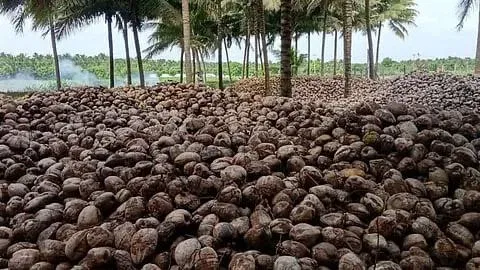
India has secured the top position in global coconut production, accounting for 31.24 per cent of world output, while ranking third in cultivation area with a 17.90 per cent share, according to an official factsheet released on Tuesday, 18 August 2025. The country produced over 20,301 million nuts during 2024-25 from 2.19 million hectares, with average productivity recorded at 9,249 nuts per hectare.
Area Expansion and Farmer Outreach
Approximately 2,175 hectares of new area were brought under coconut cultivation across several states during 2025-26, backed by financial assistance of ₹632.77 lakh for plantation establishment and maintenance. During 2024-25, nearly ₹209.24 lakh was utilised to bring an additional 2,979 hectares under cultivation, directly benefiting 13,068 farmers across the country.
State-wise Performance
Keralam holds the largest area under coconut cultivation at nearly 7.54 lakh hectares, producing approximately 5,149.87 million nuts. Tamil Nadu leads in total coconut production, while Andhra Pradesh records the highest productivity nationwide, followed by West Bengal and Tamil Nadu. This regional specialisation underscores the crop's deep integration into the agrarian economies of southern and eastern India.
Export Ambitions and Value Addition
India's coconut export basket has broadened well beyond traditional commodities to include value-added products such as virgin coconut oil, coconut milk, and activated carbon. The government has set an ambitious target of $2 trillion in coconut-related exports by 2030, scaling further to $21 trillion by 2047 — a trajectory that aligns with the broader 'Viksit Bharat' economic vision. Notably, these figures represent total sectoral value targets as stated in official documents.
Policy Support and Institutional Framework
The Coconut Development Board (CDB) remains the primary implementation arm for government schemes in the sector. A total of ₹147.21 crore was released in 2025-26 for CDB activities. The Union Budget 2026-27 introduced a dedicated Coconut Promotion Scheme aimed at strengthening sustainability, export competitiveness, and farmer incomes across the value chain.
The government's approach integrates Minimum Support Price (MSP) for copra — the dried coconut kernel — which is among the 22 mandated agricultural crops covered under the MSP regime. This multi-pronged framework also includes targeted skill development and enterprise creation initiatives. According to the official statement, 'With continued policy support, India's coconut sector is steadily advancing across production, value addition, exports, and livelihoods.'
Point of View
But the leap from traditional copra exports to a $2 trillion export target by 2030 is a significant ambition that deserves scrutiny. Value-added products like virgin coconut oil and activated carbon are growth areas, but India's export infrastructure and processing capacity will need to scale in tandem with policy intent. The MSP mechanism for copra provides a floor for farmers, yet price volatility and climate vulnerability in key producing states remain structural risks that no scheme alone can fully offset. The real test of the Coconut Promotion Scheme will be whether it translates into verifiable income gains for the 13,000-plus farmers already enrolled — not just hectarage numbers.
NationPress
18 Aug 2026
Frequently Asked Questions
What is India's rank in global coconut production?
India ranks first in global coconut production, accounting for 31.24 per cent of world output, and third in cultivation area with a 17.90 per cent share, according to an official factsheet released on 18 August 2025.
How much coconut did India produce in 2024-25?
India produced over 20,301 million nuts during 2024-25 from 2.19 million hectares, with average productivity recorded at 9,249 nuts per hectare.
Which Indian state leads in coconut production and cultivation area?
Keralam has the largest area under coconut cultivation at nearly 7.54 lakh hectares. Tamil Nadu leads in total production, while Andhra Pradesh records the highest productivity among all states.
What is India's coconut export target for 2030?
The government has set a target of $2 trillion in coconut-related exports by 2030, scaling to $21 trillion by 2047, as India expands its export basket to include value-added products such as virgin coconut oil, coconut milk, and activated carbon.
What is the Coconut Promotion Scheme introduced in the Union Budget 2026-27?
The Coconut Promotion Scheme is a dedicated initiative introduced in the Union Budget 2026-27 to strengthen sustainability, export competitiveness, and farmer incomes across the coconut value chain. It complements existing Coconut Development Board programmes, which received ₹147.21 crore in 2025-26.