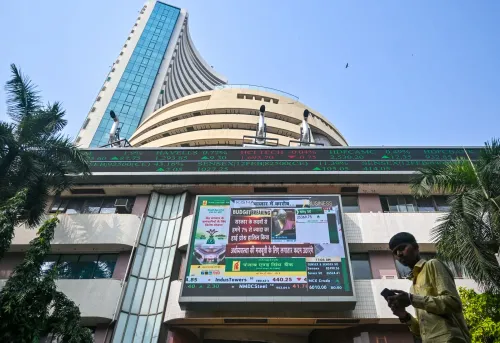
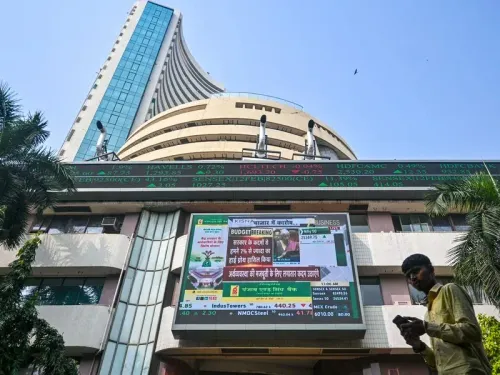
Sensex drops 493 points to 77,235 as geopolitical tensions, IT drag weigh
Synopsis
Indian equities extended their losing streak on 18 August as geopolitical jitters, a sliding IT sector, and pressure on PSU banks sent the Sensex down 493 points to 77,235 and the Nifty to 24,154. With the critical 24,150 support now in focus and crude prices adding to input-cost worries, the next few sessions could determine whether this is a brief correction or the start of a sharper unwind.
Key Takeaways
Sensex fell 493 points ( 0.63% ) to close at 77,235.46 on 18 August .
Nifty50 declined 132.75 points ( 0.55% ) to settle at 24,154.90 .
Top Nifty losers: Tata Motors Passenger Vehicles , Asian Paints , and Infosys .
Nifty IT , Nifty Realty , and Nifty PSU Bank were the biggest sectoral drags; Nifty Auto outperformed.
Analysts peg immediate Nifty support at 24,150 and resistance at 24,300 .
Rupee traded near 95.67 , with near-term range seen at 95.25–95.85 .
The BSE Sensex slid 493 points, or 0.63%, to close at 77,235.46 on Tuesday, 18 August, as heightened geopolitical tensions and broad-based selling in IT, realty, and PSU banking stocks pushed benchmark indices deeper into the red. The Nifty50 fell 132.75 points, or 0.55%, to settle at 24,154.90, extending losses from the previous session.
Key Losers and Sector Damage
Tata Motors Passenger Vehicles, Asian Paints, and Infosys were among the steepest fallers within Nifty constituents. Sectorally, Nifty IT, Nifty Realty, and Nifty PSU Bank emerged as the biggest drags on the indices. The sole bright spot was the Nifty Auto index, which outperformed the broader market during the session.
The broader market mirrored the weakness, with the Nifty MidCap index declining 0.43%, while the Nifty SmallCap index ended largely flat.
Technical Levels to Watch
Market analysts flagged the 24,300 zone as the immediate resistance for the Nifty. 'A sustained move above 24,300 could help stabilise the structure and support a recovery towards the 24,400–24,500 region. However, failure to reclaim this level could keep recovery attempts vulnerable to selling pressure,' an analyst noted.
On the downside, analysts identified 24,150 as the critical support. 'A decisive break below 24,150 could intensify selling pressure and drag the index towards the 24,000 psychological mark,' a market expert warned.
What Is Weighing on Sentiment
Market experts attributed the cautious mood to ongoing geopolitical tensions, which have kept investors on edge. Compounding the pressure, analysts pointed out that sustained high crude prices and rising input costs could erode recent earnings upgrades, adding another layer of uncertainty to near-term positioning.
'Although domestic fundamentals continue to be supportive, sustained high crude prices and rising input costs could pressure recent earnings upgrades, prompting investors to remain cautious in the near term,' a market expert said.
Rupee Holds Narrow Range
The Indian rupee traded largely flat near 95.67 against the dollar during the session, though analysts flagged continued headwinds for the currency. 'The rupee is expected to trade in the 95.25–95.85 range in the near term,' a market expert noted, pointing to broader weakness that has made it difficult for the currency to sustain any meaningful recovery.
What to Watch Next
The market's next move will hinge on whether the Nifty can reclaim the 24,300 resistance zone and whether global geopolitical pressures ease. Any fresh escalation in crude prices or a deterioration in global risk appetite could push the index toward the 24,000 psychological support. Domestic macro data and FII flow trends will be closely monitored in the sessions ahead.
Point of View
While PSU bank weakness signals that rate-sensitive plays are losing their earlier tailwind. Domestic fundamentals may be intact, but with crude elevated and earnings upgrade cycles potentially reversing, the market's recent premium valuations look increasingly hard to defend. The rupee's inability to sustain strength only adds to the risk calculus for foreign investors weighing their India allocation.
NationPress
18 Aug 2026
Frequently Asked Questions
Why did the Sensex fall on 18 August?
The Sensex fell 493 points to 77,235.46 on 18 August due to heightened geopolitical tensions and selling in IT, realty, and PSU banking stocks. High crude prices and concerns over rising input costs also dampened investor sentiment.
What are the key Nifty support and resistance levels to watch?
Analysts have identified 24,150 as the immediate support level for the Nifty; a break below it could push the index toward the 24,000 psychological mark. On the upside, 24,300 is the key resistance, and a sustained move above it could open recovery toward 24,400–24,500.
Which stocks and sectors were the biggest losers on 18 August?
Tata Motors Passenger Vehicles, Asian Paints, and Infosys were among the top Nifty losers. Sectorally, Nifty IT, Nifty Realty, and Nifty PSU Bank led the decline, while Nifty Auto was the only major sector to outperform.
How did the broader market and the rupee perform?
The Nifty MidCap index declined 0.43% while the Nifty SmallCap index ended flat, reflecting contained but present broader weakness. The rupee traded near 95.67, with analysts expecting it to remain in the 95.25–95.85 range in the near term.
What should investors watch in the coming sessions?
Investors should monitor whether the Nifty reclaims the 24,300 resistance zone and whether geopolitical tensions ease. Crude oil price movements, FII flows, and domestic macro data will be key factors shaping near-term market direction.