Why Are Sensex and Nifty Up Despite Negative Global Signals?
Synopsis
In an unexpected turn of events, the Indian equity markets showed resilience, trading higher on Monday despite global market challenges. With significant gains in Sensex and Nifty, analysts weigh in on the implications and potential future market movements.
Key Takeaways
Sensex increased by 373 points to reach 81,096 .
Nifty gained 87 points to settle at 24,913 .
Major broad-cap indices faced losses, with Nifty Midcap 100 down 0.50% .
Immediate support for Nifty is at 24,650-24,700 .
Market analysts expect a potential turnaround in the future.
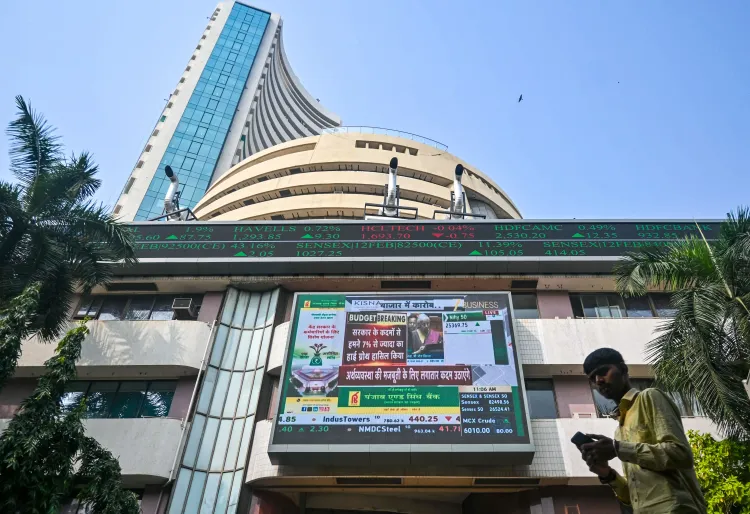
Mumbai, Feb 2 (NationPress) Early trading on the Indian equity markets saw a rise on Monday, as they began to recover from the losses incurred on Budget Day, even in the face of negative global cues. At 9:33 am, the Sensex increased by 373 points, representing a 0.46 per cent rise, reaching 81,096. Meanwhile, the Nifty climbed by 87 points, or 0.35 per cent, settling at 24,913.
Despite this upward movement, major broad-cap indices faced losses, with the Nifty Midcap 100 dropping by 0.50 per cent and the Nifty Smallcap 100 declining by 0.85 per cent.
All sectoral indices were trading downwards, with the exception of metal, realty, and oil and gas sectors. The Nifty consumer durables and IT sectors emerged as significant losers, experiencing declines of 1 per cent and 0.61 per cent, respectively.
Market analysts noted that immediate support is positioned within the 24,650-24,700 range, while resistance levels are observed between 25,950–25,000. They mentioned that the selloff seen on Budget Day was primarily a knee-jerk reaction to the substantial increase in Securities Transaction Tax (STT) on F&O trades, intended not for revenue enhancement but to deter retail traders from complex F&O trading, where 92 per cent of them are incurring losses.
Additionally, some market participants were unrealistically anticipating alterations in the Long-Term Capital Gains (LTCG) tax. The 10 per cent nominal GDP growth forecasted in the Budget is seen as attainable, with the potential to yield around 15 per cent earnings growth by FY27. A significant market turnaround may require time, possibly linked to a global retreat from AI trade.
The Asia-Pacific markets reported considerable losses during the morning session, as investors analyzed private data reflecting China’s factory activity in January. The Shanghai index in China fell by 1.32 per cent, while Shenzhen decreased by 1.41 per cent. Similarly, Japan's Nikkei dropped by 0.52 per cent, and Hong Kong's Hang Seng Index saw a decline of 2.15 per cent, with South Korea's Kospi plunging by 4 per cent.
In the previous trading session, US markets also closed largely in the negative, with the Nasdaq declining by 0.94 per cent, the S&P 500 dipping by 0.43 per cent, and the Dow falling by 0.36 per cent.
On February 1, foreign institutional investors (FIIs) net sold equities totaling Rs 588 crore, while domestic institutional investors (DIIs) were net sellers of Rs 683 crore.
Point of View
It is imperative to note that the Indian markets are demonstrating resilience amid challenging global conditions. While the gains in Sensex and Nifty are a positive sign, investors must remain cautious and informed, especially given the underlying economic factors that influenced recent sell-offs.
NationPress
7 Oct 2026
Frequently Asked Questions
What factors are causing the Indian equity markets to rise?
The rise in the Indian equity markets is primarily due to a recovery from losses incurred on Budget Day, despite negative global cues.
How did the US markets perform recently?
The US markets closed largely in the red during the last trading session, with notable declines in indices such as Nasdaq, S&P 500, and Dow.
What is the current support and resistance level for Nifty?
Immediate support for Nifty lies within the 24,650-24,700 range, while resistance is anchored between 25,950–25,000.
What sectors are performing well in the current market?
The metal, realty, and oil and gas sectors are currently trading positively, contrasting with other sectors that are experiencing losses.
Are foreign institutional investors buying or selling equities?
Foreign institutional investors (FIIs) were net sellers of equities worth Rs 588 crore recently.