India's semiconductor map: 12 approved projects, ₹1.64 lakh crore investment across 6 states

Synopsis
India now has 12 approved semiconductor projects spread across six states, anchored by a ₹91,526 crore Tata-PSMC fab at Dholera and a ₹27,120 crore Tata OSAT unit in Assam. With total committed investments crossing ₹1.64 lakh crore, the country is making its most credible push yet to break its near-total dependence on chip imports — and the geographic spread signals a deliberate supply-chain diversification strategy, not just headline numbers.
Key Takeaways
12 semiconductor projects have been approved across six states , with more than ₹1.64 lakh crore in committed investments, as highlighted by former NITI Aayog CEO Amitabh Kant on 19 October 2026 .
Gujarat leads with six projects , including the Tata-PSMC fab at Dholera (₹91,526 crore, capacity: 50,000+ wafers/month) and Micron Technology's Sanand facility (₹22,516 crore).
Tata Semiconductor Assembly and Test is building an OSAT facility in Assam worth ₹27,120 crore , with a proposed capacity of 48 million units per day .
Odisha hosts two projects — SiCSem (₹2,066 crore) and 3D Glass Solutions (₹1,943 crore) — covering silicon carbide and advanced 3D packaging.
Andhra Pradesh is developing an ASIP facility (₹480 crore, ~96 million units/year) and Punjab's CDIL is setting up a power semiconductor unit worth ₹117 crore .
India's semiconductor ecosystem is gathering decisive momentum, with 12 approved projects spanning six states and backed by more than ₹1.64 lakh crore in committed investments, former NITI Aayog CEO and G20 Sherpa Amitabh Kant highlighted on Monday, 19 October 2026. Sharing a graphic titled 'The New Semiconductor Map of India' on social media platform X, Kant described a growing network of fabrication, packaging, testing, and advanced technology facilities taking root across the country.
Gujarat Leads the Pack
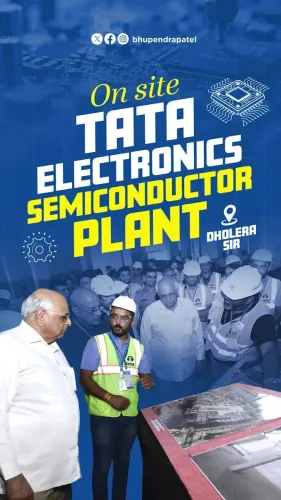
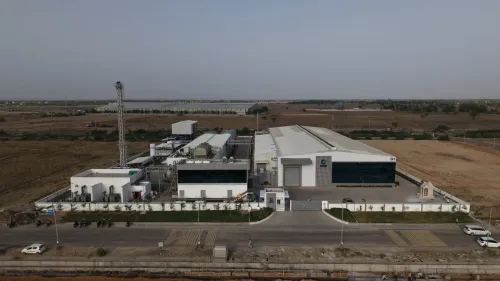
Gujarat has emerged as the dominant hub, hosting six of the twelve approved projects. The flagship investment is the Tata-PSMC semiconductor fabrication plant at Dholera, involving ₹91,526 crore and a planned capacity of more than 50,000 wafers per month — the single largest commitment in the country's semiconductor push so far.
Other significant Gujarat facilities include Micron Technology's DRAM and NAND assembly and test unit at Sanand (₹22,516 crore), and the CG Power-Renesas-Stars semiconductor OSAT facility (₹7,584 crore). Smaller but strategically relevant projects by Kaynes Semicon, Crystal Matrix, and Suchi Semicon cover semiconductor packaging, compound semiconductors, mini-LED technologies, and discrete semiconductor manufacturing.
Assam, Odisha and Andhra Pradesh Join the Map
Beyond Gujarat, the semiconductor footprint is spreading to eastern and southern India. Tata Semiconductor Assembly and Test is establishing an OSAT and packaging facility in Assam with an investment of ₹27,120 crore and a proposed capacity of approximately 48 million units per day.
Odisha has secured two projects: SiCSem's silicon carbide fabrication and packaging facility (₹2,066 crore) and 3D Glass Solutions' advanced packaging and 3D integration project (₹1,943 crore). In Andhra Pradesh, an Advanced System in Package (ASIP) facility focused on system-in-package technologies is being developed with an investment of approximately ₹480 crore and a proposed annual capacity of nearly 96 million units.
Punjab Rounds Out the Six-State Footprint
Punjab completes the emerging national semiconductor corridor, with CDIL setting up a power semiconductor project involving an investment of ₹117 crore. While modest in scale relative to the larger fabs, it reflects the policy intent to build a geographically distributed supply chain rather than concentrating capacity in a single state.
Why This Matters for India's Industrial Ambitions
Semiconductors underpin everything from smartphones and electric vehicles to defence electronics and AI infrastructure. India has historically been almost entirely dependent on imports for chips, making the current cluster of approved projects a structural shift rather than an incremental upgrade. This comes amid intensifying global competition — the United States, the European Union, Japan, and South Korea have all rolled out large-scale semiconductor incentive regimes in recent years, and India is now positioning itself as a credible alternative destination for diversified chip supply chains.
Notably, the breadth of technologies being pursued — from traditional OSAT packaging to silicon carbide, 3D integration, and compound semiconductors — suggests the strategy is targeting multiple layers of the value chain, not just assembly. How quickly these projects move from approval to production will determine whether India's semiconductor ambitions translate into a genuine industrial capability or remain at the level of announced intent.
Point of View
₹1.64 lakh crore snapshot is an encouraging milestone, but approvals and groundbreaking investments are not the same as production yields. India's semiconductor journey is still overwhelmingly in the construction and ramp-up phase — the Tata-PSMC Dholera fab, the single largest bet at ₹91,526 crore, is years away from meaningful wafer output. The real metric to watch is time-to-first-wafer and eventual utilisation rates, not committed capital. Equally significant is the geographic spread: six states participating suggests the Centre has deliberately avoided replicating the Gujarat-centric optics of earlier industrial schemes, which is politically smart but logistically complex. Whether a distributed semiconductor map can generate the cluster efficiencies that Taiwan's Hsinchu or South Korea's Gyeonggi province deliver remains the hard, unanswered question.
NationPress
19 Oct 2026
Frequently Asked Questions
How many semiconductor projects has India approved so far?
India has approved 12 semiconductor projects across six states as of October 2026, with total committed investments exceeding ₹1.64 lakh crore. The figure was highlighted by former NITI Aayog CEO Amitabh Kant in a post on social media platform X.
Which state has the most semiconductor investments in India?
Gujarat leads India's semiconductor push with six approved projects, the largest being the Tata-PSMC fabrication plant at Dholera (₹91,526 crore). Other Gujarat projects include Micron Technology's Sanand facility and the CG Power-Renesas-Stars OSAT unit.
What is the Tata-PSMC semiconductor plant at Dholera?
The Tata-PSMC plant at Dholera, Gujarat, is India's single largest approved semiconductor investment at ₹91,526 crore, with a planned output capacity of more than 50,000 wafers per month. It is a fabrication facility — the most capital-intensive and technologically complex segment of the chip supply chain.
Which other states are part of India's semiconductor map?
Beyond Gujarat, semiconductor projects have been approved in Assam (Tata Semiconductor Assembly and Test, ₹27,120 crore), Odisha (SiCSem and 3D Glass Solutions), Andhra Pradesh (ASIP facility, ₹480 crore), and Punjab (CDIL power semiconductors, ₹117 crore).
Why is India investing so heavily in semiconductors now?
Semiconductors are critical inputs for smartphones, EVs, defence electronics, and AI hardware, and India has historically imported nearly all of its chip requirements. The global push by the US, EU, Japan, and South Korea to diversify supply chains away from concentrated Asian production has created a window for India to attract investment and build domestic capability.