Will Airbus's Projections for India's Aircraft Fleet Triple by 2035?
Synopsis
Airbus forecasts a significant expansion of India's commercial aircraft fleet, predicting a rise to 2,250 aircraft by 2035. This growth reflects India's ascent to the world's third-largest civil aviation market. As domestic demand rises, the infrastructure and workforce will also need to adapt. Discover how this transformation will shape India's aviation future!
Key Takeaways
India’s aircraft fleet is set to triple by 2035.
Projected fleet size: 2,250 aircraft.
Passenger traffic growth at 8.9% per annum.
Need for 35,000 pilots and 34,000 technical staff.
Government plans to boost airport numbers to 200.
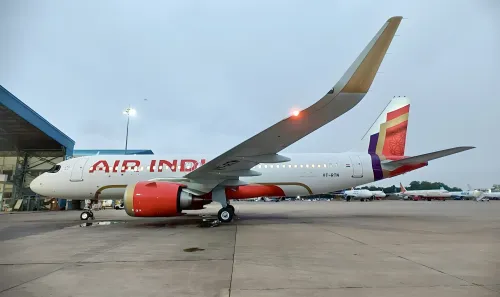
Hyderabad, Jan 29 (NationPress) The renowned aerospace leader Airbus has forecasted that India’s commercial aircraft fleet will expand threefold to 2,250 aircraft within the next decade, positioning the nation to emerge as the third-largest civil aviation market globally by 2035.
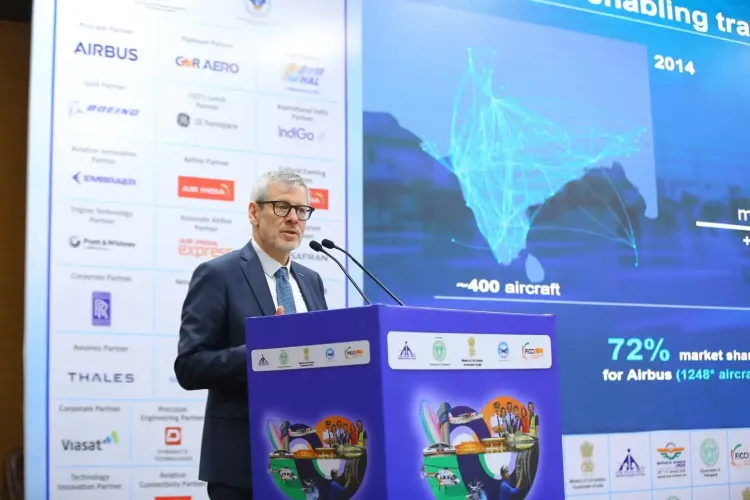
This remarkable fleet growth is fueled by the surge in the Indian aviation sector and the aspirations of Indian airlines to broaden their reach on international routes, as stated by a senior Airbus executive during the Wings India 2026 aviation exhibition and summit held on Thursday.
Jurgen Westermeier, the President and Managing Director of Airbus India and South Asia, informed the media that this significant escalation in aircraft—specifically those with over 100 seats—represents one of the most ambitious expansions recorded in the history of global aviation.
The demand for new aircraft will stem from a unique combination of rapid economic growth among G20 nations, increased government investment in infrastructure, and a fundamental change in consumer behavior in India, wherein per capita air travel is projected to rise from 0.13 to 0.29 over the coming decade.
Consequently, passenger traffic in India is expected to increase at an annual rate of 8.9 percent by 2035, the highest among major economies and significantly above the long-term global average.
To support this expanded fleet, the demand for pilots is anticipated to soar to 35,000 by 2035, up from the current 12,000, while the technical workforce will need to expand to 34,000, tripling the current strength of 11,000, Westermeier emphasized.
“We are observing a shift in the center of global aviation towards the east. The expansion of India’s fleet will not only enhance internal mobility but will also establish the nation as a pivotal hub for international transit. Therefore, it is crucial for the next phase of Indian aviation to adapt its operational models to match the pace of fleet and network expansion,” he stated.
“Airbus is exceptionally positioned to facilitate this growth with the A320 Family for domestic development and the A321XLR and A350 to spearhead India’s medium- to long-haul international initiatives.”
As the fleet expands threefold, India will rapidly transition into a hub for Maintenance, Repair, and Overhaul (MRO). The market for airframes, engines, and components is projected to triple to $9.5 billion by 2035.
Moreover, Indian airlines are expected to invest up to $1 billion by 2035 in the digitalization of flight, ground, and technical operations, alongside enhancing cybersecurity and aircraft connectivity, he noted.
The anticipated fleet growth will be matched by a similarly ambitious infrastructure strategy, with the government planning to increase the number of operational airports by 50, raising the national total to about 200 by 2035. This additional infrastructure investment will support high-frequency operations,” Westermeier added.
Point of View
It is vital to recognize the strategic importance of Airbus's projection for India's aviation sector. The anticipated fleet expansion signifies not only growth in domestic travel but also underscores India's emerging role as a global aviation hub. This development offers vast economic opportunities and creates a pressing need for enhancements in infrastructure and workforce training, ensuring India can meet the demands of future air travel.
NationPress
20 Sept 2026
Frequently Asked Questions
What is the projected size of India's aircraft fleet by 2035?
India's commercial aircraft fleet is projected to triple to 2,250 aircraft by 2035.
What factors are driving the growth of India's aviation market?
The growth is driven by rapid economic expansion, increased government spending on infrastructure, and changes in consumer behavior leading to higher air travel rates.
How many pilots will India need by 2035?
India will require approximately 35,000 pilots by 2035, up from 12,000 currently.
What is the significance of the A320 Family and A350 in this growth?
The A320 Family is aimed at domestic expansion, while the A321XLR and A350 are designed to support India's medium- to long-haul international ambitions.
How will infrastructure development support this fleet growth?
The Indian government plans to increase operational airports by 50, bringing the total to around 200 by 2035, which will accommodate the growing fleet and passenger traffic.